Persona and Shin Megami Tensei: How the Series Are Related
How Atlus's Megami Tensei franchise works, how Persona grew from spin-off to flagship, the shared demon systems and where new players should start.
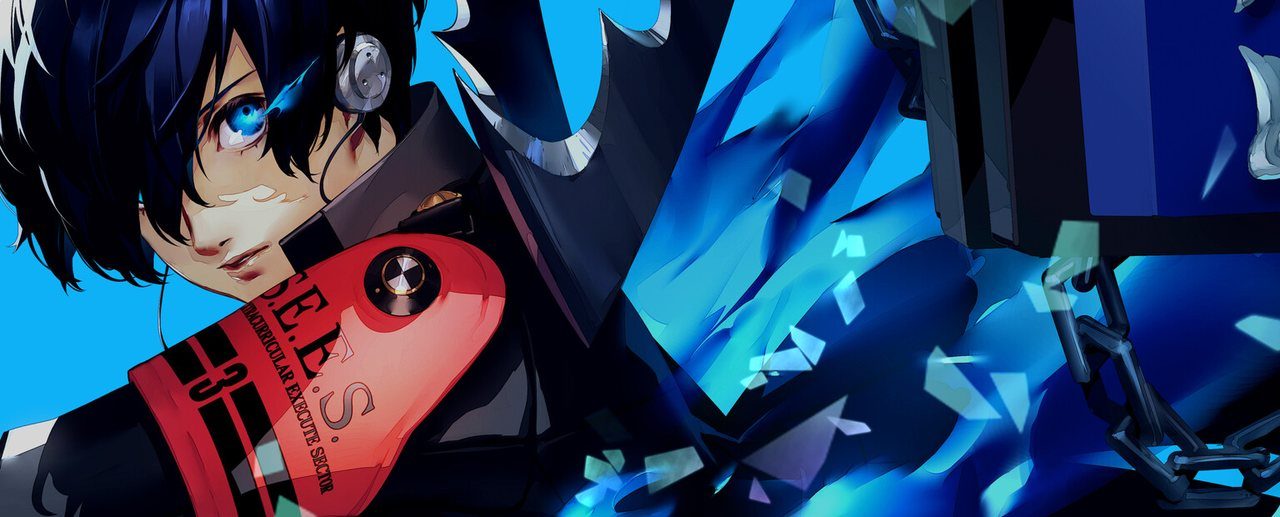
Many players discover Persona first and only later notice that the boxes once said “Shin Megami Tensei: Persona.” Others come to Shin Megami Tensei V after Persona 5 and are surprised by how different it feels, despite familiar demons, a familiar weakness-based battle system and the same publisher. The two series are branches of one franchise, Atlus’s Megami Tensei, and understanding their relationship makes it easier to know what to expect from each. This guide covers the franchise’s roots, how Persona split off and overtook its parent, the systems they share and the best entry points as of October 2026.
Where It All Began: Digital Devil Story
The franchise started with books, not games. Digital Devil Story was a series of novels by Aya Nishitani, published by Tokuma Shoten, about a student programmer who summons demons through a computer. A game adaptation, Digital Devil Story: Megami Tensei, was released for the Famicom on September 11, 1987. Atlus developed it and Namco published it.
That first game already contained the ideas that define the franchise. Players could recruit demons to fight alongside them and fuse two demons into a new, more powerful one. The setting mixed modern technology with mythology and the occult, drawing its creatures from world religions and folklore. A sequel followed on the Famicom in 1990 and introduced the morality-based alignment choices that became another series hallmark.
Shin Megami Tensei: The Main Line
In 1992, Atlus released Shin Megami Tensei for the Super Famicom. “Shin” means “true” or “new,” and this game set the template for the main series: a modern Tokyo devastated by catastrophe, a silent protagonist caught between Law and Chaos factions, and an ending determined by the player’s alignment.
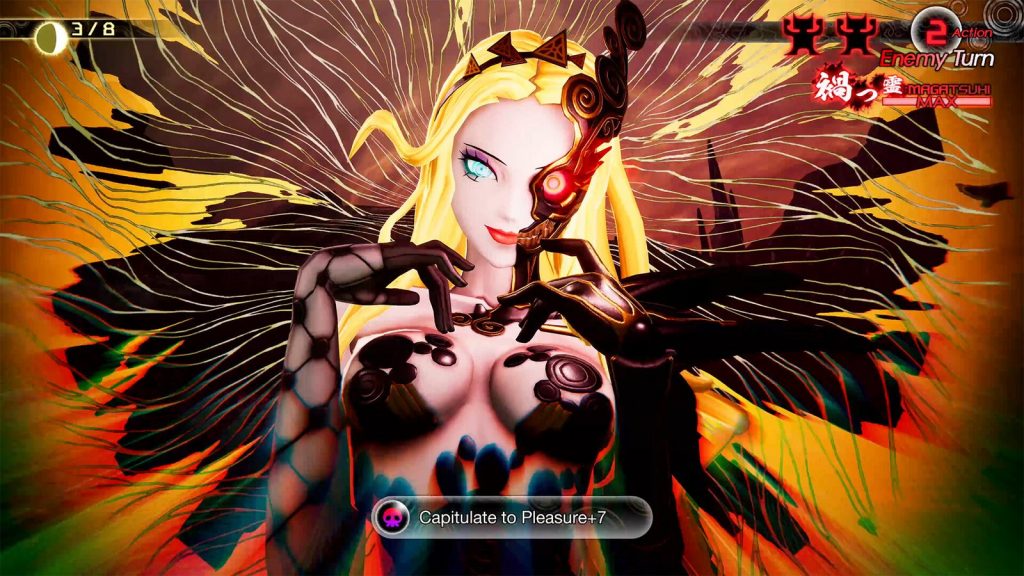
The main line has continued through these core entries:
| Game | Platform (original) | Year |
|---|---|---|
| Shin Megami Tensei | Super Famicom | 1992 |
| Shin Megami Tensei II | Super Famicom | 1994 |
| Shin Megami Tensei if… | Super Famicom | 1994 |
| Shin Megami Tensei III: Nocturne | PlayStation 2 | 2003 |
| Shin Megami Tensei IV | Nintendo 3DS | 2013 |
| Shin Megami Tensei IV: Apocalypse | Nintendo 3DS | 2016 |
| Shin Megami Tensei V | Nintendo Switch | 2021 |
| Shin Megami Tensei V: Vengeance | Multiplatform | 2024 |
Alongside the numbered games, Atlus built other spin-off lines: Devil Summoner (from 1995, including Soul Hackers in 1997 and Soul Hackers 2 in 2022) and the two-part Digital Devil Saga, which borrowed Nocturne’s systems for a more character-driven story.
Shin Megami Tensei games are known for bleak settings, philosophical themes about order versus freedom, and demanding difficulty. They tend to put exploration, demon collection and tough battles ahead of character drama.
How Persona Branched Off
The first Persona game, Megami Ibunroku Persona, was released in 1996 for the original PlayStation in Japan and North America, where it was called Revelations: Persona. Instead of summoning external demons, its high school students call on Personas, manifestations of their inner selves, drawn from the same mythological roster.
Two connected sequels followed: Persona 2: Innocent Sin (1999, Japan only on PlayStation, later ported to PSP in 2011) and Persona 2: Eternal Punishment (2000). These early games kept much of the darker Megami Tensei tone and demon negotiation, and they were relatively niche outside Japan.
The Persona 3 reinvention
The turning point was Persona 3, released in Japan in 2006 and North America in 2007 for PlayStation 2. Katsura Hashino, who had previously directed Shin Megami Tensei III: Nocturne, pitched the concept to Atlus in 2003. Persona 3 added two ideas that would define the series:
- A school-year calendar. The protagonist lives through days and nights of a school year, choosing how to spend free time.
- Social Links. Building relationships with classmates and townspeople raises a link’s rank and strengthens Personas of the related Arcana when fused. Persona 5 later expanded this into the Confidant system.
The mix of everyday life simulation and dungeon crawling proved hugely popular. Persona 3 was followed by expanded versions, FES (2007 in Japan) and Portable (2009 in Japan).
Persona 4 and Persona 5
Persona 4 (2008 in Japan and North America) moved the formula to a small rural town and a murder mystery, with a warmer tone and a beloved cast. Its expanded version, Persona 4 Golden, came to PlayStation Vita in 2012.
Persona 5 launched in Japan in September 2016 and in North America and Europe in April 2017. Its stylish presentation, heist structure and themes of rebellion against corrupt adults made it the series’ biggest hit, and Persona 5 Royal followed in 2019 in Japan and 2020 worldwide. Composer Shoji Meguro, who joined Atlus in 1995 and wrote the Velvet Room theme, was lead composer on Persona 5; his music is a major part of the series’ identity.
Hashino led the Persona team until Persona 5’s Japanese release in 2016 and then founded Studio Zero within Atlus. As of June 2026, the Persona series had sold more than 30 million copies worldwide, which, together with figures for the main Megami Tensei line, means the spin-off has outgrown its parent.
What the Two Series Share
Despite the difference in tone, Persona and Shin Megami Tensei share a core design DNA.
Demons and Personas
Both draw from the same roster of mythological figures, from Jack Frost, the series mascot, to gods and angels such as Lucifer, Odin and Metatron. In Shin Megami Tensei, demons are party members you recruit and fuse. In Persona, they are summoned powers, and the protagonist can usually hold and switch between several of them.
Fusion
Fusion combines two or more demons or Personas into a new one, often passing on chosen skills. In Persona, fusion happens in the Velvet Room, a recurring location presided over by the long-nosed Igor. In both series, fusion is central to building a strong party.
Weakness-based combat: Press Turn and One More
Both series reward exploiting elemental weaknesses, but their systems differ:
- Press Turn (introduced in Shin Megami Tensei III: Nocturne): each side has a number of turn icons. Hitting a weakness or landing a critical hit costs only half a turn, effectively granting an extra action. Missing or hitting an immunity costs extra turns. Crucially, enemies use the same rules against you.
- One More (from Persona 3 onward): hitting a weakness or landing a critical knocks the enemy down and gives the attacker another action. If all enemies are down, the party can launch an All-Out Attack.
Both systems turn battles into puzzles about scouting and exploiting weaknesses. Press Turn is generally harsher, because enemies that hit your weaknesses can chain extra turns and wipe a party quickly. Our overview of RPG combat systems puts these turn-based variations in wider context.
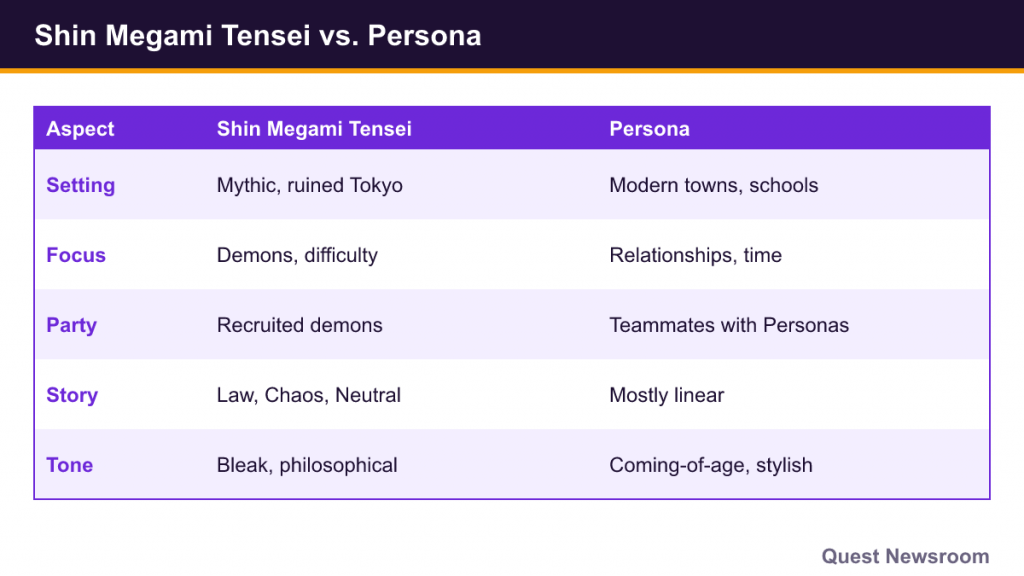
Key Differences at a Glance
| Aspect | Shin Megami Tensei | Persona |
|---|---|---|
| Setting | Post-apocalyptic or mythic Tokyo, cosmic conflicts | Contemporary Japanese towns and schools |
| Focus | Exploration, demon collection, difficulty, alignment | Characters, relationships, time management |
| Party | Recruited demons, often with few human allies | Human teammates, each with a Persona |
| Story structure | Branching endings based on Law, Chaos or Neutral choices | Mostly linear plot, with relationship and ending variations |
| Tone | Bleak, philosophical | Coming-of-age, stylish, often warm |
A common question is whether you need to play Shin Megami Tensei before Persona, or earlier Persona games before later ones. You don’t. Story connections between numbered entries are light, usually limited to cameos and recurring figures such as Igor, and each game introduces its own systems from scratch. The bigger adjustment is expectations: a Persona fan moving to Shin Megami Tensei should expect less hand-holding and fewer story scenes, while a Shin Megami Tensei fan moving to Persona should expect a slower opening and plenty of everyday life between dungeons.
Both are recognizably Japanese RPGs in tradition. If you want context on how they fit that label, see our explainer on JRPG vs. western RPG design.
Remakes and Recent Releases
Atlus has spent recent years bringing older entries to modern platforms. The biggest example is Persona 3 Reload, a full remake released on February 2, 2024, for PlayStation 4, PlayStation 5, Windows and Xbox, with a Nintendo Switch 2 version following in October 2025. On the Shin Megami Tensei side, Shin Megami Tensei V: Vengeance (June 2024) expanded the 2021 game with a new story route and brought it to more platforms.
Spin-offs have also widened the Persona brand, including the action game Persona 5 Strikers (2020 in Japan, 2021 worldwide) and the tactical game Persona 5 Tactica (November 2023).
As of October 2026, the next major remake, Persona 4 Revival, has been announced (in June 2025) but not released. Atlus has scheduled it for February 18, 2027, with a Nintendo Switch 2 version listed for May 20, 2027.
Where to Start
Because each numbered Persona and Shin Megami Tensei game has its own cast and story, you can start almost anywhere. A few practical suggestions:
- For story and characters: Persona 5 Royal is the most popular entry and a polished introduction. Persona 3 Reload offers a modernized take on the game that established the modern formula.
- For a challenging dungeon crawl: Shin Megami Tensei V: Vengeance is the most accessible modern main-series game, with a large world and Press Turn combat at its best.
- For the darkest, most atmospheric experience: Shin Megami Tensei III: Nocturne is a cult classic and the origin of Press Turn.
- If you want to wait for a remake: Persona 4’s revival is scheduled for 2027; until then, Persona 4 Golden remains the definitive version.
Each game is long, so pick the setting and tone that appeals most rather than worrying about order.