Open-World RPGs Explained: What Makes Them Different
What makes an RPG open-world, how it differs from linear and hub-based design, and how Skyrim, The Witcher 3 and Elden Ring each approach freedom.
“Open world” is printed on so many game boxes that it has almost stopped meaning anything. In RPGs, though, it describes a specific design bargain: the game hands you a large, continuous map early on and trusts you to decide where to go, what to do and in what order. That freedom changes how stories are told, how difficulty works and how players spend their time. This explainer covers what separates an open-world RPG from its linear and hub-based cousins, the systems that make these worlds tick, and the different philosophies behind three landmark examples.
Defining the Open-World RPG
An open-world RPG combines the core of any role-playing game, a character who grows through experience, gear and choices, with a world you can explore largely without barriers. A few traits tend to appear together:
- A large, continuous map that you can traverse on foot or by mount, rather than a sequence of separate levels.
- Early freedom. After a tutorial, most of the map is open, even if some regions are dangerous.
- Player-driven pacing. The main quest waits for you. You can ignore it for dozens of hours.
- Dense optional content: side quests, dungeons, points of interest, crafting materials and secrets scattered across the map.
- Systems that interact, such as day-night cycles, NPC schedules, factions and physics, producing moments the designers did not script directly.
None of these is unique to open-world games, but the combination is. If you are newer to the genre, our guide to XP and leveling explains the progression systems these games build on.
Linear, Hub-Based and Open: Three Ways to Build an RPG
It helps to compare the open world with the alternatives.
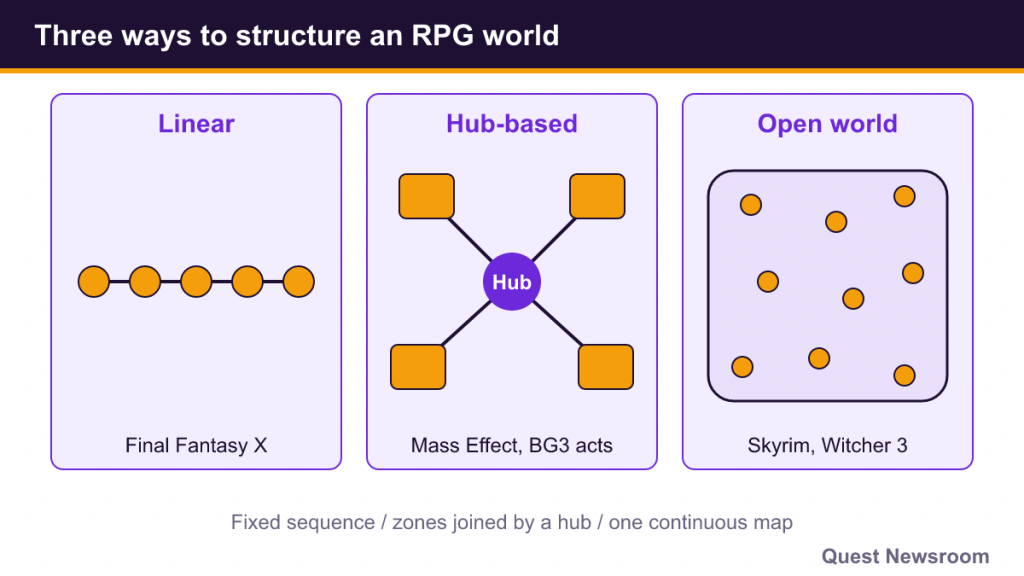
| Structure | How it works | Typical examples |
|---|---|---|
| Linear | The story moves through a mostly fixed sequence of areas. Backtracking is limited or optional. | Final Fantasy X, many classic JRPGs |
| Hub-based | Several self-contained zones or maps connected by a hub, world map or ship, often unlocked in story order. | Mass Effect, Dragon Age: Inquisition, Baldur’s Gate 3’s acts |
| Open world | One large continuous map, mostly accessible early, with content placed throughout. | Skyrim, The Witcher 3, Elden Ring |
Each approach has strengths. Linear games control pacing and can make every scene count. Hub-based games balance freedom with authored set pieces. Open worlds trade some narrative control for a sense of place and discovery, and the best of them make the journey between quest markers worth taking.
The Systems That Make Open Worlds Work
Side quests and radiant content
An open world needs things to do. Developers fill it with handcrafted side quests, smaller activities and, in some games, procedurally assigned tasks. Bethesda’s Radiant systems are the best-known example. In The Elder Scrolls V: Skyrim (2011), the Radiant AI system, carried over and updated from Oblivion, lets NPCs follow routines such as farming, milling and mining and react to each other and their surroundings. Some quest parameters, such as which location a task sends you to, can be adjusted based on places you have not yet explored. The upside is a steady stream of content; the downside is that generated tasks can feel repetitive next to handcrafted quests.
Level scaling
When players can go anywhere, designers must decide how difficulty works. There are three broad options:
- Full scaling: enemies and loot grow with the player’s level, so any region stays challenging. The Elder Scrolls IV: Oblivion is the famous example: most generic enemies leveled with the player, and loot quality scaled too. Players criticized it because a character who leveled up through non-combat skills could actually fall behind the enemies around them.
- Fixed regions: each area has its own difficulty, and dangerous zones stay dangerous until you are ready. This gives a clear sense of progress but can make the “open” world feel gated by numbers.
- Hybrid: many modern games scale within ranges, or scale some content while keeping other areas fixed, to get some of the benefits of both.
Our Elder Scrolls series history covers how Bethesda’s approach evolved from game to game.
Traversal and navigation
Moving across a big map has to be enjoyable on its own. Mounts, fast travel, climbing, gliding and vehicles all change how a world is experienced. Navigation is just as important: some games rely on quest markers and minimaps, while others give directions in dialogue or let landmarks guide the eye. The choice shapes whether players watch the map or the world.
Emergent gameplay
Open worlds are full of systems that collide. A dragon attacks a town while you are shopping; a thief steals from the wrong person and starts a fight; weather changes how a monster behaves. These unscripted moments are why many players remember open-world RPGs as stories they created themselves.
Three Philosophies of Open-World Design
Three influential games show how differently developers can approach the same idea.
Skyrim: the simulation sandbox
The Elder Scrolls V: Skyrim launched on November 11, 2011, for PC, PlayStation 3 and Xbox 360, and has been re-released many times since, including the Special Edition (2016), a Nintendo Switch version (2017), the Anniversary Edition (2021) and a Nintendo Switch 2 version announced and released on December 9, 2025. Bethesda reported more than 60 million copies sold by June 2023.
Skyrim’s design philosophy is breadth and freedom. You can join any faction, become a thief, a mage and a warrior on the same character, and ignore the main quest about dragons almost entirely. Its progression system supports that: you raise 18 skills by using them, and character levels come from skill growth rather than kills. The world is dense with dungeons and NPCs going about their routines. The trade-off is that many individual quests are simple, and the strength lies in the cumulative feeling of living in a place.
The Witcher 3: the authored world
The Witcher 3: Wild Hunt (2015) takes almost the opposite approach. You play a defined character, Geralt of Rivia, and the world is built around a strong central story. Its regions, from war-ravaged Velen to the city of Novigrad and the Skellige Isles, are huge, but much of their content is handcrafted quests with characters, moral dilemmas and consequences. Quests and enemies carry visible levels, which nudge players along a rough path through the world while still allowing detours.
Wild Hunt showed that open-world side content could match the quality of main-story writing, and it influenced many games that followed. Our Witcher games history traces how CD Projekt Red got there.
Elden Ring: discovery without hand-holding
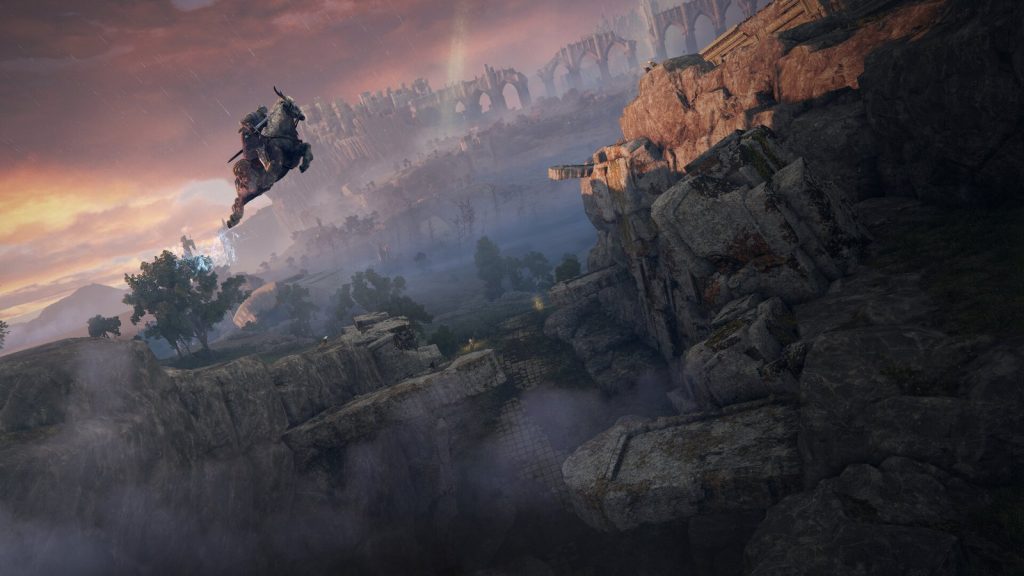
Elden Ring, released by FromSoftware and Bandai Namco on February 25, 2022, brought the studio’s Souls design into a large open world called the Lands Between. You cross it mainly on a spectral steed, Torrent, with major regions connected by open landscapes and dense “legacy dungeons” that resemble the tightly designed levels of Dark Souls. Hidden catacombs, caves and tunnels are scattered everywhere.
Elden Ring uses almost no quest markers. Instead, it relies on sightlines: a castle on the horizon, a glowing tree, a strange ruin. In a 2022 Xbox Wire interview, director Hidetaka Miyazaki said no single game served as the model, naming The Elder Scrolls series, The Witcher 3 and, more recently, The Legend of Zelda: Breath of the Wild among the open-world games the team valued. He described the goal as a “sense of adventure,” letting players engage with a vast, dangerous world on their own terms.
Elden Ring’s openness also changes its difficulty. A boss that blocks you can be left for later while you explore elsewhere, level up and find new gear, which made it more approachable than earlier FromSoftware games for many players. It won Game of the Year at The Game Awards 2022 and had sold 30 million copies by April 2025.
Common Problems Open-World RPGs Face
Freedom brings its own design risks, and even celebrated games wrestle with them:
- Narrative urgency. The main story may say the world is ending, while the game encourages you to spend hours picking flowers. This mismatch is a well-known open-world tension.
- Content bloat. Maps covered in icons can turn exploration into a checklist. Players often report burnout when activities feel interchangeable.
- Balance. If players can go anywhere, some will become overpowered for the main quest, while others will wander into areas that are far too hard.
- Performance and bugs. Large simulated worlds are technically demanding, and interacting systems can produce glitches.
- Weaker companions or party systems. Many open-world RPGs focus on a single character, so the party interplay common in CRPGs and JRPGs is often thinner.
How to Approach an Open-World RPG as a New Player
A few general habits make these games more enjoyable:
- Follow the main quest early on. The opening story hours usually unlock key systems, such as fast travel or mounts, that make exploring easier.
- Pick a direction and commit. Trying to clear every icon in a region before moving on is a fast route to fatigue.
- Treat danger as information. If an area is too hard, it is often a signal to come back later, especially in games like Elden Ring, where some regions are clearly meant for later.
- Use the world, not just the map. Landmarks, NPC conversations and books often point to the most interesting content.
- Adjust difficulty if available. Skyrim and The Witcher 3 offer difficulty settings; Elden Ring does not, but exploring and leveling elsewhere serve a similar purpose.
Where the Subgenre Is Heading
Recent open-world RPGs have moved away from map icons toward the kind of curiosity-driven exploration Elden Ring and Breath of the Wild popularized, while still borrowing The Witcher 3’s emphasis on strong side stories. Developers are also experimenting with smaller, denser worlds rather than ever-larger maps. Whatever shape they take, the core promise remains the same: a world that feels like it exists beyond the main path, and the freedom to find your own story inside it.