Character Builds Explained: Specialists, Hybrids, Min-Maxing and Respecs
What a character build is, how stats, skills, gear and synergies combine, the trade-offs of glass cannons, tanks and hybrids, and how respecs work.

Ask RPG players what they are playing and many will answer with a build rather than a class: “a bleed katana build,” “a stealth archer,” “a Sorcadin.” A build is the plan behind a character, the combination of stats, abilities and equipment chosen to make them good at something specific. Understanding builds turns character sheets from intimidating menus into a toolbox. This guide explains what goes into a build, the classic archetypes and their trade-offs, why diminishing returns exist, what min-maxing really means and how major RPGs let you start over.
What a Build Actually Is
At its simplest, a build is every decision that shapes how your character plays. In most RPGs those decisions fall into four layers:
- Attributes or stats. Where you put your points when you level up: Strength, Dexterity, Intelligence and so on. These set your baseline. Our explainer on RPG character stats covers what the common attributes do.
- Skills, talents and abilities. Skill trees, perks, feats or spell lists that give your character specific actions or passive bonuses.
- Equipment. Weapons, armor and accessories, which often have stat requirements and special properties.
- Synergies. How the pieces reinforce each other. A skill that adds damage to poisoned enemies is good; paired with a weapon that poisons on hit, it becomes the core of a build.
Synergy is what separates a build from a random collection of upgrades. Two characters with identical stats can play completely differently depending on which abilities and items they combine.
The Classic Archetypes and Their Trade-Offs
Almost every build sits somewhere along a few familiar lines. Each one gives something up to gain something else.
The glass cannon
A glass cannon puts nearly everything into damage and very little into defense. Fights end quickly when things go right, and very badly when they don’t. Glass cannons reward players who know enemy patterns, can avoid hits and are comfortable reloading. Many caster builds in action RPGs work this way, since spells can deal huge damage from range but robes offer little protection.
The tank
A tank invests in health, armor and resistances, often with abilities that draw enemy attention. In party-based RPGs the tank protects fragile allies; in single-character games a tank build simply survives mistakes. The cost is slower fights. A tank can outlast almost anything but may struggle against enemies that heal or against timed objectives.
The specialist
Specialists focus a whole build around one primary stat and one main tool: a pure Strength greatsword user, a pure Intelligence sorcerer, a pure Dexterity archer. Specialization is efficient because every point goes toward the same goal. Its weakness is inflexibility: an enemy that resists your one damage type or a situation that calls for a different tool can leave you stuck.
The hybrid
Hybrids mix two or more roles, such as a spellblade who fights in melee and casts spells or a paladin who tanks and heals. They are flexible and fun, but they spread their points across more stats, so early in a game they can feel weaker than specialists. Hybrids tend to come into their own later, once they have enough levels to meet the requirements of both halves.
Support and utility
In party RPGs, some characters exist to make others better: buffing allies, debuffing enemies, healing and controlling the battlefield. A good support build can be the reason a party wins, even if it never tops the damage numbers.
Soft Caps and Diminishing Returns
Many RPGs, especially FromSoftware’s Souls games, use soft caps. A soft cap is a stat level after which each additional point gives noticeably less benefit. Up to the cap, a point in your main damage stat might add a lot of damage; past it, the same point adds much less.
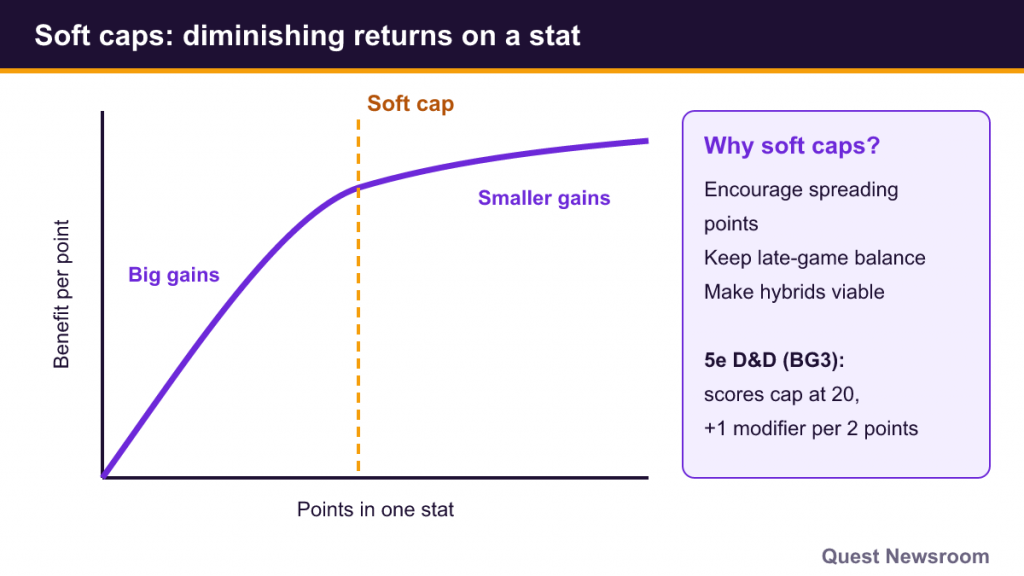
Soft caps exist for a few reasons:
- To encourage spreading points. Without diminishing returns, the optimal build would often be to pour everything into one stat forever.
- To keep late-game balance. They prevent a single stat from making characters so strong that encounters stop working.
- To make hybrids viable. Once a primary stat hits its soft cap, investing in a secondary stat becomes more attractive.
The exact soft-cap values differ by game, stat and sometimes by patch, so check a current, game-specific wiki rather than relying on numbers you remember from another title. The principle is what matters: once returns start to drop, look at where else your points could help.
Fifth edition D&D, the rules behind Baldur’s Gate 3, solves the same problem differently. Ability scores are capped at 20 for player characters in normal play, and the modifier rises by only one for every two points, so stacking a single stat has a hard ceiling. Our article on how Baldur’s Gate 3 uses 5e rules explains how those modifiers feed into rolls.
Min-Maxing: What It Means and When It Matters
Min-maxing means maximizing a character’s strengths while minimizing everything that doesn’t contribute, often by dumping unneeded stats as low as possible. A min-maxed wizard might leave Strength at the minimum because it never casts a spell; a min-maxed fighter might dump Intelligence.
Min-maxing has a bad reputation in some circles because it can make characters feel like spreadsheets. In practice, it is a tool with appropriate uses:
- It matters on the hardest difficulties, where small efficiency gains decide whether encounters are possible at all.
- It matters for challenge runs, such as low-level or speed runs.
- It matters less on normal difficulty, where most RPGs are designed to be completed with reasonable, unoptimized choices.
There are also real costs to extreme min-maxing in story-heavy RPGs. Dumping Charisma or Intelligence can lock you out of dialogue options, persuasion checks and sometimes entire quest solutions. In games like Baldur’s Gate 3, a character with very low Charisma may fail conversations a more balanced character would win.
How Respec Systems Work in Major RPGs
A respec, short for “re-specialization,” lets you reallocate stats or skills. Its availability shapes how much early decisions matter. Some examples:
| Game | How respec works |
|---|---|
| Baldur’s Gate 3 | The camp follower Withers resets a character to level 1 for 100 gold, letting you change class, subclass, ability scores, skills, spells and feats. Race, background and appearance stay fixed; appearance changes use a separate Magic Mirror. |
| Elden Ring | Rennala, Queen of the Full Moon, offers rebirth in exchange for a Larval Tear, letting you reallocate attributes gained from leveling. Larval Tears are limited, so respecs are not unlimited. |
| The Elder Scrolls V: Skyrim | Since patch 1.9 (2013), a skill at 100 can be made Legendary, resetting it to 15 and returning the perk points spent in that tree for use elsewhere. |
Some older or more traditional RPGs have no respec at all, which makes planning more important. Others, especially modern action RPGs, let you change skills freely, effectively making builds a loadout rather than a commitment. Neither approach is better; they produce different kinds of satisfaction. Permanent choices make a character feel like your own; free respecs encourage experimentation.
Building a Character Without a Guide
Online build guides are useful, but planning your own build is part of the fun. A simple process works in almost any RPG:
- Pick a fantasy first. Decide what you want to do: hit hard up close, cast from range, sneak, summon allies. Everything else follows from that.
- Identify your primary stat. Look at the weapons or spells you want and check what they scale with or require.
- Cover survival. Put enough into health or defense to avoid dying to a single mistake. In Souls-style games, many players prioritize the health stat early.
- Add a secondary option. A ranged backup, a crowd-control spell or a healing source covers the situations your main tool can’t handle.
- Look for synergies as you play. Read item and skill descriptions. Many build-defining effects are found, not planned.
- Know your respec options. If a game allows respecs, don’t fear experimenting. If it doesn’t, plan a little more carefully before spending points.
For first-time players, our guide on choosing difficulty, class and a first build covers the early-game decisions in more detail.
Common Build Mistakes
- Spreading points everywhere. Putting one or two points into every stat usually leaves you mediocre at everything, especially in the early game.
- Ignoring requirements. Planning around a weapon or spell without checking its stat requirements can leave you unable to use it for hours.
- Neglecting defense entirely. Pure damage feels great until a boss can kill you in one hit.
- Overvaluing marginal stats. A point past a soft cap, or one that doesn’t change a modifier, often does less than a point elsewhere.
- Copying an endgame build at level 1. Many popular builds rely on items or levels you won’t have for a long time. Learn what a build needs to function early.
- Forgetting the party. In party-based RPGs, your main character doesn’t need to do everything. Let companions cover roles you skip.
Why Builds Keep Players Coming Back
Builds are one of the main reasons people replay RPGs. The same world feels different when you approach it as a stealthy archer instead of an armored brute, and discovering an unexpected synergy is a reward in itself. Whether you plan every point or simply follow what seems fun, the most important rule is that a build should match how you enjoy playing. The most optimized character in the world is a poor choice if you don’t enjoy controlling it.