Where to Start With Final Fantasy: A Practical Guide for New Players
Most Final Fantasy games stand alone. Here is where to start by taste, how the FF7 Remake trilogy relates to the 1997 original, and what to play on.
With sixteen numbered games, remakes, remasters, sequels and spin-offs, Final Fantasy can look impossible to approach. The good news is that it is one of the easiest long-running series to jump into, because nearly every mainline game tells its own story in its own world. This guide explains how the series fits together, recommends starting points based on what you like, and lists where each suggestion can be played as of October 2026.
The Most Important Fact: The Numbers Are Not a Story Order
Unlike most numbered series, Final Fantasy VI is not a sequel to V, and X is not a sequel to IX. Each mainline entry has a new cast, a new world and usually a new combat system. What carries over are recurring elements: chocobos and moogles, a character named Cid, crystals, summoned creatures, classic spells and a focus on music. You can start with any number and lose nothing in story terms.
There are a few exceptions where games connect directly:
- Final Fantasy X-2 is a direct sequel to X.
- Final Fantasy XIII has two sequels, XIII-2 and Lightning Returns.
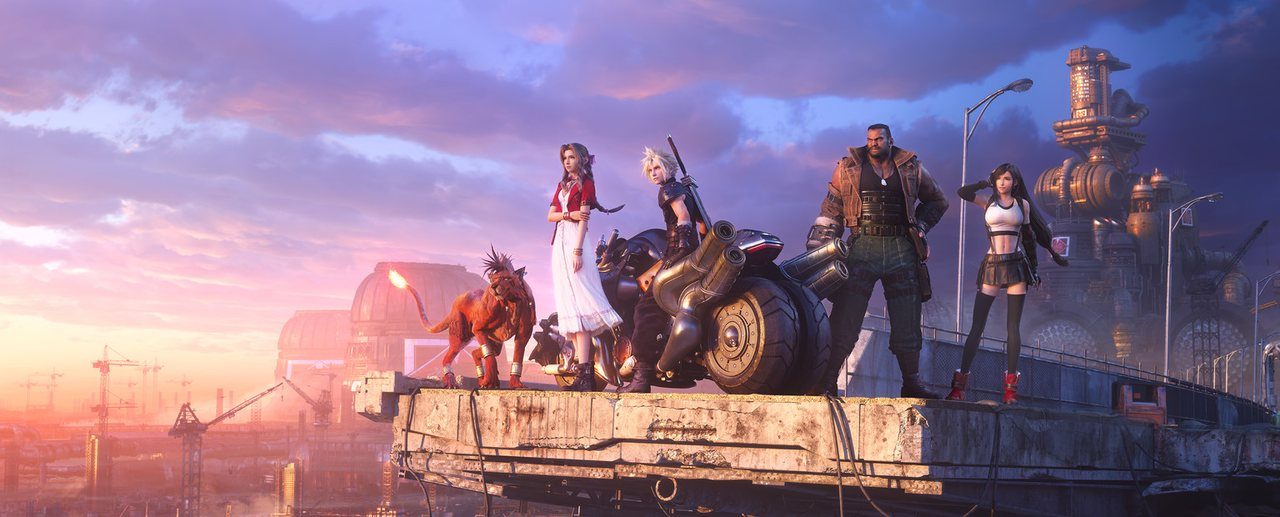
- The Final Fantasy VII Remake project is a multi-part retelling of the 1997 original, with its own continuity.
- Final Fantasy XI and XIV are online multiplayer games, quite different from the single-player entries; this guide does not cover them.
For a full chronological overview, see our Final Fantasy series history.
If You Want Classic Turn-Based Adventures
Start with: Final Fantasy IV, VI or IX
The 2D era is the heart of classic Final Fantasy, and the easiest way to play it is the Pixel Remaster collection of I through VI. These versions feature redrawn sprites supervised by original artist Kazuko Shibuya and a rearranged soundtrack supervised by Nobuo Uematsu, with an option to switch to the original music on consoles. They also include quality-of-life options such as experience multipliers and encounter rate controls, which remove the grinding that put off some players in the 1990s.
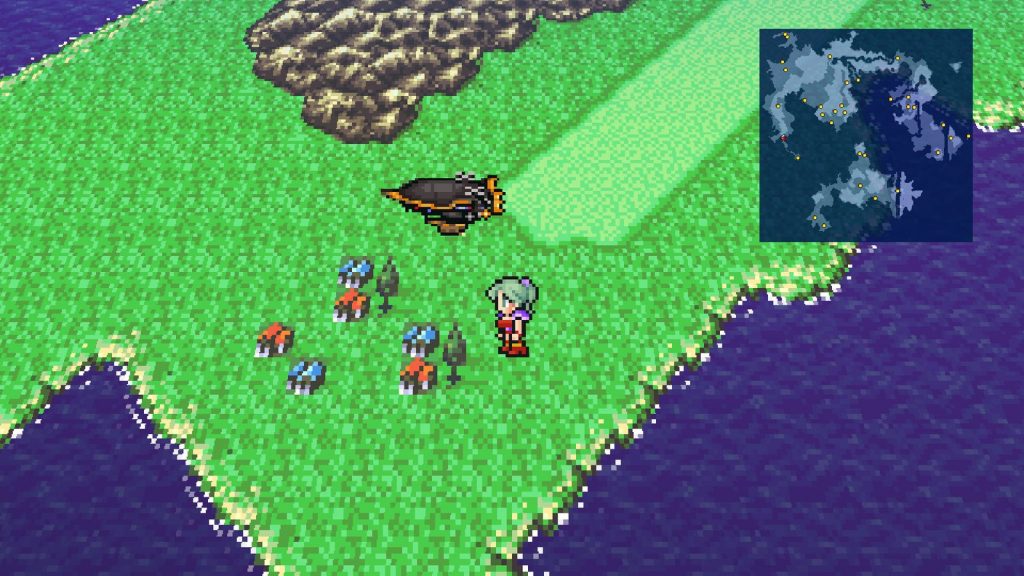
- Final Fantasy IV (1991) introduced Active Time Battle and a tightly told story about Cecil, a dark knight seeking redemption. It is a compact, story-driven start.
- Final Fantasy VI (1994) has a large ensemble cast and is often ranked among the series’ best. Its opera house scene is one of the series’ most famous moments.
- Final Fantasy IX (2000), from the PlayStation era, deliberately returned to medieval fantasy and is full of references to earlier games, making it a lovely “classic” choice with 3D characters.
Where to play: the Pixel Remasters launched on PC and mobile in 2021-2022, arrived on PlayStation 4 and Nintendo Switch on April 19, 2023, and on Xbox Series X/S on September 26, 2024. Final Fantasy IX is available on PC, mobile, PlayStation 4, Nintendo Switch and Xbox One.
One caveat: the Pixel Remasters do not include extra content added in the Game Boy Advance versions, such as bonus dungeons and superbosses. Most new players will not miss it.
If You Want Action
Start with: Final Fantasy XVI or Final Fantasy VII Remake
Final Fantasy XVI (2023) is a fully real-time action game. You control Clive Rosfield directly, combining sword attacks, dodges and the powers of summoned Eikons. Its battle director, Ryota Suzuki, previously worked on Devil May Cry, and it shows. It is also the darkest, most mature mainline story. A Story mode with assist accessories helps if you are less confident in action games.
Where to play: PlayStation 5 (June 2023), Windows (September 2024) and Xbox Series X/S (June 2025).
Final Fantasy VII Remake (2020) is a hybrid: real-time action with an ATB gauge that lets you pause the action to choose spells and abilities, and switch between party members at will. It feels exciting while still rewarding planning. If you are not sure whether you prefer menus or action, this is the best middle ground. Our guide to RPG combat systems explains how these styles compare.
If You Want a Big, Story-Heavy Epic
Start with: Final Fantasy X or Final Fantasy VII
Final Fantasy X (2001) was the first game in the series with voice acting, and its pilgrimage story through the world of Spira remains one of its most emotional. Combat uses the Conditional Turn-Based system, which shows upcoming turn order and pauses on each turn, making it one of the most approachable turn-based systems in the series. The HD Remaster bundled with X-2 is the version to get.
Where to play: Final Fantasy X/X-2 HD Remaster is available on PlayStation 4, Windows, Nintendo Switch and Xbox One.
Final Fantasy XII: The Zodiac Age is a great alternative for players who enjoy political drama and programming party behavior with “Gambits”. It is available on PlayStation 4, Windows, Nintendo Switch and Xbox One.
Final Fantasy VII: Original or Remake?
This is the most common question, and it deserves a clear answer.
The original Final Fantasy VII (1997) is a complete game with turn-based ATB combat, 3D characters over pre-rendered backgrounds and the Materia customization system. It tells the entire story of Cloud, Avalanche and Sephiroth in one adventure. It is available on PC, PlayStation 4, Nintendo Switch, Xbox One and mobile devices.
The Remake project retells that story across three large games with modern graphics and action-based combat:
| Part | Covers | Platforms as of October 2026 |
|---|---|---|
| Final Fantasy VII Remake (2020; Intergrade 2021) | The opening Midgar section, greatly expanded | PS4, PS5, Windows, Nintendo Switch 2, Xbox Series X/S |
| Final Fantasy VII Rebirth (2024) | The journey beyond Midgar, with open regions | PS5, Windows, Nintendo Switch 2, Xbox Series X/S |
| Final Fantasy VII Revelation | The conclusion | Announced for spring 2027 on PS5, Xbox Series X|S, Switch 2 and PC |
The Remake games are not a scene-by-scene copy. They add new characters, expand side stories and introduce plot developments that play with expectations set by the original. That means there are two reasonable approaches:
- Play the original first if you want the complete story now and want to appreciate everything the Remake changes and references. Its age shows in visuals and translation, but it remains very playable.
- Start with the Remake if you prefer modern presentation and action combat, and are happy to wait for the finale. The Remake games are designed to be enjoyable for newcomers, even if some moments resonate more with veterans.
Whichever path you choose, play Remake before Rebirth; they form one continuous story.
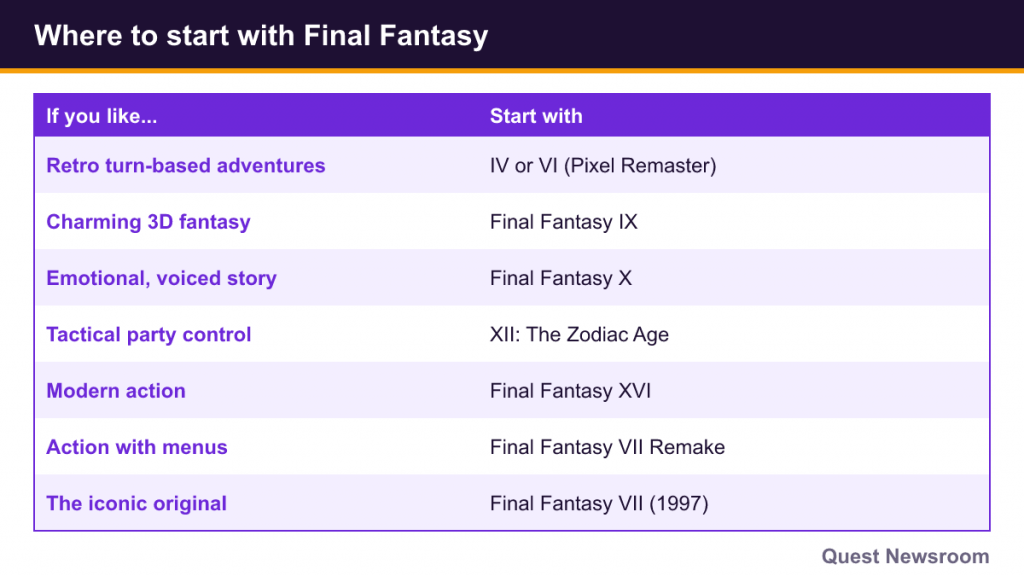
Suggested Starting Points at a Glance
| If you like… | Start with | Why |
|---|---|---|
| Retro, turn-based adventures | Final Fantasy IV or VI (Pixel Remaster) | Classic design with modern conveniences |
| Charming fantasy with 3D characters | Final Fantasy IX | A love letter to the early games |
| Emotional, voiced story | Final Fantasy X | Accessible turn-based combat and a strong narrative |
| Tactical party control | Final Fantasy XII: The Zodiac Age | Gambits and real-time strategy |
| Modern action | Final Fantasy XVI | Fast, cinematic combat |
| Action with menus | Final Fantasy VII Remake | Hybrid combat and a famous story |
| The iconic original | Final Fantasy VII (1997) | The full classic story in one game |
Common Questions
Should I start with Final Fantasy I?
You can, and the Pixel Remaster makes it far more comfortable than the 1987 original. But the first game is simple by modern standards, with a thin story. Most players find IV or VI a more representative introduction to the classic era.
Do I need to play Final Fantasy XV before XVI?
No. They are unrelated stories in different worlds.
Is it okay to use the Pixel Remaster boost options?
Absolutely. The experience and encounter controls were added so players can enjoy the stories without grinding. Turn them on or off as you like.
What about the spin-offs?
Spin-offs such as Final Fantasy Tactics and Crisis Core are worth exploring later, once you know which parts of the series you love most. For other genre-wide suggestions, see our list of the best RPGs for beginners.
Tips for Your First Final Fantasy
- Read the battle tutorials. Because each entry changes its combat, even veterans of other RPGs benefit from the in-game explanations. ATB, Conditional Turn-Based, Gambits and the Remake hybrid all behave differently.
- Exploit elemental weaknesses. Fire, Blizzard and Thunder spells, and their stronger versions, appear throughout the series. Checking which element an enemy fears is often the fastest way through a tough fight.
- Experiment with customization. Materia in VII, the Sphere Grid in X and licenses in XII reward trying different setups. Most are flexible enough that early experiments are rarely wasted.
- Talk to townspeople. Older entries hide hints, optional characters and side quests in dialogue.
- Do not chase every optional boss on a first run. Superbosses and endgame challenges are designed for players who have mastered the systems, often after the final dungeon becomes available.
- Use quality-of-life features. Pixel Remaster boosts, auto-battle options in remasters and difficulty settings in modern entries are there to help you enjoy the story at your pace.
The Bottom Line
There is no wrong door into Final Fantasy. Pick the combat style and tone that appeal to you, start there, and branch out. Because every numbered game reinvents itself, falling in love with one entry is often the beginning of a long tour through all the others.