Turn-Based, Real-Time With Pause or Action: RPG Combat Systems Explained
Turn-based, Active Time Battle, real-time with pause, action and hybrids: how each RPG combat model works, with examples, pros and cons.
Two RPGs can share a fantasy setting, a level-up system and a party of heroes and still feel nothing alike, because they fight in completely different ways. Combat is where you spend most of your time in most role-playing games, so understanding the main combat models is one of the best ways to predict whether you will enjoy a game. This guide walks through the five big families, with well-known examples, strengths and weaknesses, and the kind of player each suits.
1. Classic Turn-Based Combat
How it works
The battle advances in rounds. On your turn, you pick an action for each character from a menu (attack, magic, skill, item, defend, flee), then the enemies act. Time stops while you decide. Turn order may be fixed or determined by a speed stat.
Examples
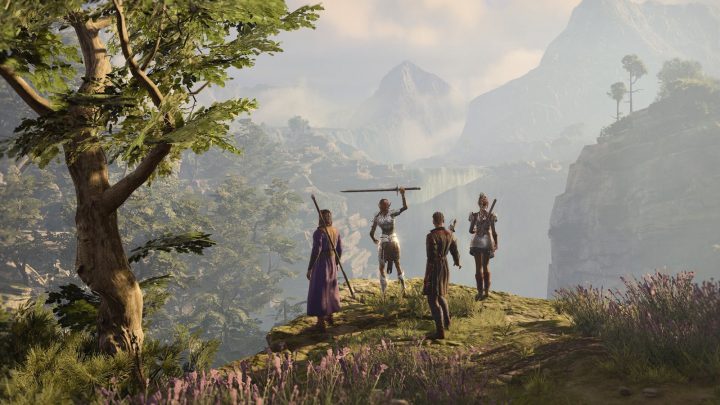
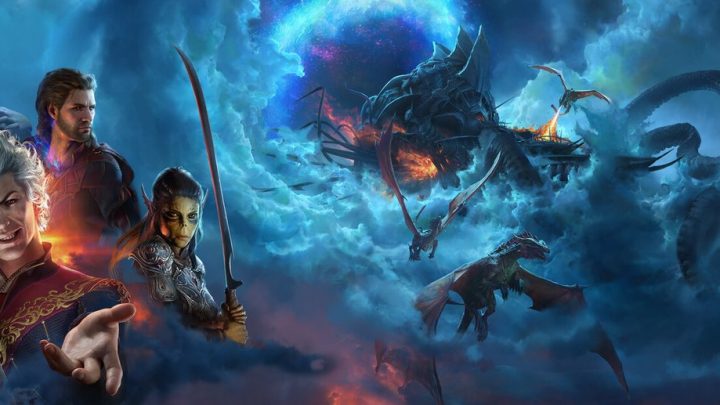
Dragon Quest, first released in 1986, is the archetype on consoles, and the series has stayed loyal to the format through Dragon Quest XI (2017), which keeps traditional turn-based combat with enemies visible on the field rather than random encounters. Persona 5 (2016) uses turn-based fights built around exploiting weaknesses for extra turns. On PC, Fallout (1997) and Baldur’s Gate 3 (2023) use turn-based combat on a tactical map, where movement and positioning matter as much as the action you choose.
Strengths and weaknesses
- Pros: no pressure on reflexes; clear information; rewards planning and understanding systems; accessible for players who do not enjoy fast action.
- Cons: routine fights can feel slow; repetitive menu inputs can drag in long games, which is why many modern turn-based games add speed-up or auto-battle options.
Suits: strategic thinkers, players who enjoy puzzles and anyone who wants to play at their own pace.
2. Active Time Battle (ATB)
How it works
ATB keeps the menus of turn-based combat but adds a clock. Each character has a gauge that fills in real time according to their speed; when it is full, they can act. Enemies have their own timers and do not wait for you to finish thinking.
Origin and examples
ATB debuted in Final Fantasy IV, released for the Super Famicom in Japan on July 19, 1991. It was conceived by designer Hiroyuki Ito, who has said he was inspired by watching a Formula One race, where cars of different speeds pass each other. The idea of giving each character an individual speed value created the “race” of turns. Square used ATB through Final Fantasy IX; Final Fantasy X (2001) replaced it with the Conditional Turn-Based system, which pauses on each turn and shows the upcoming turn order. Chrono Trigger (1995) is another celebrated ATB game.
Strengths and weaknesses
- Pros: adds urgency and tension without requiring action-game reflexes; speed stats become meaningful.
- Cons: can feel stressful in menus; slow menu navigation may cost you. Many ATB games offer a “wait” setting that pauses the clock while you browse menus.
Suits: players who like menus but want a bit more momentum.
3. Real-Time With Pause (RTwP)
How it works
The battle runs continuously, with characters auto-attacking and following orders, but you can pause at any moment to issue new commands to the whole party. Many games let you set the game to pause automatically on certain events, such as an enemy appearing or a character falling low on health.
Examples
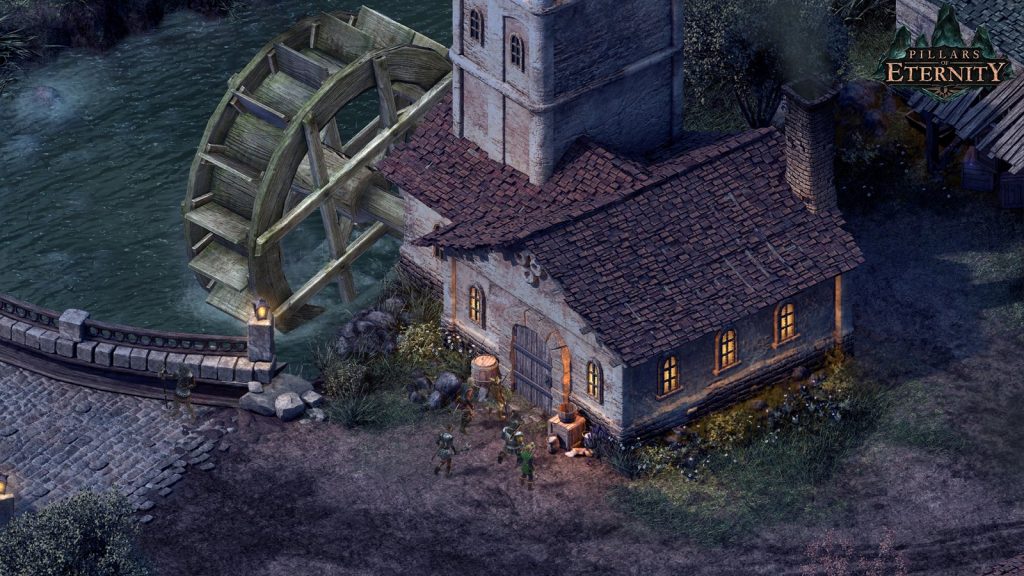
Baldur’s Gate (1998), developed by BioWare on the Infinity Engine, made RTwP the standard for western party RPGs while adapting Advanced Dungeons & Dragons rules. It was followed by Planescape: Torment, Icewind Dale and Baldur’s Gate II. Obsidian’s Pillars of Eternity (2015) revived the system for a new generation, as described in our CRPG explainer. Final Fantasy XII (2006) is a console relative: its Active Dimension Battle system runs in real time, with “Gambits” acting as programmable rules for party members.
Strengths and weaknesses
- Pros: fast resolution of easy fights; full tactical control when you need it; good for large parties.
- Cons: chaotic at first; hard to follow what happened in a big fight; heavily dependent on companion AI and good interface design.
Suits: players who want tactical depth without the slower pace of strict turns.
4. Action Combat
How it works
You directly control your character’s attacks, dodges, blocks and movement in real time. Stats and gear still determine damage and survivability, but your execution decides whether attacks land and whether you avoid them.
Examples
Action RPGs span a huge range: the loot-driven Diablo series, first-person open-world combat in The Elder Scrolls V: Skyrim (2011), and the demanding stamina-based fights of Dark Souls and Elden Ring (2022). Our soulslike guide covers that last family in detail. Final Fantasy XVI (2023) moved the series fully into action: you control only Clive directly, chaining attacks, dodges and Eikon abilities, with a Stagger meter that leaves enemies vulnerable. Its battle director, Ryota Suzuki, previously worked on Devil May Cry.
Strengths and weaknesses
- Pros: immediate, physical and exciting; player skill can overcome stat disadvantages; great sense of mastery.
- Cons: can be inaccessible for players with slower reflexes or limited mobility; party tactics are usually simplified, since you can only control one character at a time.
Suits: players who enjoy action games and want RPG progression underneath.
5. Hybrids: The Modern Default
Many recent RPGs refuse to pick a side. Some well-known hybrid designs:
- Final Fantasy VII Remake (2020) and Rebirth (2024) blend real-time action with an ATB gauge. Basic attacks and dodges happen in real time and fill the gauge, which you then spend on abilities, spells and items. You can pause the action to pick commands or map abilities to shortcuts, and you can switch between party members at will.
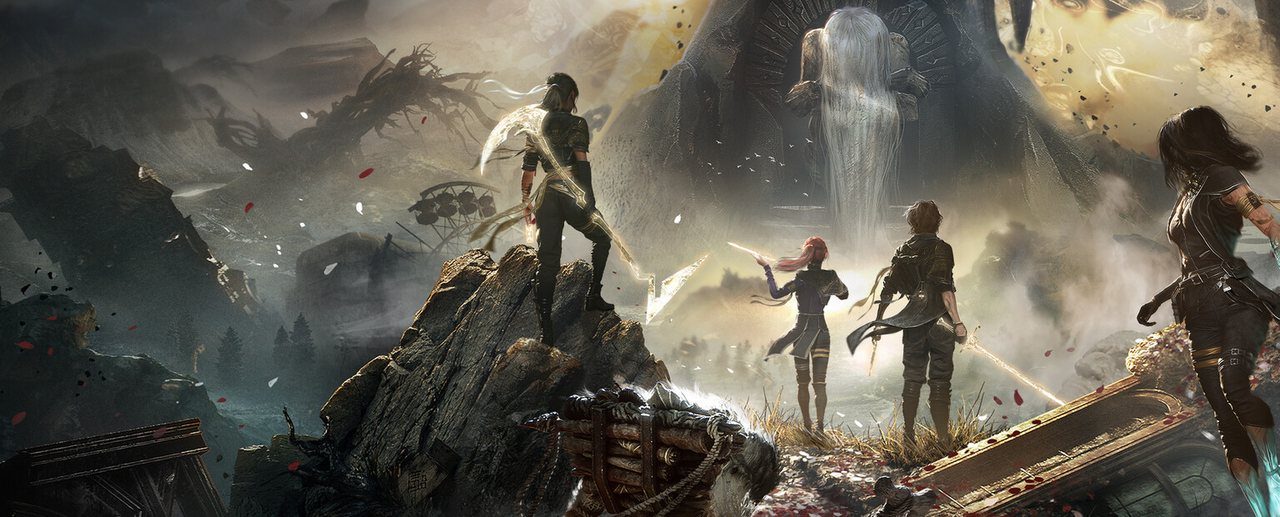
- Clair Obscur: Expedition 33 (2025) is turn-based, but during enemy turns you can dodge, parry or jump over attacks in real time. Successful parries grant resources and open counterattacks.
- Tactical RPGs such as Fire Emblem and Triangle Strategy place turn-based combat on a grid map, where terrain, height and unit positioning take center stage.
- Selectable modes: some CRPGs and remakes let you choose between real-time and turn-based play, or between full action and a more forgiving “story” setting. Final Fantasy XVI, for example, offers a Story mode with accessories that simplify combat.
Comparison at a Glance
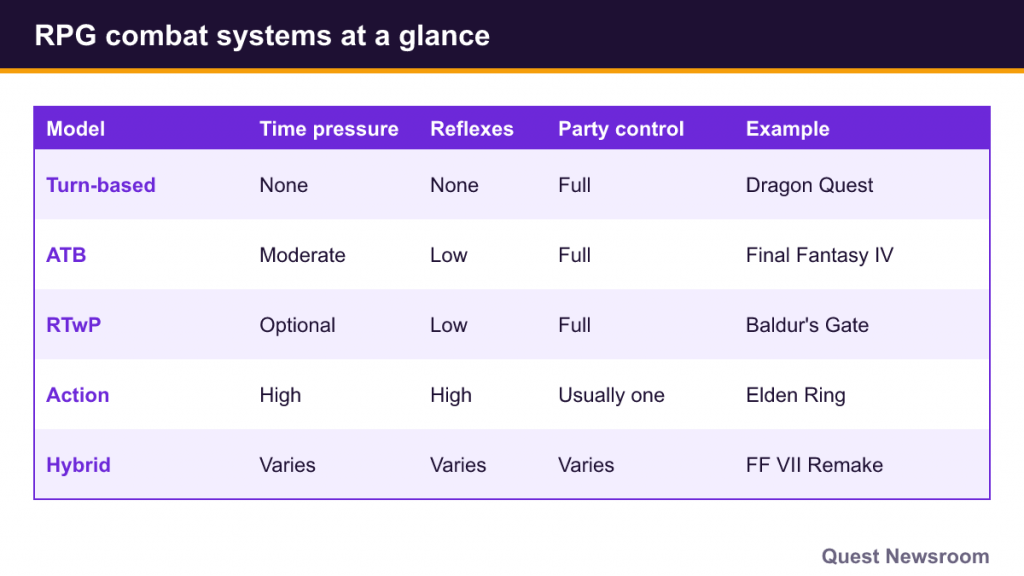
| Model | Time pressure | Reflexes needed | Party control | Classic example |
|---|---|---|---|---|
| Turn-based | None | None | Full | Dragon Quest |
| Active Time Battle | Moderate | Low | Full | Final Fantasy IV |
| Real-time with pause | Optional | Low | Full | Baldur’s Gate |
| Action | High | High | Usually one character | Elden Ring |
| Hybrid | Varies | Varies | Varies | Final Fantasy VII Remake |
Common Misconceptions
“Turn-based is outdated”
Some of the most acclaimed RPGs of the 2020s are turn-based. Baldur’s Gate 3 won Game of the Year at The Game Awards 2023, and Clair Obscur: Expedition 33 won the same award in 2025. Turn-based design is a choice, not a limitation.
“Action RPGs are not real RPGs”
Character building, stat allocation and gear progression remain central in action RPGs. Elden Ring may depend on your dodging, but your build decides what weapons you can wield and how much punishment you can take.
“RTwP and turn-based are basically the same”
They share a tactical mindset, but the rhythm differs. RTwP lets several characters act simultaneously and rewards watching the flow of battle; strict turn-based combat isolates each decision.
How Combat Systems Shape the Rest of the Game
A combat model is not just a battle mechanic; it ripples through the whole design.
- Party size. Turn-based and RTwP games can comfortably manage four to six characters because you have time to direct each one. Action games usually let you control one character directly, with AI handling allies, which is why Final Fantasy XVI centers on Clive.
- Stats vs. skill. In turn-based games, numbers decide almost everything, so character building carries more weight. In action games, player execution can compensate for weaker stats, which is why skilled players can beat soulslikes at very low levels.
- Encounter design. Turn-based games often use many shorter fights and must avoid repetition. Action games tend to place enemies by hand in the environment so that each encounter is a small set-piece.
- Accessibility. Turn-based combat is generally easier for players who cannot use fast inputs, while action games increasingly add assist modes and difficulty options to widen their audience.
- Pacing of story. Fully turn-based battles create clear pauses between exploration and fights, while real-time systems let combat flow directly from exploration without a screen transition, as in Final Fantasy XII.
Knowing this helps explain why studios redesign combat when they modernize an older game. When Final Fantasy VII Remake replaced the 1997 original’s ATB battles with a real-time hybrid, it also had to rebuild enemy design, party switching and level layouts around the new system.
How to Choose
Think about the games you already enjoy outside the genre. If you like chess or deck-builders, start with turn-based or tactical RPGs. If you like character action or shooters, start with an action RPG. If you are not sure, a hybrid like Final Fantasy VII Remake or Clair Obscur: Expedition 33 gives you a taste of both worlds. And remember that difficulty settings exist for a reason: the right combat system on the right difficulty is the difference between a chore and a favorite game.