The Elder Scrolls Series History: From Arena to Skyrim
Bethesda's open-world RPG series from Arena (1994) to Skyrim, Oblivion Remastered and the status of The Elder Scrolls VI as of October 2026.
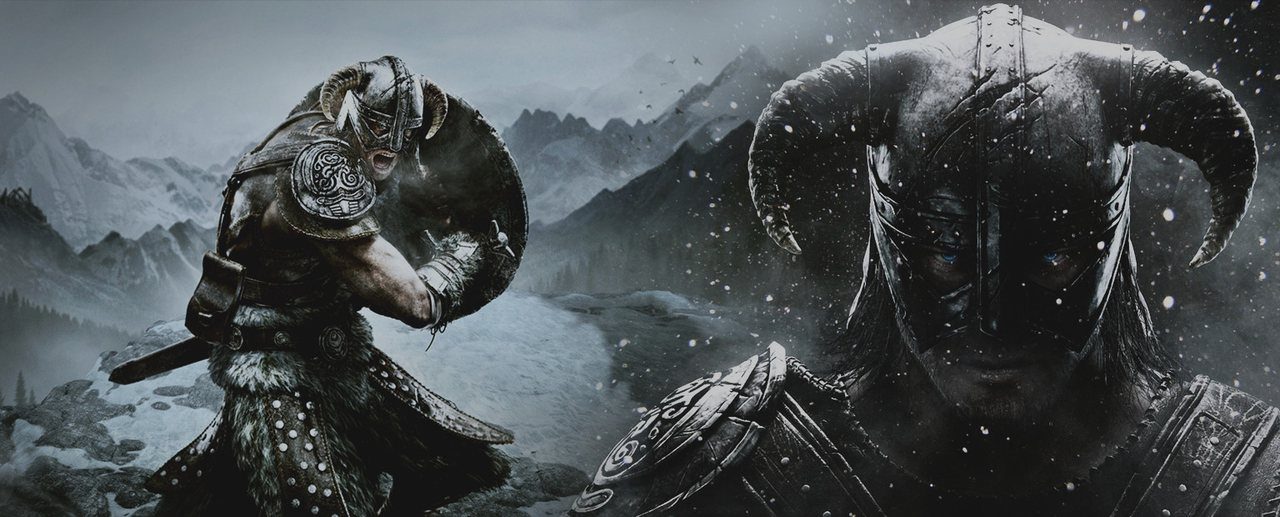
Few RPG series are as closely tied to the idea of freedom as The Elder Scrolls. Since 1994, Bethesda’s games have promised a huge world where you can be anyone and go anywhere, and each mainline entry has redefined what an open-world RPG can be. This history covers every main game, the most important spin-offs and re-releases, and where The Elder Scrolls VI stands as of October 2026.
Arena (1994): An Accidental RPG
The Elder Scrolls: Arena launched on March 25, 1994, for MS-DOS. It began life as a gladiatorial combat game, which explains the name, but grew during development into a sprawling first-person role-playing game set across the continent of Tamriel. Julian LeFay, according to early designer Ted Peterson, “really spear-headed the initial development of the series”.
Arena was ambitious to the point of excess, with procedurally generated towns and dungeons spread across a vast map. Its progression was traditional: you gained experience points by killing monsters and leveled up at preset thresholds. It found an audience slowly, but it established the series’ identity: a whole continent, first-person exploration and the freedom to ignore the main quest.
Daggerfall (1996): Scale Beyond Reason
The Elder Scrolls II: Daggerfall followed in September 1996, with Ted Peterson as lead designer. It is still famous for its sheer size, with a procedurally generated world covering the Iliac Bay region. More importantly for the series’ future, it replaced the experience-point system with skill-based advancement: your character improved the skills you used, and leveled up once a set of those skills had developed. This “learn by doing” approach became the series’ signature, as described in our guide to how XP and leveling work.
Two smaller spin-offs followed: An Elder Scrolls Legend: Battlespire (1997) and the action-adventure The Elder Scrolls Adventures: Redguard (1998).
Morrowind (2002): The Handcrafted World
The Elder Scrolls III: Morrowind launched in North America on May 1, 2002, on PC, followed by an Xbox version in June. It marked a turning point. Instead of a procedurally generated continent, Bethesda built a single, handcrafted island, Vvardenfell, full of alien landscapes, giant mushrooms, ash storms and political intrigue between the Great Houses.
Morrowind trusted players to find their own way. Quest directions were given in text, there was no compass marker leading you to objectives, and you could stumble into enormous trouble. Two expansions, Tribunal (November 2002) and Bloodmoon (June 2003), expanded the world. For many long-time fans, Morrowind remains the series’ high point for worldbuilding and freedom, and its arrival on Xbox helped bring the series to consoles.
Oblivion (2006): Into the Mainstream
The Elder Scrolls IV: Oblivion released in March 2006 for PC and Xbox 360, co-published with 2K Games, and later came to PlayStation 3. Set in the heartland province of Cyrodiil, it introduced fully voiced NPCs, a “Radiant AI” system for NPC routines, a quest compass and dramatic demonic gates opening across the land.
Its leveling worked through major skills: raise them by a combined ten points and you gained a level, with the chance to increase attributes. Its level scaling was also its most controversial feature. Enemies and loot grew stronger as you leveled, and because skills could rise involuntarily, a character could level up without becoming better at fighting, leaving enemies disproportionately tough. Even so, its quests, especially the Thieves Guild and Dark Brotherhood storylines, are often praised as among the series’ best. Knights of the Nine (2006) and the surreal expansion Shivering Isles (2007) followed.
Skyrim (2011) and Its Many Lives
The Elder Scrolls V: Skyrim released on November 11, 2011, for PlayStation 3, Windows and Xbox 360. Set in the cold northern province of Skyrim during a civil war and the return of dragons, it became one of the best-known games ever made, and the Dragonborn’s shouts, or Thu’um, entered gaming culture.
Skyrim simplified and refined the series’ systems. It removed classes and major skills: each of its 18 skills has its own experience bar that fills as you use it, and enough skill increases raise your overall level, which grants a perk point and lets you raise health, magicka or stamina. Players praised the freedom to experiment without committing to a class at the start.
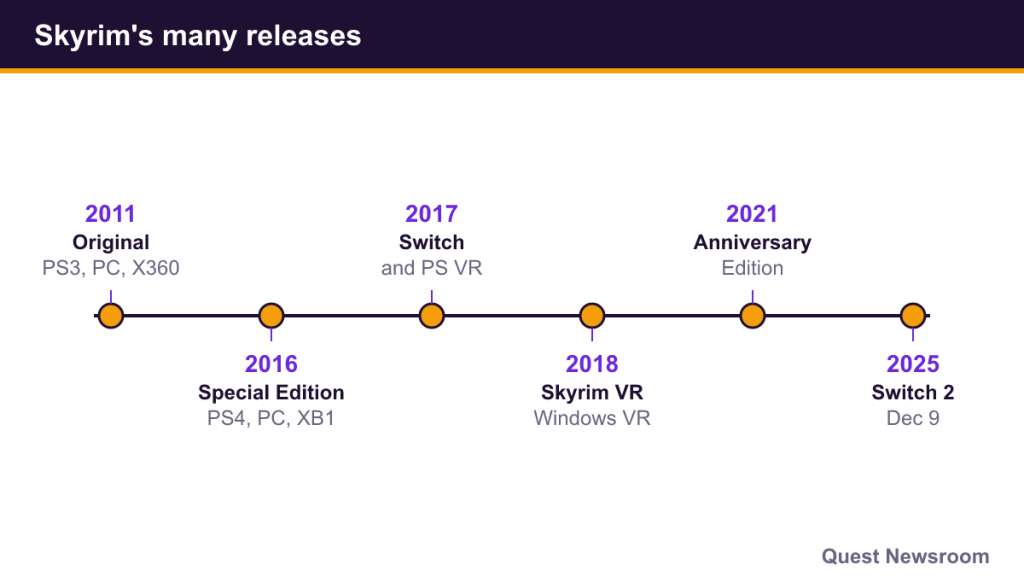
Three add-ons followed in 2012: Dawnguard, Hearthfire and Dragonborn. Then came the re-releases that turned “Skyrim on everything” into a running joke:
| Version | Release | Platforms |
|---|---|---|
| Original | November 11, 2011 | PS3, Windows, Xbox 360 |
| Special Edition | October 28, 2016 | PS4, Windows, Xbox One |
| Nintendo Switch | November 17, 2017 | Switch |
| Skyrim VR | 2017 (PlayStation VR); April 2, 2018 (Windows VR) | PS VR, Windows VR headsets |
| Anniversary Edition | November 11, 2021 (Switch: September 29, 2022) | PS4, PS5, Windows, Xbox One, Xbox Series X/S, Switch |
| Nintendo Switch 2 | December 9, 2025 | Switch 2 |
The game’s modding community has also kept it alive for well over a decade, especially on PC.
The Elder Scrolls Online: The MMO Branch
The Elder Scrolls Online launched for Windows and macOS on April 4, 2014, with console versions following in June 2015. It is an MMORPG developed by ZeniMax Online Studios and set many centuries before the events of Skyrim. Because it is an online game shared with many other players, it sits outside the single-player focus of this site, but it is worth knowing that it exists and that its lore is considered part of the wider series.
Oblivion Remastered (2025)
On April 22, 2025, The Elder Scrolls IV: Oblivion Remastered launched for PlayStation 5, Xbox Series X/S and PC. Rather than a simple resolution upgrade, it rebuilt the game’s visuals with modern engine technology while preserving the original’s world and quests. It gave many younger players their first chance to visit Cyrodiil, and long-time fans a reason to return nearly two decades later.
The Elder Scrolls VI: Status as of October 2026
The Elder Scrolls VI was announced at Bethesda’s E3 conference on June 10, 2018, with a short teaser trailer and confirmation that it was in pre-production. Bethesda Game Studios focused on Starfield (2023) first. In March 2024, during the series’ 30th anniversary, Bethesda said early builds of the game were being played internally. Todd Howard has described it as the studio’s primary development priority, and in 2026 he confirmed it runs on an updated version of the studio’s Creation Engine.
As of October 2026, Bethesda has not announced a release date, a release window, a subtitle or a setting. Platforms have not been officially confirmed by Bethesda for launch. Any claims about where the game takes place or when it will arrive come from fans and reports rather than official statements, so we leave them out here.
What Defines an Elder Scrolls Game
Across three decades, a few principles have held steady:
- Freedom first. The main quest is always optional for long stretches. You can join guilds, become a thief or simply wander.
- A first-person world. Every mainline game offers a first-person view, with third person added in later entries, which makes the world feel immediate.
- Learn by doing. Since Daggerfall, characters improve the skills they use. It rewards building a character organically through play.
- Deep lore. Tamriel’s history, gods and races are described in hundreds of in-game books, letting curious players dive as deep as they like.
- Modding and longevity. On PC, mods have extended the life of Morrowind, Oblivion and Skyrim for many years.
Frequently Asked Questions
Do I need to play the older games before Skyrim?
No. Each mainline game tells a standalone story in a different province. Returning characters, factions and historical events add flavor for veterans, but the games are designed so that newcomers can start with any of them.
Why did Bethesda move from procedural worlds to handcrafted ones?
Arena and Daggerfall used procedural generation to create enormous maps, but much of that space felt repetitive. Starting with Morrowind, Bethesda built smaller worlds by hand, which allowed more distinctive locations, quests and environmental storytelling. Each later game has followed that handcrafted approach.
Is Oblivion’s level scaling still a problem?
The original game’s scaling is a frequent topic of debate, and many PC players use mods to adjust it. If you find enemies becoming frustratingly tough, the usual advice is to choose major skills you will use deliberately in combat, so that leveling tracks your actual fighting ability, and to lower the difficulty slider when needed.
Are the spin-offs worth playing?
Battlespire and Redguard are mainly of historical interest today. The series’ larger spin-off is The Elder Scrolls Online, which is an MMO rather than a single-player RPG.
Where to Start Today
For most new players, Skyrim (in its Special or Anniversary Edition) is the easiest and most widely available entry point, with versions on every major current platform. If you prefer modern visuals with a more classic feel, Oblivion Remastered is a strong choice. Morrowind is best approached once you are comfortable with older design conventions, such as reading directions rather than following markers. You do not need to play the games in order: each is set in a different province with a self-contained story, and only lore enthusiasts will spot most of the connections.