D&D Rules in Video Games: How Baldur’s Gate 3 Uses Fifth Edition
How Baldur's Gate 3 turns D&D 5e rules into a video game: d20 rolls, advantage, actions, spell slots, rests, and where Larian changed the tabletop rules.

Baldur’s Gate 3 is many people’s first contact with Dungeons & Dragons. Larian Studios built the game on the fifth edition of the tabletop rules, the version of D&D that has dominated since 2014, and the game shows its working more openly than most RPGs. Hover over an attack and you see a hit percentage; talk your way past a guard and a twenty-sided die rolls across the screen.
This guide explains the core 5e mechanics as they appear in Baldur’s Gate 3, why they work the way they do, and the places where Larian deliberately departed from the tabletop rulebook. If you are new to the genre as a whole, our explainer on what a CRPG is gives useful context first.
A Quick Background: Why a Video Game Uses Tabletop Rules
Baldur’s Gate 3 was developed and published by Larian Studios, the Belgian studio behind Divinity: Original Sin 2. It entered early access in 2020 with only its first act, then launched in full on Windows on August 3, 2023, followed by PlayStation 5 in September 2023, macOS later the same month, and Xbox Series X|S in December 2023. It won Game of the Year at The Game Awards 2023 and, by April 2024, had become the first game to win Game of the Year at all five major industry ceremonies.
The original Baldur’s Gate (1998) used the Advanced Dungeons & Dragons 2nd edition rules in real time with pause. Baldur’s Gate 3 switched to fully turn-based combat, which is a much better fit for 5e. The tabletop game is designed around turns: each creature acts in initiative order, and every turn has a fixed budget of things you can do. Larian’s job was to automate the math a Dungeon Master would normally handle, while keeping the feel of rolling dice.
Wizards of the Coast publishes the core 5e rules in a free System Reference Document (SRD), the baseline for everything below.
The d20 Test: The Roll Behind Almost Everything
Fifth edition resolves nearly every uncertain action with a single mechanic, called a D20 Test in the current rules. You roll one twenty-sided die, add the relevant ability modifier, add your proficiency bonus if you are trained in what you are doing, and compare the total to a target number. Equal or higher succeeds.
There are three kinds of D20 Test, and Baldur’s Gate 3 uses all of them:
- Attack rolls are compared to the target’s Armor Class (AC). Melee weapon attacks normally use Strength, ranged weapon attacks use Dexterity, and spell attacks use the caster’s spellcasting ability. In BG3 the game shows this as a hit percentage before you commit.
- Ability checks are compared to a Difficulty Class (DC). These are the dice rolls you see in dialogue: Persuasion, Deception, Intimidation, Perception, Sleight of Hand and so on. The game displays the DC on the roll screen.
- Saving throws are rolled to resist an effect, such as a Dexterity save against a fireball or a Wisdom save against a charm spell. The DC usually comes from the caster’s spell save DC.
The tabletop rules give typical DCs as 5 (very easy), 10 (easy), 15 (medium), 20 (hard), 25 (very hard) and 30 (nearly impossible). The same scale is a good guide in BG3: a DC 10 conversation check is generous, while a DC 20 or higher check usually needs a high ability score, proficiency and some help.
Ability modifiers
The six abilities, Strength, Dexterity, Constitution, Intelligence, Wisdom and Charisma, each produce a modifier. A score of 10 or 11 gives +0, and every two points above or below shifts the modifier by one, so 16 gives +3 and 8 gives -1. Those modifiers, not the raw scores, are what get added to rolls. That is why raising a stat from 16 to 17 changes nothing on its own, while going from 17 to 18 does. Our guide to RPG character stats covers how the six D&D abilities shaped video game attributes in general.
Proficiency Bonus and Why Levels Feel Different in 5e
The proficiency bonus is a single number added to anything your character is trained in: weapons, skills, saving throws and spells. In the tabletop rules it starts at +2 at level 1 and rises to +3 at level 5, +4 at level 9, +5 at level 13 and +6 at level 17.
Baldur’s Gate 3 caps characters at level 12, so in the game your proficiency bonus will never exceed +4. That reflects 5e’s design philosophy, often called “bounded accuracy”: numbers grow slowly, so weak enemies stay relevant and a lucky roll can still beat a strong defense. Much of your power growth comes from new abilities and extra attacks rather than bigger modifiers.
Advantage and Disadvantage
Advantage is fifth edition’s signature mechanic, and BG3 leans on it heavily. When you have advantage, you roll two d20s and keep the higher result. With disadvantage, you keep the lower. Multiple sources do not stack: three reasons for advantage still only give you two dice. If you have both advantage and disadvantage on the same roll, they cancel out and you roll a single die.
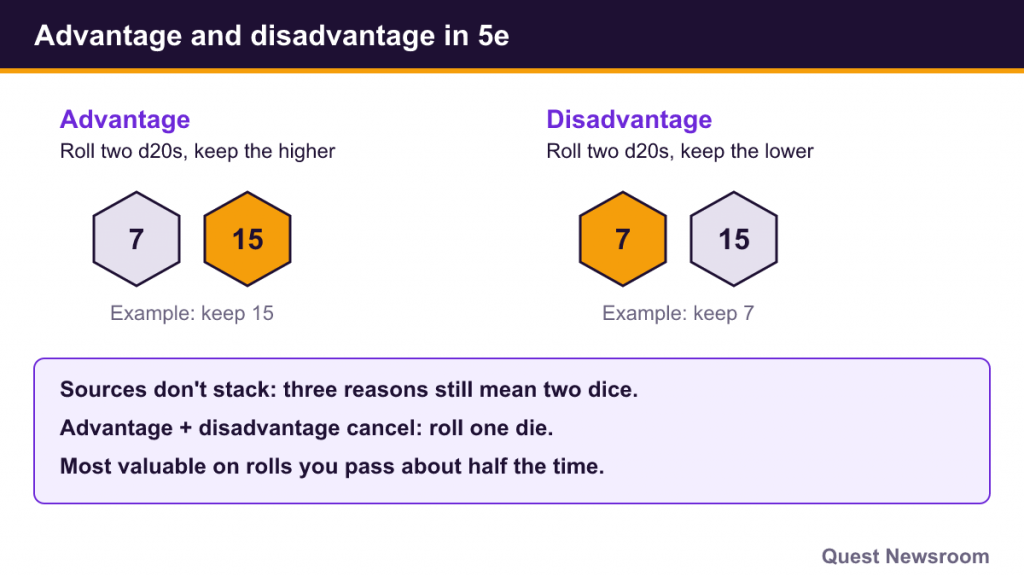
Advantage is most valuable on rolls you would succeed on about half the time. Common sources in Baldur’s Gate 3 include attacking a prone or restrained target, attacking while hidden, spells such as Faerie Fire and Guiding Bolt, and the Barbarian’s Reckless Attack, which grants advantage at the cost of giving enemies advantage against you.
Disadvantage tends to come from fighting while blinded, attacking at long range, being frightened or poisoned, or attacking a target you cannot see. Learning to stack the odds in your favor is the single biggest skill jump for new BG3 players.
Actions, Bonus Actions, Reactions and Movement
Every creature’s turn in 5e has a budget. In Baldur’s Gate 3 the budget appears as icons on the hotbar, and understanding it is the key to efficient fights.
- Action: your main thing for the turn, such as attacking, casting most spells, Dash, Disengage, Dodge, Help or Hide.
- Bonus Action: a smaller, second thing, available only when a feature or rule allows it. In tabletop 5e you can take only one per turn. Off-hand attacks with two light weapons, the Rogue’s Cunning Action and spells like Healing Word or Misty Step use it.
- Reaction: an instant response to a trigger, such as an opportunity attack when an enemy leaves your reach, or the Shield spell when you are hit. You get one per round.
- Movement: a number of feet (or meters, in BG3) you can move, which you can split before and after your action.
Extra Attack is one of the clearest examples of 5e progression. At level 5, martial classes such as Fighters, Paladins, Rangers and Barbarians make two attacks whenever they take the Attack action. It is why level 5 feels like a turning point.
Larian added extra uses for the bonus action. In Baldur’s Gate 3, Jump, Shove and drinking a potion are all bonus actions for every character. The bonus-action potion was a Larian house rule that the tabletop game later adopted.
Spell Slots, Cantrips and Concentration
Fifth edition magic uses spell slots. A spellcaster has a fixed number of slots of each spell level (1st, 2nd, 3rd and so on), and casting a leveled spell uses up a slot of that level or higher. Casting with a higher slot than required, known as upcasting, often makes a spell stronger.
Cantrips are minor spells that cost no slot and can be cast every turn. Their damage scales with character level rather than slot level. In tabletop 5e, cantrip damage increases at levels 5, 11 and 17. Because BG3 stops at level 12, Larian moved the second upgrade to level 10, so players actually get to see it.
Concentration is the main brake on stacking powerful effects. Many buffs and control spells, such as Bless, Hold Person and Haste, require concentration. You can concentrate on only one spell at a time, and taking damage forces a Constitution saving throw to keep it going. BG3 also ends concentration if the caster is knocked prone. Protecting your concentrating caster and breaking enemy concentration are both strong tactics.
Larian also trimmed bookkeeping: prepared casters such as Clerics, Druids and Wizards can swap prepared spells freely outside combat, and any caster can cast ritual spells without using a slot.
Short Rests, Long Rests and Camp Supplies
On the tabletop, a short rest lasts about an hour and lets characters spend Hit Dice to recover hit points, while a long rest lasts about eight hours and restores hit points and most resources, including spell slots.
BG3 translates this into a camp system:
- Short rests: the party gets two per long rest. Instead of rolling Hit Dice, each short rest restores half of each character’s maximum hit points. Short-rest class resources, such as the Warlock’s spell slots and the Fighter’s Action Surge, also come back.
- Long rests: you travel to camp. A full long rest requires camp supplies, which are food and drink items found in the world. Without enough supplies, you can only take a partial rest that restores fewer resources.
The camp system also turned resting into a story beat, since many companion scenes only happen there.
Where Larian Changed the Rules
Larian treats its adjustments as house rules, the way a tabletop group might tweak the book. The fan-maintained bg3.wiki keeps a detailed list; the most important general changes are:
| Rule | Tabletop 5e (2014) | Baldur’s Gate 3 |
|---|---|---|
| Level cap | 20 | 12 |
| Natural 20 / natural 1 on ability checks | No automatic success or failure | Natural 20 always succeeds, natural 1 always fails |
| Drinking a potion | Action | Bonus action |
| Shove and Jump | Part of the Attack action or movement | Bonus actions for everyone |
| High ground | No general rule | +2 to ranged attacks from at least 10 ft above, -2 from below |
| Short rest healing | Spend Hit Dice | Restore half maximum HP, two per long rest |
| Multiclassing | Ability score minimums | No ability score requirements |
| Spell components | Verbal, somatic, material | Ignored |
Other changes include reduced darkvision ranges, an automatic Inspiration system tied to your character’s background, the ability to dip weapons in fire or poison surfaces as a bonus action, and reactions that refresh at the end of your turn. Many race and class features were also adjusted to fit the shorter level range.
Even the dice are adjusted: a Karmic Dice option, on by default, smooths out long streaks of very good or very bad rolls, and purists can switch it off. Note that under 5e rules a natural 1 still always misses an attack, so even a 95% hit chance fails about one swing in twenty.
Why the Translation Worked
Turn-based combat let Larian keep the core of fifth edition intact: the action economy, advantage and disadvantage, concentration and spell slots behave much as they do at a table. Where rules would have been tedious on a screen, Larian simplified them, and it added its own layer of verticality, surfaces and shoving. For readers who want to compare this approach with the older real-time-with-pause games, our article on RPG combat systems explains the trade-offs.
If you understand the d20 test, the turn budget and the rest cycle, you understand most of what Baldur’s Gate 3 asks of you.