RPG Glossary: Essential Terms Every Player Should Know
An A-to-Z glossary of RPG terms for single-player fans: aggro, AoE, buffs, builds, DPS, i-frames, kiting, NG+, procs, respecs, RNG, tanks and more.
RPG players speak a dialect of their own. Guides, forums and even in-game menus throw around terms like “aggro”, “proc”, “i-frames” and “NG+” as though everyone already knows them. This glossary defines the most common terms in plain language, with short examples, focused on single-player and small co-op role-playing games. Terms are grouped by letter so you can scan quickly.
A to C
Action points (AP). A per-turn budget spent on moving, attacking or using items in many turn-based games. In Fallout (1997), your agility affects how many action points you get.
Aggro. Short for aggression: which character an enemy is currently targeting. A “tank” tries to hold aggro so that fragile allies are not attacked. “Pulling aggro” means accidentally drawing an enemy’s attention.
AoE (area of effect). An attack or spell that affects everything in a zone rather than a single target. Fireball is the classic example. Watch for AoE that can hit your own party.
Archetype. A broad character role, such as warrior, rogue or mage. Many classes are variations on these.
ATB (Active Time Battle). A combat system introduced in Final Fantasy IV (1991) in which each character acts when a personal gauge fills in real time.
Attributes. Core character statistics such as Strength, Dexterity or Intelligence, from which other numbers are derived. See our full explainer on RPG character stats.
Backtracking. Returning to earlier areas, often with new abilities or keys that open previously blocked paths.
Bonfire. The checkpoint in Dark Souls, where you rest, heal, level up and respawn. The word is now used generically for checkpoints in soulslikes.
Boss. A powerful, usually unique enemy that guards the end of an area or story section. “Superbosses” are optional, extremely hard bosses.
Buff. A temporary positive effect, such as increased attack or faster speed. The opposite is a debuff.
Build. The overall combination of attributes, skills, equipment and abilities that defines how a character plays. “A strength build” focuses on heavy weapons; “a glass cannon build” maximizes damage at the expense of defense.
Cheese. Defeating an enemy with an unintended or exploitative tactic, such as attacking from a spot the boss cannot reach.
Class. A role or profession chosen for a character, which determines available abilities and often stat growth.
Companion. A party member with a personality, story and often an opinion of your choices. Many western RPGs track companion approval, which can unlock personal quests or lead a companion to leave.
Cooldown. The waiting time before an ability can be used again.
Crit (critical hit). An attack that deals extra damage, usually triggered randomly with a chance influenced by stats or gear.
CRPG. Computer role-playing game. Usually refers to PC-rooted, rules-heavy, party-based RPGs such as Baldur’s Gate.
D to H
Debuff. A temporary negative effect placed on a target: lowered defense, slowed speed, reduced accuracy.
DoT (damage over time). Damage applied repeatedly over several turns or seconds, such as poison, burning or bleeding.
DPS. Damage per second. Also used loosely for a character whose role is dealing damage (“the party needs more DPS”).
Dump stat. An attribute deliberately left low to invest elsewhere. Dumping Charisma in a dialogue-heavy RPG can lock you out of options, so dump with care.
Elemental weakness. An enemy’s vulnerability to a damage type such as fire, ice or lightning. Exploiting weaknesses is central to many JRPGs; in Persona 5, hitting a weakness grants an extra turn.
Encounter. A battle. “Random encounters” trigger unpredictably while you walk; “visible encounters” show enemies on the map so you can engage or avoid them.
Farming. Repeating an activity, such as defeating a specific enemy, to collect a particular item or resource.
Fast travel. Instantly moving to a previously discovered location, common in open-world RPGs.
Gambits. Programmable rules for party AI in Final Fantasy XII, combining a target, an action and a priority.
Glass cannon. A character who deals huge damage but cannot survive much. Fun and risky.
Grinding. Fighting repeatedly to gain experience or money, usually to overcome a difficulty spike. See our guide to experience points and leveling.
HP (hit points). A character’s health. At zero, the character falls.
Hybrid. A build or class that mixes roles, such as a fighter who also casts spells.
I to M
I-frames (invincibility frames). Brief moments during an action, typically a dodge roll, when your character cannot be hit. Mastering i-frames is key in action RPGs and soulslikes: you roll through an attack rather than away from it.
Inventory management. Handling limited carrying space or weight. Many western RPGs use a weight limit; many JRPGs allow nearly unlimited items.
Kiting. Staying out of an enemy’s reach while damaging it, usually with ranged attacks, so it chases you without landing blows.
Level. A measure of a character’s overall progression. Also used for areas (“a level 20 zone”).
Level cap. The maximum level a character can reach.
Level scaling. When enemies or loot adjust to the player’s level. The Elder Scrolls IV: Oblivion (2006) is a well-known example.
Loot. Items obtained from enemies, chests or quests. A “loot-driven” RPG, like Diablo, focuses on collecting ever-better gear.
Meta. The strategies or builds widely considered the most effective at a given time. In single-player games, the meta is optional; play what you enjoy.
Min-maxing. Maximizing strengths and minimizing irrelevant stats to create the most efficient character possible.
MP (magic points), mana or FP. The resource spent to cast spells or use special abilities.
N to R
NG+ (New Game Plus). Starting a new playthrough after finishing the game while keeping some progress, such as levels or items. Enemies are often tougher. Soulslikes typically increase difficulty with each cycle.
NPC (non-player character). Any character controlled by the game rather than the player: shopkeepers, quest givers, villagers.
Nuke. A very high-damage attack, typically a spell, used to defeat a target quickly.
One-shot. Defeating an enemy, or being defeated, in a single hit.
Party. The group of characters you control or travel with.
Permadeath. Permanent character death. In Fire Emblem‘s Classic mode, fallen units do not return.
Proc. When a random or conditional effect triggers: “my sword’s poison procced”. The term likely comes from “programmed random occurrence” or “procedure”, though its origin is debated.
Pull. Drawing one enemy or a small group toward your party, rather than engaging everything at once.
Quest. A task with a goal and a reward. The “main quest” drives the story; “side quests” are optional.
Respec. Resetting and redistributing a character’s attribute or skill points. Many modern RPGs allow it, often at a cost.
RNG (random number generator). The randomness behind hit chances, critical hits and item drops. “Bad RNG” means bad luck.
RTwP (real-time with pause). Combat that runs in real time but can be paused to give orders, as in Baldur’s Gate (1998).
S to Z
Scaling. In Souls-style games, how much bonus damage a weapon gains from a particular attribute, often shown as a letter grade.
Skill check. A test, usually hidden or rolled, that compares a character’s skill to a difficulty to see if an action succeeds, such as picking a lock or persuading a guard.
Skill tree. A branching set of abilities where some unlock only after others.
Soft cap. A point after which investing more in a stat gives smaller returns. Common in Souls-style games, though exact values vary by game and update.
Status effect. A condition such as poison, sleep, stun or silence that changes what a character can do.
Stagger. A state in which an enemy is briefly helpless or takes extra damage after being worn down. Final Fantasy XVI uses a Stagger meter.
Summon. Calling a creature or ally to fight alongside you, such as Final Fantasy‘s summons or Elden Ring‘s Spirit Ashes.
Support. A role focused on helping allies through healing, buffs and debuffs.
Tank. A durable character who absorbs damage and draws enemy attention to protect the party.
Turn-based. Combat in which participants act in sequence and time stops while you choose.
XP (experience points). Points earned from battles, quests or discoveries that lead to leveling up.
Zerg. Overwhelming an enemy with sheer numbers. Rare in single-player RPGs, but you may see it in co-op discussions.
Terms That Mean Different Things in Different Games
Some words are used inconsistently, which can confuse new players:
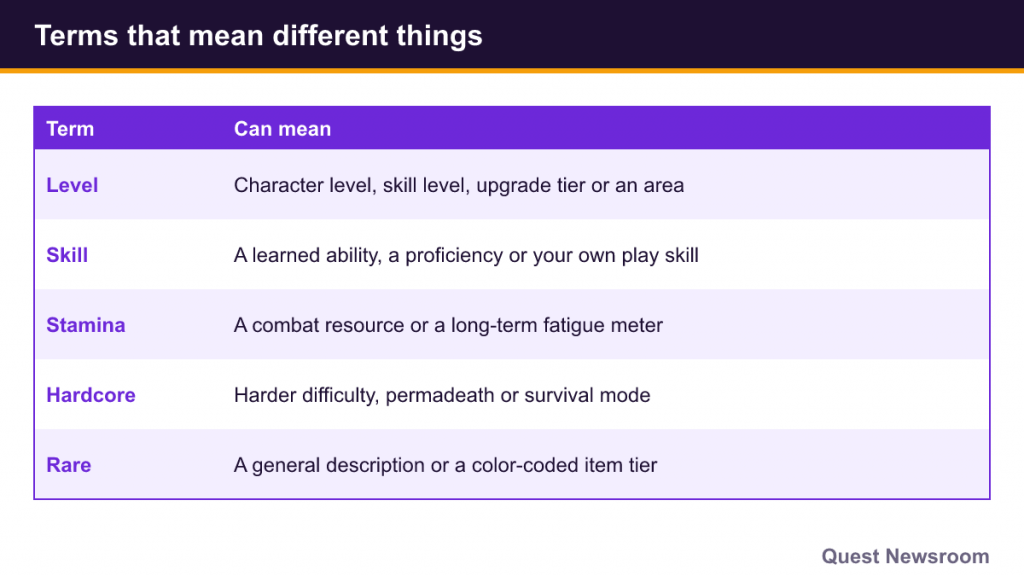
- “Level” can mean character level, skill level, weapon upgrade level or an area of the game.
- “Skill” may refer to a learned ability (like Fireball), a proficiency (like Lockpicking) or player skill (your own reflexes and decisions).
- “Stamina” is a combat resource in action RPGs, but in some games it is a long-term fatigue meter.
- “Hardcore” may mean a harder difficulty, a permadeath mode or a survival mode with hunger and fatigue.
- “Rare” can be a general description or a specific color-coded item tier.
When in doubt, check the in-game glossary or tooltip; most modern RPGs include one.
How to Use This Glossary
You do not need to memorize every term before you play. Keep this page handy while you start your first RPG, and look up words as they appear in tutorials or guides. Within a few hours, most of them will feel natural. If you are about to start a new game, our guide on choosing difficulty, class and your first build puts many of these terms into practice.