What Is an RPG? A Beginner’s Guide to Role-Playing Video Games
What makes a game an RPG? Character growth, stats, parties, quests and choice explained, plus the tabletop roots and the main branches of the genre.
“RPG” is one of the most widely used labels in gaming, and also one of the fuzziest. It gets stuck on everything from 100-hour fantasy epics to shooters that happen to have a skill tree. If you are new to the genre, that can make it hard to know what you are actually signing up for. This guide explains what a role-playing video game is, where the idea came from, and how the genre split into the families you will see on store pages today.
A Working Definition
A role-playing game is, at its core, a game about becoming someone and watching them grow. You take control of a character, or a group of characters, inside a fictional world, and the game tracks how that character changes over time. Most RPGs are built from a handful of recurring ingredients:
- Character progression. Your character gets stronger as you play, usually by earning experience points (XP) and gaining levels, by improving individual skills, or by finding better equipment.
- Stats. Numbers such as strength, agility or intelligence describe what your character is good at. They decide how hard you hit, how much damage you can take and which options are open to you.
- A party. Many RPGs let you lead several characters at once, each with a role: one soaks up damage, another heals, another deals damage from range.
- Quests. The game structures your adventure as tasks, typically a main storyline plus optional side quests.
- Story and choice. RPGs tend to put heavy weight on narrative. Some tell a fixed, authored story; others let your decisions change outcomes, relationships or endings.
- Items and inventory. Loot, gear, consumables and money are part of the loop of getting stronger.
Not every RPG has every ingredient. A game like Elden Ring has almost no party and very little dialogue, yet nobody doubts it is an RPG because character building through stats and gear sits at its heart. Meanwhile, plenty of action and shooter games borrow levels and skill trees without being RPGs in the full sense. A useful rule of thumb: if the game’s central question is “who is my character and how do they become more capable?”, you are probably playing an RPG.
The Tabletop Roots: Dungeons & Dragons
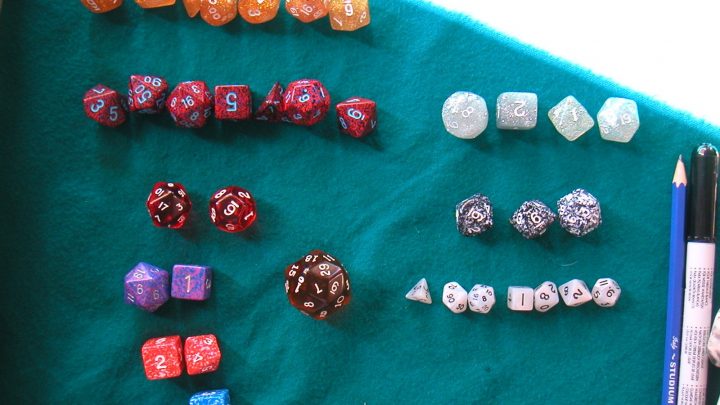
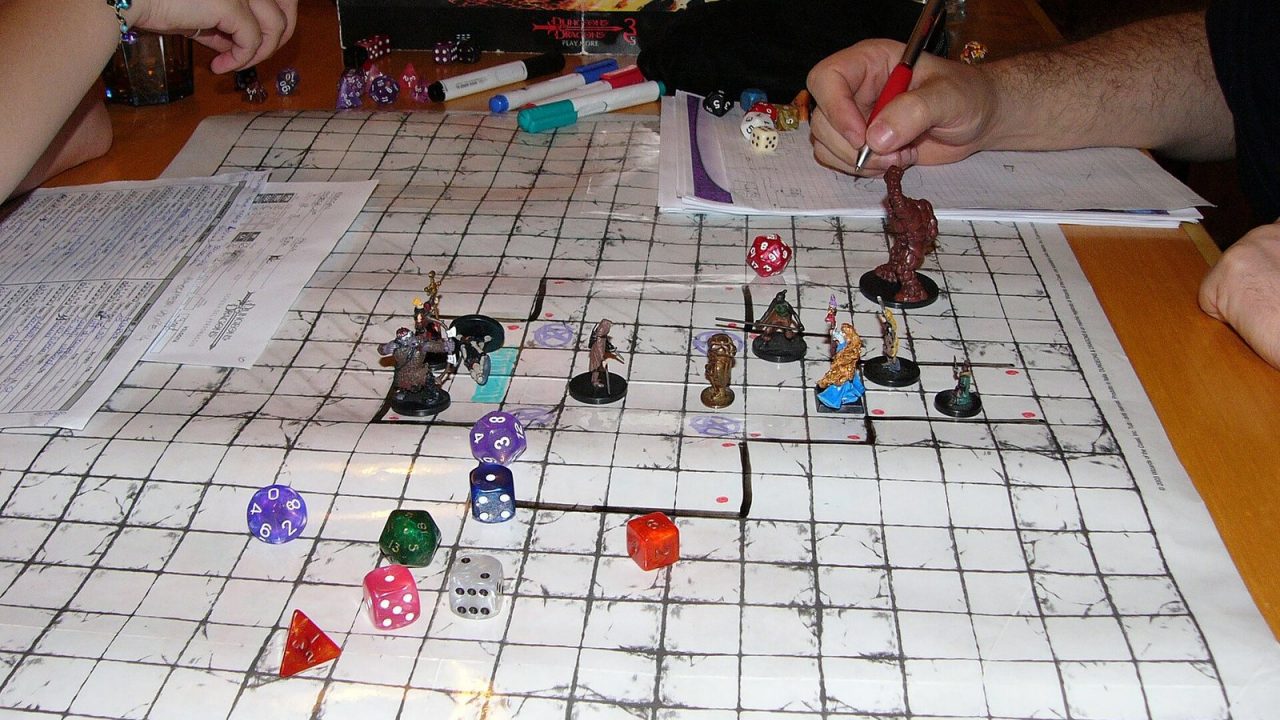
Role-playing video games grew directly out of tabletop role-playing. The landmark was Dungeons & Dragons, created by Gary Gygax and Dave Arneson and first published in 1974 by Tactical Studies Rules (TSR). D&D asked players to describe what their characters did while a referee, the Dungeon Master, described the world and resolved actions with dice and rules.
Almost every idea that defines computer RPGs was already present on the tabletop: ability scores, character classes such as fighter and magic-user, hit points, experience points and levels, treasure and dungeons. When programmers began writing games on university mainframes and early home computers in the 1970s, they essentially automated the Dungeon Master. The computer rolled the dice, tracked the numbers and drew the map, so a single player could explore alone.
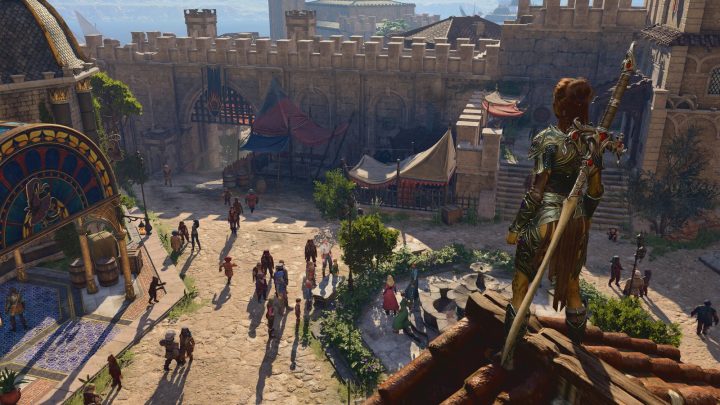
That heritage still shows. When a modern game asks you to choose between strength and dexterity, or gives you a “critical hit”, it is speaking a language that D&D made common. Baldur’s Gate 3 (2023) goes further and adapts D&D’s fifth edition rules directly.
Early Computer RPGs
Several experimental role-playing games ran on the PLATO educational network in the 1970s. One of them, Oubliette (1977), is cited as an influence on Wizardry. The genre reached a wide home-computer audience in the early 1980s through two series:
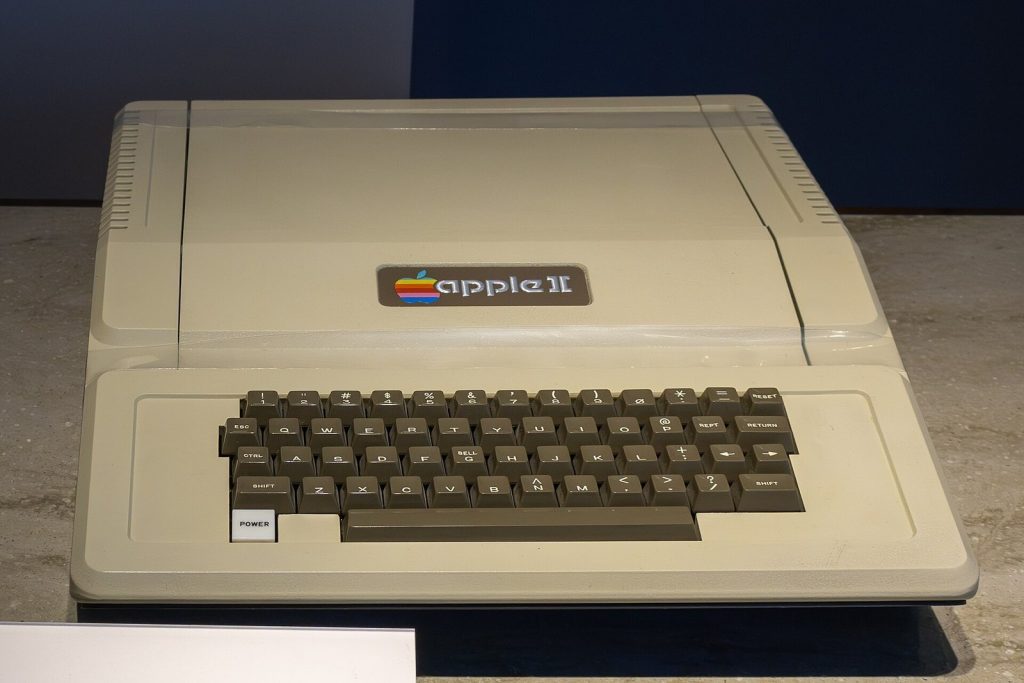
- Ultima by Richard Garriott, officially released in June 1981 for the Apple II. It combined a top-down overworld you could roam freely with first-person dungeons and is often described as one of the first open-world computer games. Garriott’s earlier hobby project Akalabeth was its precursor.
- Wizardry: Proving Grounds of the Mad Overlord, designed by Andrew C. Greenberg and Robert Woodhead and released by Sir-Tech in September 1981. It had you build a party of up to six adventurers and lead them through a first-person, ten-level maze that you had to map by hand.
These two games set templates that are still visible: Ultima for free exploration of a large world, Wizardry for party-based dungeon crawling. Both were also important in Japan, where they inspired Dragon Quest (1986) and, in turn, Final Fantasy (1987).
The Main Branches of the Genre
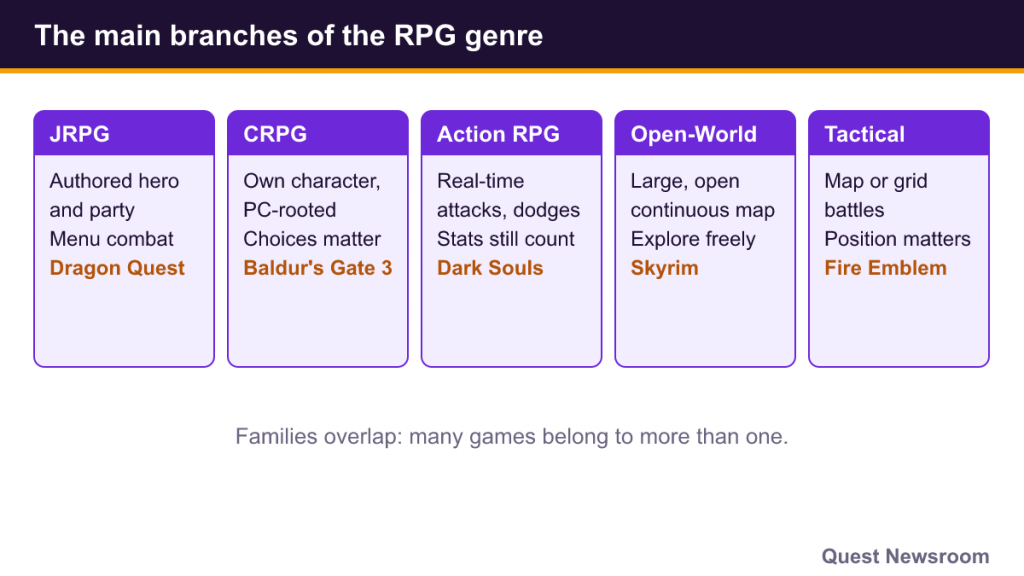
Over four decades, RPGs have split into several broad families. The boundaries overlap and many games belong to more than one, but the labels are still useful for knowing what to expect.
Japanese RPGs (JRPGs)
JRPGs usually follow a defined protagonist and party through an authored story, with distinct character designs, a strong musical identity and, traditionally, menu-driven combat. Dragon Quest, first released for the Famicom on May 27, 1986, created the template for console RPGs in Japan. Final Fantasy, Persona and the Tales of series are other cornerstones. The label describes a design tradition rather than a passport: some Japanese RPGs play very differently, and some non-Japanese studios make games in the JRPG style.
Western RPGs and CRPGs
Western RPGs often let you create your own character and emphasize branching choices, dialogue options and consequences. The term “CRPG” (computer role-playing game) is commonly used for the PC-rooted, rules-heavy branch, frequently viewed from an isometric angle. Examples include Fallout (1997), Baldur’s Gate (1998), Divinity: Original Sin II (2017) and Baldur’s Gate 3 (2023).
Action RPGs
Action RPGs move combat into real time: you control attacks, dodges and blocks directly, while stats and gear still matter underneath. The family ranges from loot-driven games like Diablo to the demanding “soulslike” style that FromSoftware popularized with Demon’s Souls (2009) and Dark Souls (2011).
Open-World RPGs
Open-world RPGs give you a large, continuous map and the freedom to explore it in almost any order. Bethesda’s The Elder Scrolls series, including Skyrim (2011), CD Projekt Red’s The Witcher 3: Wild Hunt (2015) and FromSoftware’s Elden Ring (2022) are the best-known examples.
Tactical RPGs
Tactical (or strategy) RPGs stage battles on a map, often a grid, where positioning, terrain and turn order matter as much as raw stats. Fire Emblem, Final Fantasy Tactics and Triangle Strategy (2022) are representative. In Japan this style is often called a “simulation RPG”.
How Combat Usually Works
Combat is the area where RPGs differ most, so it helps to recognize the main models before you buy:
- Turn-based: you and the enemies take turns choosing actions from menus. Time stops while you think. Classic Dragon Quest works this way.
- Active Time Battle: a Square innovation introduced in Final Fantasy IV (1991), where each character acts when a personal gauge fills, so speed matters and enemies do not wait forever.
- Real-time with pause: common in older CRPGs such as Baldur’s Gate; the battle runs in real time but you can pause at any moment to issue orders.
- Action: you control your character directly, as in Elden Ring.
- Hybrids: many modern games mix systems, like Final Fantasy VII Remake, which blends real-time action with an ATB gauge, or Clair Obscur: Expedition 33 (2025), which is turn-based but asks you to dodge and parry in real time during enemy turns.
None of these is “the real RPG”. They suit different temperaments: turn-based combat rewards planning, action combat rewards reflexes, and hybrids try to offer both.
Common Myths About RPGs
“RPGs are all about grinding”
Older games sometimes required you to fight the same enemies repeatedly to gain levels. Many modern RPGs are tuned so that following the story and doing some side content keeps you at a comfortable power level, and many include difficulty settings or experience boosters. The Final Fantasy Pixel Remasters, for example, added options for adjusting experience gains and encounter rates.
“You need to understand every number”
You do not. Most games explain their core stats in menus, and the majority are forgiving if you put points in sensible places. Understanding what a stat does helps, but obsessive optimization is optional.
“RPGs take hundreds of hours”
Some do. Others can be finished in a few dozen hours if you focus on the main story. Side content is usually optional, and it is fine to skip much of it.
“MMORPGs and RPGs are the same thing”
Massively multiplayer online RPGs share the vocabulary of levels and gear, but they are built around persistent online worlds shared with thousands of players. This site focuses on single-player (and small co-op) RPGs, where the story and the world are designed around you.
How to Pick Your First RPG
The best first RPG depends on what you already enjoy in other games:
- If you like stories and characters and do not want pressure on your reflexes, try a turn-based JRPG such as Dragon Quest XI S, which also offers an optional retro 2D mode.
- If you like making decisions and talking your way through problems, a CRPG like Baldur’s Gate 3 or Divinity: Original Sin II will reward you. Both use turn-based combat, so you can take your time.
- If you love exploring, start with an open-world game like Skyrim or The Witcher 3.
- If you enjoy challenging action games, an action RPG suits you, and a soulslike may become a favorite once you accept that dying is part of the learning process.
- If you like chess-style thinking, a tactical RPG such as Fire Emblem: Three Houses (2019) lets you turn off permanent character death with its Casual mode while you learn.
Whatever you choose, read the game’s tutorials, check its difficulty options and do not be afraid to lower the difficulty if the game stops being fun. Every RPG fan started somewhere, and most of the genre’s best games are designed to teach you as you go.
Key Terms to Know Before You Start
A few words appear in almost every RPG:
- HP (hit points): how much damage a character can take before falling.
- MP (magic points) or mana: the resource spent on spells and abilities.
- XP (experience points): the currency of progression, earned from battles or quests.
- Class: a role or profession such as warrior, rogue or mage that shapes your abilities.
- Buff and debuff: temporary effects that strengthen allies or weaken enemies.
- Party: the group of characters you control or travel with.
Learn those, and you can follow the tutorial of nearly any role-playing game. The rest of the genre’s vocabulary comes naturally as you play.