How Experience Points and Leveling Work in RPGs
XP curves, level-ups, skill trees, use-based growth, milestone leveling and level scaling: how RPG progression systems work and why they differ.

The level-up jingle is one of the most satisfying sounds in gaming. It is also the visible tip of a surprisingly varied set of systems. Some RPGs reward you for every enemy defeated, some for the skills you use, some for story milestones, and some quietly adjust the world to match your strength. This guide explains how experience points and leveling work, the main alternatives, and the trade-offs designers face.
Experience Points: The Basic Loop
Experience points, or XP, are a running score of how much your character has accomplished. You earn XP by defeating enemies, completing quests, discovering locations or solving problems. When your total crosses a threshold, you gain a level, and your character becomes more capable.
The concept comes straight from tabletop Dungeons & Dragons, first published in 1974. In D&D, characters earn experience mainly by defeating enemies or completing difficult tasks, and enough XP advances them a level, unlocking improved class features and abilities. Early computer RPGs automated this bookkeeping, and the idea became a near-universal part of the RPG toolkit.
What a level-up gives you varies by game, but common rewards include:
- Higher maximum HP and MP.
- Automatic increases to attributes such as strength or magic.
- Points to spend on attributes, skills or talents.
- New spells, abilities or class features.
- Access to better equipment or areas gated by level.
XP Curves: Why Each Level Takes Longer
In almost every RPG, the XP needed for the next level grows as you level up. This is called the experience curve. Designers use rising curves for two reasons. First, stronger characters defeat enemies faster and fight tougher enemies that give more XP, so a rising requirement keeps the pace of level-ups steady. Second, the curve naturally slows progress if you linger in easy areas: weak enemies give little XP relative to your next threshold, which discourages spending hours farming early zones.
Curves can be linear, polynomial or exponential, and many games hand-tune their tables. The practical effect for players is the same: early levels come quickly, which makes the opening hours feel rewarding, while later levels arrive at a slower, more meaningful rhythm.
Stat Growth: Automatic vs. Player-Assigned
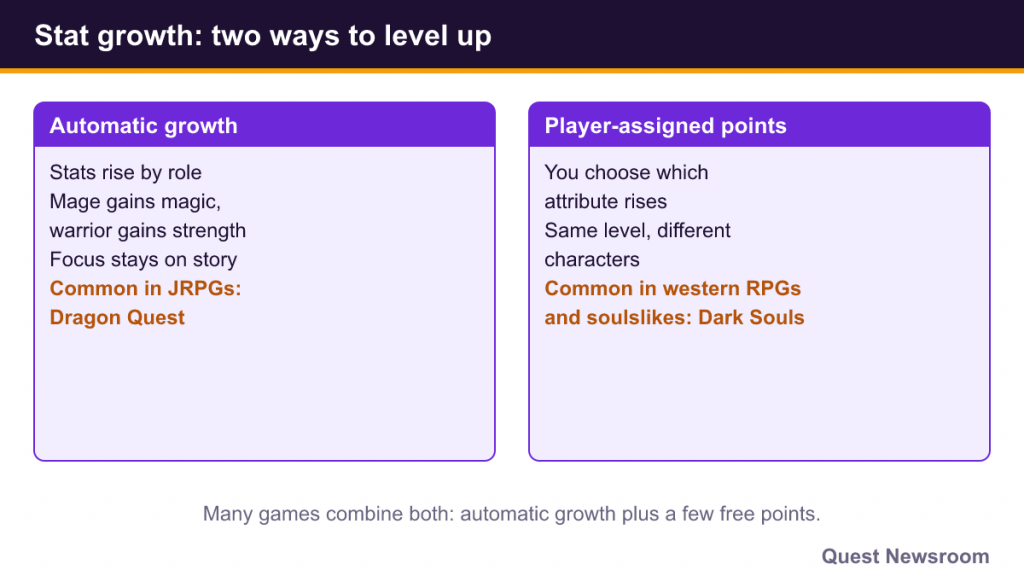
When you level up, your stats can grow in two ways.
Automatic growth
Many JRPGs raise each character’s stats automatically, according to their role. A mage gains more magic, a warrior more strength. This keeps the focus on story and combat decisions rather than spreadsheets, and it ensures every party member stays useful. Dragon Quest traditionally works this way, although later entries add skill point systems on top.
Player-assigned points
Many western RPGs and action RPGs give you points to distribute. In soulslikes such as Dark Souls, every level is bought with the same currency you also spend in shops, and you choose which attribute rises. This makes leveling part of character building: two players at the same level can have entirely different characters.
Many games combine the two, with automatic base growth plus a smaller number of free points.
Skill Trees and Talent Systems
A skill tree is a menu of abilities arranged so that some unlock only after others. Each level-up (or a separate skill point currency) lets you pick a node. Trees let you specialize in a particular style, such as archery, fire magic or stealth, and they create meaningful decisions because points are limited.
The Elder Scrolls V: Skyrim (2011) is a famous example: each of its skills has its own perk tree, and every character level grants a perk point you can spend immediately or save for later. Final Fantasy XII‘s License Board and the Sphere Grid in Final Fantasy X are grid-based variants that let characters drift into each other’s specialties.
Alternatives to Classic XP
Use-based progression
Instead of gaining abstract XP, you improve what you actually do. Swing a sword often and your sword skill rises; cast spells and your magic grows.
- Final Fantasy II (1988) introduced an activity-based progression system to the series. Later Final Fantasy games dropped it, but the idea lived on.
- The SaGa series, created by Akitoshi Kawazu and beginning with Makai Toushi Sa·Ga (1989, released in North America as The Final Fantasy Legend), used a non-level-based, individualized growth system. In Romancing SaGa 3, character development depends on the commands you use in battle, so frequent spellcasting raises magical power.
- The Elder Scrolls moved away from plain XP early. Arena (1994) used experience from killing monsters, but Daggerfall, Morrowind and Oblivion used skill-based advancement, leveling the character once a set of skills had been developed. In Skyrim, each skill has its own experience bar that fills as you use it, and enough skill increases raise your overall level.
Use-based systems feel natural and reward role-playing, but they can be exploited, for example by jumping repeatedly to raise an athletics skill, and they can level your character in directions you did not intend.
Milestone leveling
Some games skip XP entirely and grant levels at story milestones: finish a chapter, gain a level. Many tabletop groups play this way too. Milestones guarantee the party is the right strength for each part of the story, at the cost of removing the reward for optional fights. Video games often use a hybrid: XP from quests rather than kills, so exploration and dialogue are rewarded as much as combat.
Level Scaling: When the World Levels With You
Level scaling adjusts enemies, and sometimes loot, to match the player’s level. It solves a real problem in open worlds: if players can go anywhere, how do you keep every area interesting?
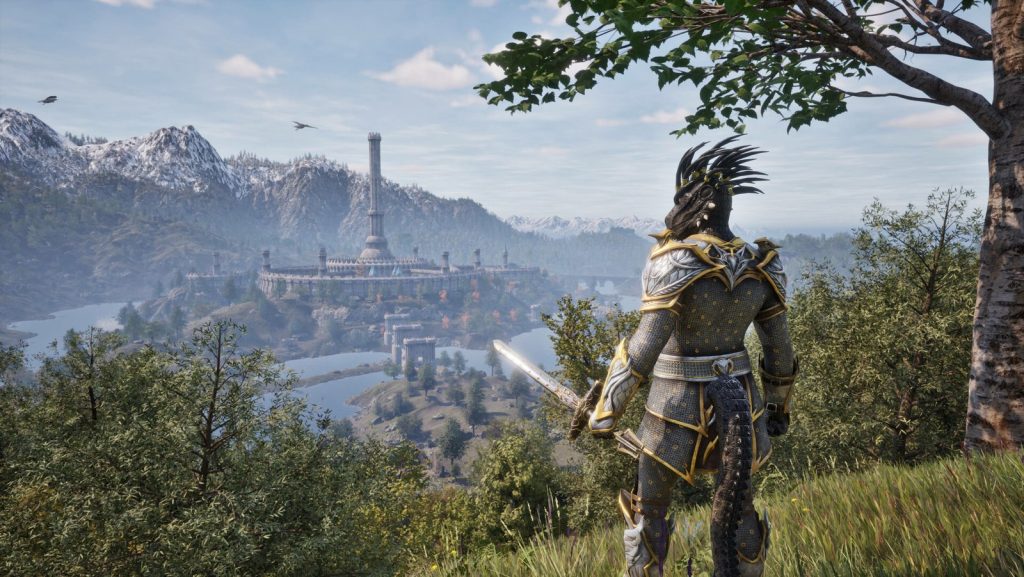
The Elder Scrolls IV: Oblivion (2006) is the most discussed example. The player levels up after improving their major skills by a combined ten points, and enemies grow stronger while looted weapons and armor become more effective as the player levels. The goal was steady, moderate difficulty. In practice, critics noted that major skills such as athletics could rise involuntarily, so a character might level quickly without becoming better at fighting, and find enemies disproportionately harder. Reviewers also criticized enemies scaling to the player’s level rather than their combat ability.
Modern games often use softer approaches:
- Zone-based levels: each region has a fixed level range, so returning to early areas makes you feel powerful.
- Partial scaling: enemies scale within a minimum and maximum range.
- No scaling: the world is fixed, and the player must judge where they are ready to go. Elden Ring (2022) leans this way, letting players leave a difficult area and return later.
Grinding: Friend or Foe?
“Grinding” means fighting repeatedly, usually the same enemies, to gain levels or items. It became infamous in older JRPGs where difficulty spikes demanded extra levels. Grinding can be a useful safety valve: if a boss is too hard, a few extra levels may help. But mandatory grinding is widely seen as padding.
Modern RPGs reduce grinding in several ways: better-tuned XP curves, catch-up mechanics that give extra XP to under-leveled characters, shared XP for benched party members, and adjustable options. The Final Fantasy Pixel Remasters (2021-2022 on PC and mobile) eventually added experience multipliers and encounter rate controls, letting players decide how much grinding they want.
Level Caps, Respecs and Endgame Progression
Most RPGs have a maximum level, the level cap. Reaching it can take the whole game or only part of it, depending on design. Some games set a low cap so every level feels significant; others set a high cap that only dedicated players reach. Skyrim‘s 2013 update added “Legendary” skills, which let you reset a maxed skill to keep leveling, effectively removing the cap.
When leveling decisions are permanent, mistakes can hurt. That is why many modern RPGs include a respec option, letting you refund and reassign points, often for a fee or using a rare item. If a game has a respec system, it is worth experimenting freely in the early hours. If it does not, a balanced approach is safer until you understand the systems.
After the level cap, progression usually shifts to other systems: better equipment, optional bosses, New Game Plus or post-game challenges. In soulslikes, for example, character level matters less late in the game than weapon upgrades and player skill.
One more design choice is worth knowing: whether party members outside the active group still earn experience. Some games share XP with everyone so the whole roster stays usable; others give it only to fighters, which rewards rotating your lineup. Checking this early prevents unpleasant surprises when the story forces you to use a character you have neglected.
Tips for Players
- Do side quests early. They are often the most efficient source of XP and keep you ahead of the curve without grinding.
- Read what your level-up actually gave you. New abilities can change how you should fight.
- In use-based systems, play naturally. Trying to game the system can create a character who levels without becoming stronger.
- Check whether the game scales. In a heavily scaled world, building a focused, efficient character matters more than raw level.
- Do not fear lower difficulty. It is often a better solution to a difficulty spike than hours of grinding.
Leveling systems are ultimately about pacing and reward. The best ones make you feel stronger at the right moments, while still leaving room for the next challenge. For more on how combat pacing interacts with progression, see our guide to RPG combat systems.