Final Fantasy Series History: Every Mainline Game in Context
From Final Fantasy I in 1987 to XVI and the FF7 Remake trilogy: every mainline game in context, the story behind the name, and how combat evolved.
Few series have reinvented themselves as often as Final Fantasy. Each numbered entry has its own world, characters and systems, yet all share recurring elements: crystals, chocobos, moogles, a character named Cid and a commitment to big, emotional storytelling. This history walks through every mainline game from 1987 to the present, explaining what each one changed and where the Final Fantasy VII Remake project stands as of October 2026.
The Origin and the Name
The first Final Fantasy was released in Japan on December 18, 1987, for the Famicom (NES). It was created by Hironobu Sakaguchi at Square, who directed the first five games and later served as producer until he left Square in 2001.

The famous name has a well-known backstory, though not quite the one often repeated. Sakaguchi has described the first game as a personal last-ditch effort: if it had failed, he said he would have quit the industry and gone back to college. The team originally wanted the title “Fighting Fantasy”, but a gamebook series already used that name, so they changed it. “Final” was a familiar English word in Japan, and Sakaguchi has said any title that abbreviated to “FF” would have worked. The game succeeded, and the “final” fantasy became the start of a franchise that passed 200 million copies sold by March 2025.
The 8-Bit and 16-Bit Era (I-VI)
Final Fantasy (1987)
Four Light Warriors, a party you build from classes such as Fighter, Thief and Black Mage, and a quest to restore elemental crystals. It established turn-based combat viewed from the side, with the party facing enemies on a separate battle screen, and drew on the computer RPGs that had already influenced Dragon Quest a year earlier.
Final Fantasy II (1988)
A darker story about rebels fighting an empire, with named characters and a use-based progression system: characters improve the skills and stats they actually use rather than gaining levels through experience points. Later Final Fantasy games dropped the system, but Square’s SaGa series expanded it.
Final Fantasy III (1990)
The last Famicom entry introduced a flexible job system, letting characters switch between classes, an idea the series returned to many times.
Final Fantasy IV (1991)
The first Super Famicom game, released in Japan on July 19, 1991, debuted the Active Time Battle (ATB) system designed by Hiroyuki Ito, in which characters act when their individual gauges fill. It also put a stronger focus on a defined cast and dramatic story, following the dark knight Cecil. In North America it was released as Final Fantasy II, because the first two Famicom sequels had not been localized there.
Final Fantasy V (1992)
Brought back and deepened the job system, letting characters combine abilities from different jobs. Its systems remain influential; the battle designers of Final Fantasy XVI later cited V‘s mechanics as a basis for their combat.
Final Fantasy VI (1994)
The last 2D mainline game featured a large ensemble cast, a steampunk-influenced world and one of the series’ most memorable villains. Its opera house sequence is a famous example of how the series used music to tell its story.
The PlayStation Revolution (VII-IX)
Final Fantasy VII (1997)
Released in Japan on January 31, 1997, and in North America that September, VII was the first mainline entry with 3D graphics, using 3D character models over pre-rendered backgrounds. Development moved from a planned SNES game to Sony’s PlayStation, largely because CD-ROMs offered far more storage than Nintendo 64 cartridges. The story of Cloud Strife, the eco-terrorist group Avalanche and the villain Sephiroth became a global phenomenon. Its Materia system let players slot orbs into equipment to customize spells, summons and abilities.
VII is widely credited with helping console RPGs reach mass-market appeal outside Japan. The original version alone had sold over 15.3 million copies as of September 2025. It also grew into a multimedia “Compilation of Final Fantasy VII”.
Final Fantasy VIII (1999)
Moved to realistically proportioned characters and a military academy setting, built around a romance between Squall and Rinoa and an unusual “junction” system for attaching magic to stats.
Final Fantasy IX (2000)
Conceived as a retrospective, it returned to a medieval fantasy world and drew heavily on the original Final Fantasy, with references throughout the series. It was the last mainline game to use ATB in its classic form.
A New Century of Experiments (X-XV)
Final Fantasy X (2001)
Released on PlayStation 2 on July 19, 2001, in Japan, X was the first Final Fantasy with voice acting. It replaced ATB with the Conditional Turn-Based Battle system, which pauses during each turn and shows the upcoming turn order, and introduced the Sphere Grid for character growth. It also spawned the series’ first direct sequel, X-2.
Final Fantasy XI (2002)
The series’ first massively multiplayer online game, launched on PlayStation 2 and PC. It introduced real-time battles in place of random encounters.
Final Fantasy XII (2006)
Set in the world of Ivalice, it introduced the Active Dimension Battle system: real-time, seamless fights with enemies visible on the field. Players control party behavior with “Gambits”, rules that combine a target, an action and a priority. The 2017 remaster The Zodiac Age added a job system with twelve license boards.
Final Fantasy XIII (2009)
Released for PlayStation 3 and Xbox 360, it featured a fast, role-switching battle system and a famously linear structure in its first half, which divided players. It spawned two sequels.
Final Fantasy XIV (2010)
The second MMORPG launched on Windows to heavy criticism, then was relaunched as A Realm Reborn in 2013 and became a long-running success. As an online game, it falls outside the scope of this site.
Final Fantasy XV (2016)
A road-trip story about Prince Noctis and his three friends, released for PlayStation 4 and Xbox One. It moved to real-time action combat in a large open world.
Final Fantasy XVI and the Action Era
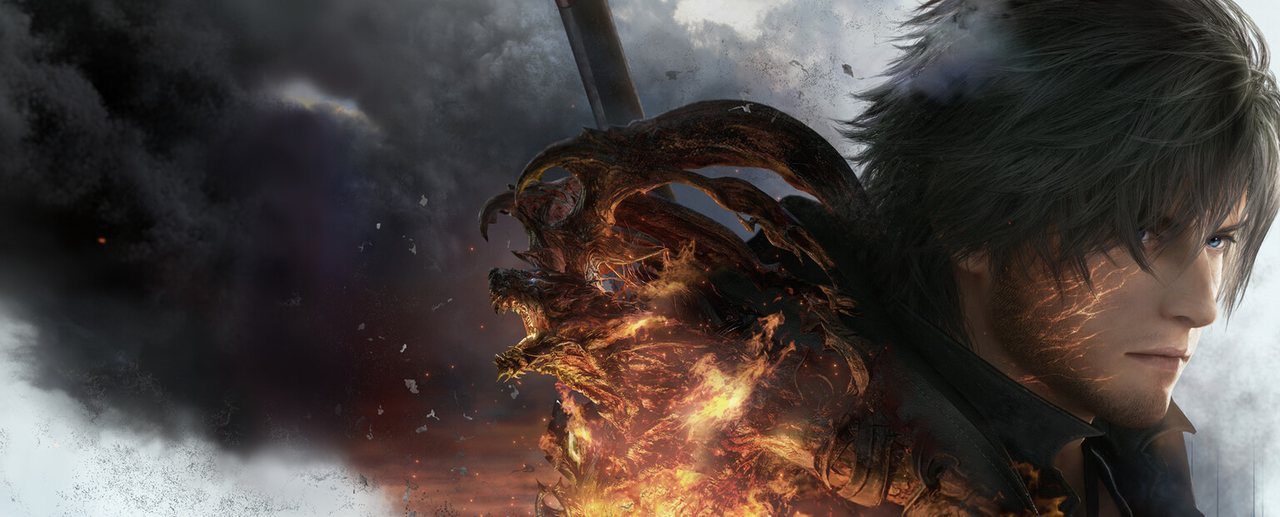
Final Fantasy XVI launched worldwide on PlayStation 5 on June 22, 2023, followed by Windows on September 17, 2024, and Xbox Series X/S on June 8, 2025. It is a darker, more mature story centered on Clive Rosfield and the “Eikons”, powerful summoned beings. Combat is fully real-time: you control only Clive, chaining attacks, dodges and Eikon abilities, while allies are AI-controlled. Its battle director, Ryota Suzuki, previously worked on Devil May Cry. For players less comfortable with action, a Story mode offers accessories that simplify combat. Two expansions followed: Echoes of the Fallen (December 2023) and The Rising Tide (April 2024).
The Final Fantasy VII Remake Project
Rather than a straightforward remaster, Square Enix chose to rebuild Final Fantasy VII as a multi-part series.
- Final Fantasy VII Remake launched on PlayStation 4 on April 10, 2020. It covers only the opening Midgar section of the original, expanded into a full game with real-time action combat built around an ATB gauge. The enhanced Intergrade version followed on PlayStation 5 (June 2021) and Windows (December 2021), and on Nintendo Switch 2 and Xbox Series X/S on January 22, 2026.
- Final Fantasy VII Rebirth released on PlayStation 5 on February 29, 2024, on Windows on January 23, 2025, and on Switch 2 and Xbox Series X/S on June 3, 2026. It opens up the world beyond Midgar, with large explorable regions and a “Synergy” system for combined attacks.
- Final Fantasy VII Revelation, the third and final part, was announced at Summer Game Fest in June 2026. As of October 2026, it is scheduled for spring 2027 on PlayStation 5, Xbox Series X|S, Nintendo Switch 2 and PC.
The remakes are not a scene-by-scene reproduction. Their story adds new characters and plot developments, and it deliberately plays with fans’ expectations of the 1997 original. Players can enjoy them without knowing the original, but they gain extra meaning if you do.
How Combat Evolved: A Summary
| Era | Games | Combat model |
|---|---|---|
| Classic turn-based | I-III | Menu-based turns |
| Active Time Battle | IV-IX | Real-time gauges with menus |
| Conditional Turn-Based | X | Turn order shown, time stops |
| Seamless real-time with AI rules | XII | Active Dimension Battle and Gambits |
| Action and hybrids | XV, XVI, VII Remake series | Real-time action, some with ATB elements |
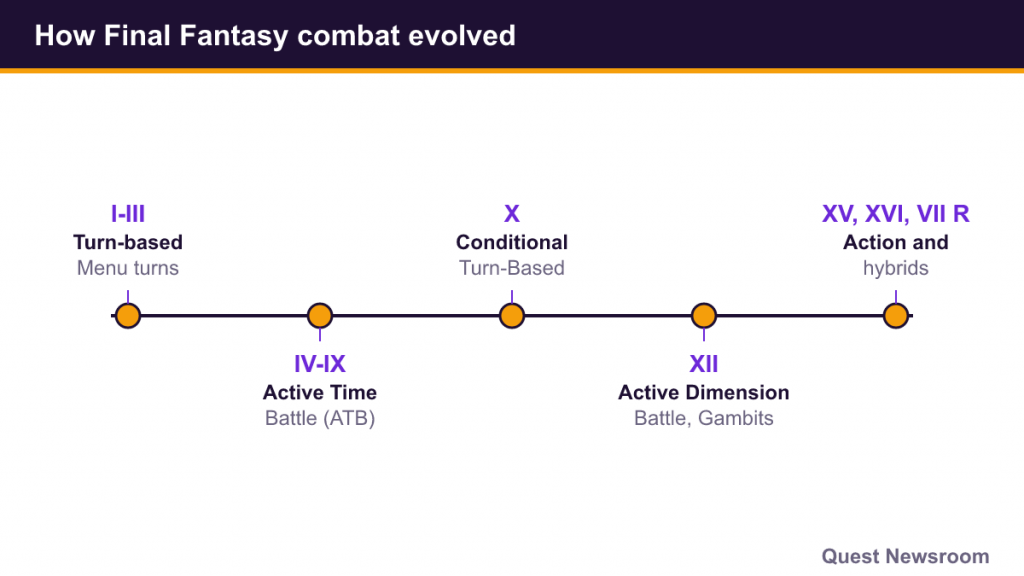
The table shows a long journey from menus toward action, but the series never fully abandoned its roots. The Remake games keep an ATB gauge at the heart of their combat. For an explanation of these combat families across the whole genre, see our guide to RPG combat systems.
What Ties the Series Together
Since almost every mainline game has its own world, what makes something feel like Final Fantasy? Fans usually point to recurring creatures and names (chocobos, moogles, Cid, Bahamut and other summons), crystals as a motif, airships, classic spells such as Fire, Blizzard and Cure, an emphasis on music, originally led by composer Nobuo Uematsu, and an appetite for reinvention. That last trait is the most important. Final Fantasy has always been a series where each team gets to redefine what the next game should be, which is why fans debate rankings so passionately. It is also why the series has stayed at the center of the JRPG tradition for nearly four decades.