What Is a CRPG? Computer Role-Playing Games Explained
CRPG explained: the PC-rooted, rules-heavy, party-based branch of RPGs, from Ultima and Wizardry to Fallout, Baldur's Gate and Baldur's Gate 3.
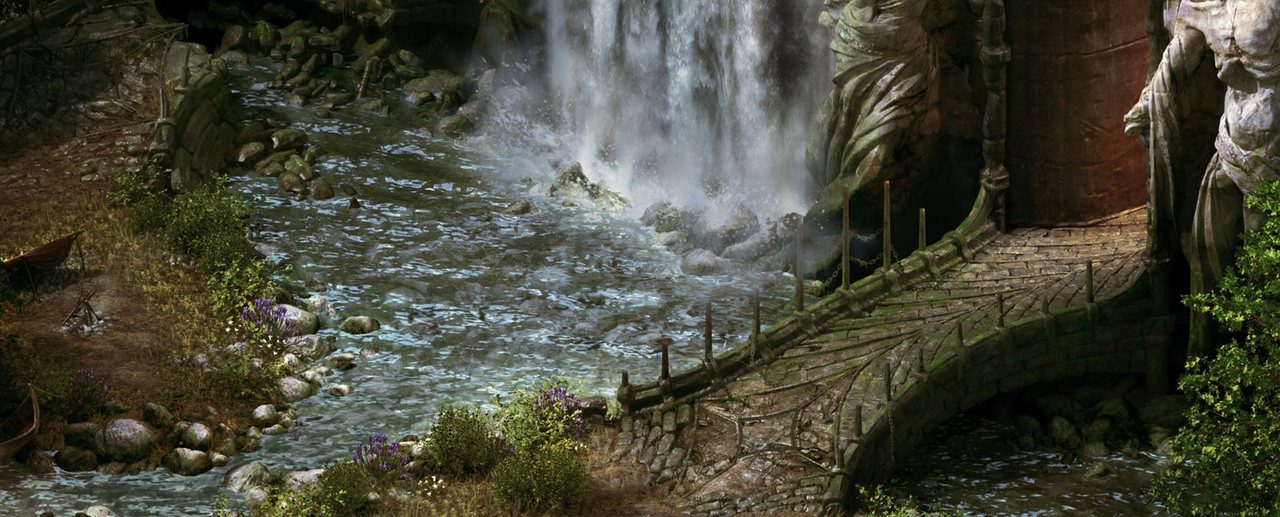
“CRPG” literally means “computer role-playing game”, which sounds like it should cover every RPG ever made. In practice, players use it for something much more specific: a style of RPG that grew up on personal computers, leans heavily on tabletop-style rules, usually shows the world from a high, angled camera and puts dialogue and character systems front and center. If you have heard people describe Baldur’s Gate 3 or Divinity: Original Sin II as CRPGs and wondered what that means, this is the explainer for you.
What People Mean by “CRPG”
There is no official definition, but games described as CRPGs usually share most of these traits:
- PC roots. The tradition was born on home computers in the late 1970s and 1980s and kept its identity on Windows PCs, even though many modern CRPGs also come to consoles.
- Rules-heavy systems. Attributes, skills, feats, spell lists, saving throws and dice rolls, often directly adapted from tabletop systems like Dungeons & Dragons or Pathfinder.
- Party-based play. You usually control a group of characters, either created by you or recruited as companions.
- An isometric or top-down view. The classic look is a high camera angle over a detailed map, which makes tactical positioning readable. This is common rather than essential.
- Deep dialogue and choice. Conversations branch, skills and attributes unlock dialogue options, and quests can often be solved in more than one way.
- Tactical combat. Fights reward positioning, preparation and smart use of abilities more than reflexes.
The term also has a cultural meaning: it describes the western, PC-centered branch of the genre, as opposed to the console RPG traditions discussed in our JRPG vs. western RPG comparison.
The Founders: Ultima and Wizardry
Two series laid the foundation in 1981. Richard Garriott’s Ultima, officially released in June 1981 for the Apple II, combined a top-down overworld with first-person dungeons and is often described as one of the first open-world computer games. Sir-Tech’s Wizardry: Proving Grounds of the Mad Overlord, designed by Andrew C. Greenberg and Robert Woodhead and released in September 1981, had players build a party of up to six characters and explore a ten-level maze in first person. It drew on earlier role-playing games on the PLATO network, most notably Oubliette (1977).

From Ultima, CRPGs inherited the idea of a world to explore and a story with moral weight. From Wizardry, they inherited the custom party, class system and detailed combat math. Both influences still run through the genre, and both series were important enough to inspire Japanese developers too, including the creators of Dragon Quest.
Gold Box, Fallout and the Infinity Engine
Through the late 1980s, licensed Dungeons & Dragons games such as Pool of Radiance (1988) brought official tabletop rules to computers, and Wasteland (1988) showed that the formula worked outside fantasy. The late 1990s produced the games most people still picture when they hear “CRPG”:
- Fallout (1997). Released by Interplay on October 10, 1997, it was originally built on Steve Jackson Games’ GURPS tabletop system. When the license was dropped in March 1997, the team created its own SPECIAL system: seven attributes (Strength, Perception, Endurance, Charisma, Intelligence, Agility, Luck). Combat is turn-based, with action points spent on moving, attacking and reloading.
- Baldur’s Gate (1998). Developed by BioWare and published by Interplay through its Black Isle Studios division, it shipped on December 21, 1998. It adapted Advanced Dungeons & Dragons 2nd edition rules and introduced the Infinity Engine.
- The Infinity Engine family. The same engine powered Planescape: Torment (1999), famous for its writing, Icewind Dale (2000), and Baldur’s Gate II: Shadows of Amn (2000), followed by Icewind Dale II (2002).
Beamdog later modernized several of these games as Enhanced Editions between 2012 and 2017, which is the easiest way to play them today.
Decline and Revival
In the 2000s, big-budget RPGs moved toward 3D, consoles and real-time action, and the isometric, text-heavy CRPG became rare. Crowdfunding brought it back. Obsidian Entertainment launched the Kickstarter campaign for Pillars of Eternity on September 14, 2012, and the game released on March 26, 2015, as a deliberate return to Infinity Engine-style real-time-with-pause party combat. Larian Studios’ Divinity: Original Sin II, also crowdfunded, reached its $500,000 Kickstarter goal in under 12 hours and exceeded $2 million; it fully released on September 14, 2017.
The revival peaked with Baldur’s Gate 3, which Larian released on Windows on August 3, 2023, followed by PlayStation 5 on September 6, 2023, macOS later that month and Xbox Series X/S on December 7, 2023. Adapted from D&D‘s fifth edition with turn-based combat, it won Game of the Year at The Game Awards 2023 and, by April 2024, became the first game to win Game of the Year at all five major award ceremonies. A genre once considered niche had produced one of the most celebrated games of its decade.
Combat Styles: Turn-Based vs. Real-Time With Pause
CRPG combat comes in two main flavors.
Turn-based
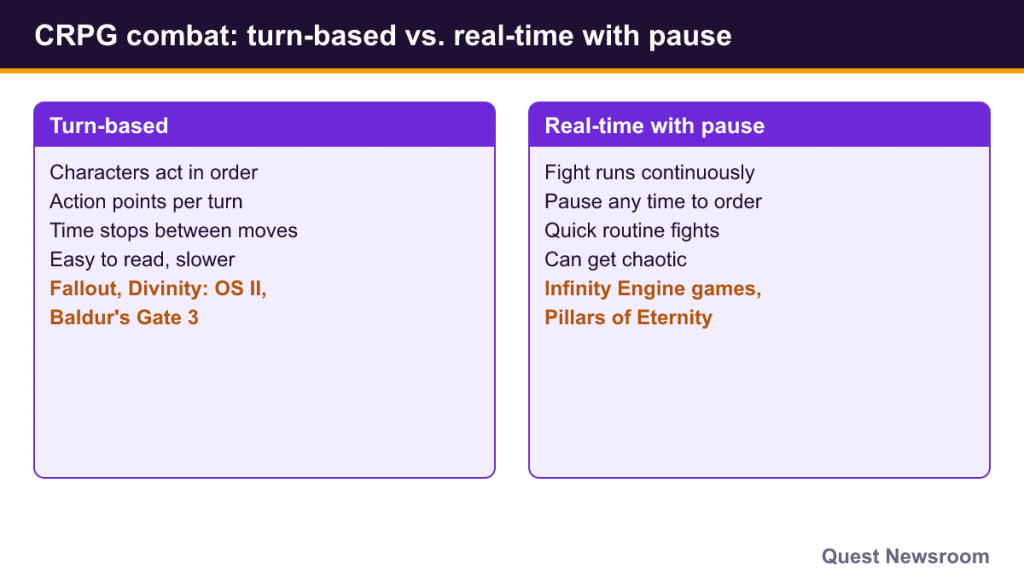
Each character acts in order, typically spending action points or a set of actions per turn. Time stops between moves, so you can plan carefully. Fallout used action points; Divinity: Original Sin II uses an action-point system plus elemental surfaces such as water, ice, oil and fire that can be combined; Baldur’s Gate 3 follows fifth edition’s action and bonus action structure. Turn-based combat is easier to read and rewards careful positioning, at the cost of slower battles.
Real-time with pause (RTwP)
The fight plays out continuously, but you can pause at any time to give orders to every party member. This was the Infinity Engine standard and returned in Pillars of Eternity. RTwP makes routine fights quick, while still allowing tactical control in hard ones. The downside is that big battles can become chaotic, and newcomers often struggle to track what is happening.
Neither style is objectively better. Many players enjoy both, and some modern CRPGs let you choose between them.
What Makes CRPG Dialogue Different
CRPGs are often defined less by their combat than by their conversations. Dialogue options can depend on your attributes, skills, race, class or past decisions. A high Intelligence might reveal a clever solution; a strong persuasion skill might talk a boss out of fighting; a companion might leave the party if you act against their values. Quest design often anticipates violent, stealthy and diplomatic approaches.
This makes CRPGs especially replayable. A second playthrough with a different character can reveal new options, scenes and endings. It also means these games involve a lot of reading, which is part of the appeal for fans and a hurdle for some newcomers.
CRPG vs. Other RPG Labels
Because “CRPG” overlaps with other terms, a few comparisons help:
- CRPG vs. western RPG. Every classic CRPG is a western RPG, but not every western RPG is a CRPG. Skyrim is western and PC-friendly, yet its first-person, real-time action and minimal party focus place it in the open-world action RPG camp rather than the CRPG one.
- CRPG vs. tactical RPG. Tactical RPGs such as Fire Emblem focus on battles between many units on a map, with story delivered between fights. CRPGs focus on a small party exploring, talking and questing, with tactical combat as one part of the whole.
- CRPG vs. dungeon crawler. Wizardry-style first-person dungeon crawlers are an early branch of the same tree. They emphasize exploration and combat over dialogue and branching quests.
- CRPG vs. action RPG. In an action RPG your hands decide success; in a CRPG your character’s stats and your tactical decisions do. A dice roll, not a dodge, decides whether a sword hits.
These distinctions are loose, and players argue about borderline cases. What matters is the feeling: if a game asks you to think like a tabletop player, with rules, a party and dialogue checks, most fans will call it a CRPG.
Tips for Your First CRPG
- Start on a lower difficulty. Rules-heavy combat can be punishing while you learn the systems. There is no shame in using an easier mode for the first playthrough.
- Read tooltips. CRPGs usually explain what each stat and ability does in-game. Hover over everything during character creation.
- Do not over-optimize. A balanced character with sensible stats can finish almost any modern CRPG. Detailed build planning is optional.
- Save often, in multiple slots. Branching quests and permanent consequences make it worth keeping older saves.
- Talk to everyone. Dialogue is where many quests, rewards and alternate solutions hide.
- Use pause or turn order to think. The tactical layer is the point. Take your time.
Where to Start
For most people in 2026, Baldur’s Gate 3 is the most approachable way into the style: it is available on PC, PlayStation 5, Xbox Series X/S and Mac, offers multiple difficulty settings, and is fully voiced. Divinity: Original Sin II is a good alternative with strong co-op support for up to four players, and its Definitive Edition is available on PC, PlayStation 4, Xbox One, Nintendo Switch and more. If you want the classic experience, the Enhanced Editions of Baldur’s Gate and Planescape: Torment keep the originals playable on modern systems, and Pillars of Eternity recreates that feel with modern conveniences.
Whichever you pick, expect to read, think and experiment. The CRPG is the branch of the genre that comes closest to sitting at a tabletop with a patient, very detailed Dungeon Master, and for many players that is exactly what role-playing is supposed to feel like.