Elden Ring Beginner Guide: Core Systems Explained
New to Elden Ring? Runes, Sites of Grace, flasks, Spirit Ashes, Torrent, Ashes of War, starting classes and keepsakes explained in plain language.

Elden Ring explains very little. You are dropped into the Lands Between with a few tutorial messages and a world full of things that want to kill you, and much of the game’s appeal lies in figuring things out. That is part of the charm, but it also means many new players miss systems that would make their first hours far easier. This guide explains Elden Ring’s core mechanics in plain language, without spoilers and without patch-specific numbers that change over time. If you are new to the style altogether, our explainer on what a soulslike is covers the genre’s general rules.
Starting Classes and Keepsakes
Character creation asks you to choose an origin, or starting class, and a keepsake. Neither choice locks you in permanently, because every class can level any attribute and use any weapon whose requirements it meets. Your class mainly decides your starting equipment, level and stat spread.
The classes
The original game offers ten classes. The Nintendo Switch 2 release, Elden Ring Tarnished Edition, adds two more: the Heavy Knight and the Idus Knight.
| Class | Starting level | Style |
|---|---|---|
| Vagabond | 9 | Armored melee knight with a shield; a sturdy, forgiving start |
| Samurai | 9 | Dexterity fighter with a katana and a longbow |
| Astrologer | 6 | Glintstone sorcery caster |
| Prophet | 7 | Faith-based healing and incantations |
| Confessor | 10 | Sword and incantation hybrid |
| Prisoner | 9 | Intelligence and Dexterity hybrid |
| Warrior | 8 | Dexterity dual-wielder |
| Hero | 7 | Strength fighter with a battleaxe |
| Bandit | 5 | Arcane and Dexterity, with a bow |
| Wretch | 1 | Level 1, 10 in every stat and only a club; for experienced players who want a blank slate |
For a first playthrough, the Vagabond and Samurai are popular choices because they combine decent health with strong starting weapons. The Astrologer is a good pick if you want to fight from range. Avoid the Wretch unless you want a challenge.
Keepsakes
A keepsake is a bonus starting item. The options include the Crimson Amber Medallion (more maximum HP), the Golden Seed (which strengthens your healing flasks), the Lands Between Rune (a lump of runes), the Fanged Imp Ashes (a spirit summon), Stonesword Keys (which unseal imp statues), the Cracked Pot, the Bewitching Branch, the Boiled Prawn, Shabriri’s Woe and None. Shabriri’s Woe draws enemy attention to you and is essentially a hard-mode option. For a first run, the Golden Seed is a common recommendation because it gives you an extra flask charge early.
Runes: Experience and Currency in One
Runes are Elden Ring’s single resource for everything. You earn them by defeating enemies and spend them on leveling up, buying items and upgrading equipment.
When you die, you drop all the runes you were carrying at the spot where you fell. If you return and touch that spot, you get them back. If you die again before reaching it, they are gone for good. Practical habits:
- Spend runes before risky fights. Leveling or buying something at a Site of Grace means you have less to lose.
- Don’t chase lost runes recklessly. If the place you died is dangerous, losing a small amount is better than losing your temper.
- Remember that runes are also currency. Merchants sell useful items, including crafting cookbooks and upgrade materials.
Sites of Grace: Your Checkpoints
Sites of Grace are the glowing golden spots scattered across the world. Resting at one lets you:
- Level up, once you have unlocked the option early in the game.
- Refill your flasks and restore health and FP.
- Change memorized spells and swap Ashes of War.
- Fast travel to any Site of Grace you have discovered, as long as you are not in combat.
- Pass time and allocate your flask charges.
Resting also respawns most regular enemies, so plan routes accordingly. When you die, you respawn at the last Site of Grace you rested at, or at a nearby Stake of Marika if one is closer, which is often right outside a boss arena. The faint golden rays coming from a Site of Grace point toward the main path, a subtle hint if you feel lost.
Flasks: Healing and FP
Your healing comes from the Flask of Crimson Tears, which restores HP, and the Flask of Cerulean Tears, which restores FP, the resource used for spells and weapon skills. The two share a pool of charges, and you can split charges between them at any Site of Grace. Melee players typically keep most charges on Crimson; casters need more Cerulean.
Flasks improve in two ways:
- Golden Seeds increase the number of charges. You start with four, and each additional charge needs more seeds than the last.
- Sacred Tears increase how much each sip restores.
Both are used at Sites of Grace and are often found near small churches and glowing saplings, so exploring is directly rewarded. Note that the Crimson flask also heals your mount, Torrent, when you are riding.
Torrent: Your Spectral Steed
Early in the game you receive a whistle that summons Torrent, a spectral horse. Torrent is the main way to cross the open world. It can double-jump, ride up special jump spots on spiritsprings to reach high ledges, and let you fight from the saddle against large enemies.
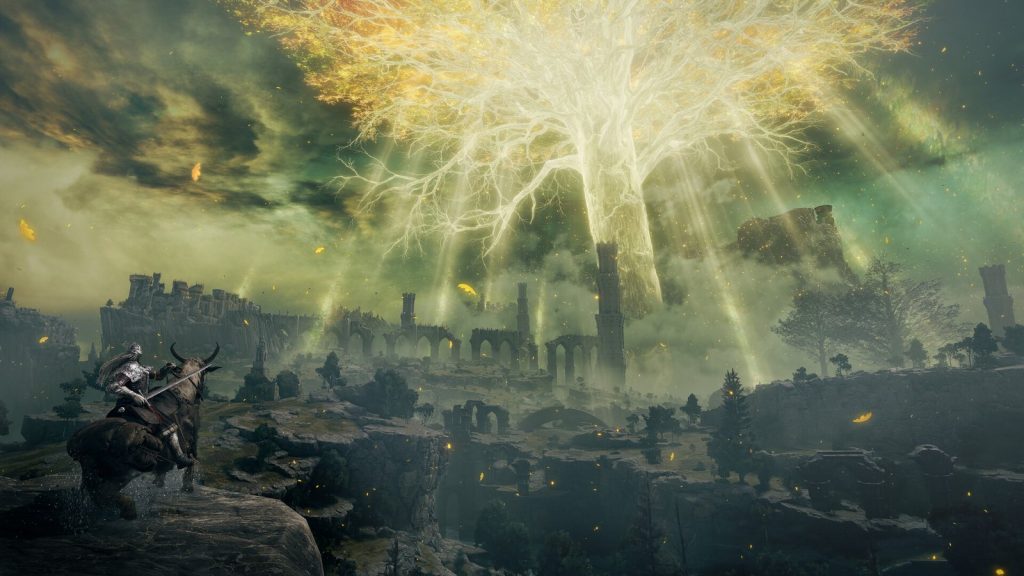
You can only use Torrent outdoors in most cases, not inside dungeons or legacy dungeons. If Torrent falls in battle, a sip from your Crimson flask while summoning it can revive it. Use Torrent to escape fights you are not ready for. Running past danger is a legitimate tactic in Elden Ring.
Spirit Ashes: Summoning Help
Spirit Ashes let you summon AI-controlled allies, from packs of wolves to skilled warriors. To use them, you need the Spirit Calling Bell, which you receive early in the game. Spirits can only be summoned near Rebirth Monuments, small stone markers found in many large areas and most boss arenas. Each summon costs FP or HP depending on the spirit.
Spirit Ashes can be upgraded with special materials, and many players consider them essential for tough bosses. Summons draw enemy attention and give you openings to heal or attack. There is no shame in using them; the game is designed around their availability. Elden Ring also offers online co-op through summon signs if you want human help.
Ashes of War and Weapon Upgrades
Ashes of War are items that add a special skill, called a weapon art, to a weapon. They are applied and removed at Sites of Grace once you have a Whetstone Knife, and they can also change a weapon’s affinity, such as making it scale better with a particular stat. This means you can customize most standard weapons heavily, and you find Ashes of War from defeating certain enemies and exploring.
Weapons are upgraded with Smithing Stones. Standard weapons use regular Smithing Stones, while most unique weapons, many of which have fixed skills that cannot be changed, use rarer Somber Smithing Stones. Upgrading your main weapon is usually more effective than collecting many un-upgraded weapons, so pick one or two favorites and invest in them.
Attributes: What to Level
Elden Ring has eight attributes:
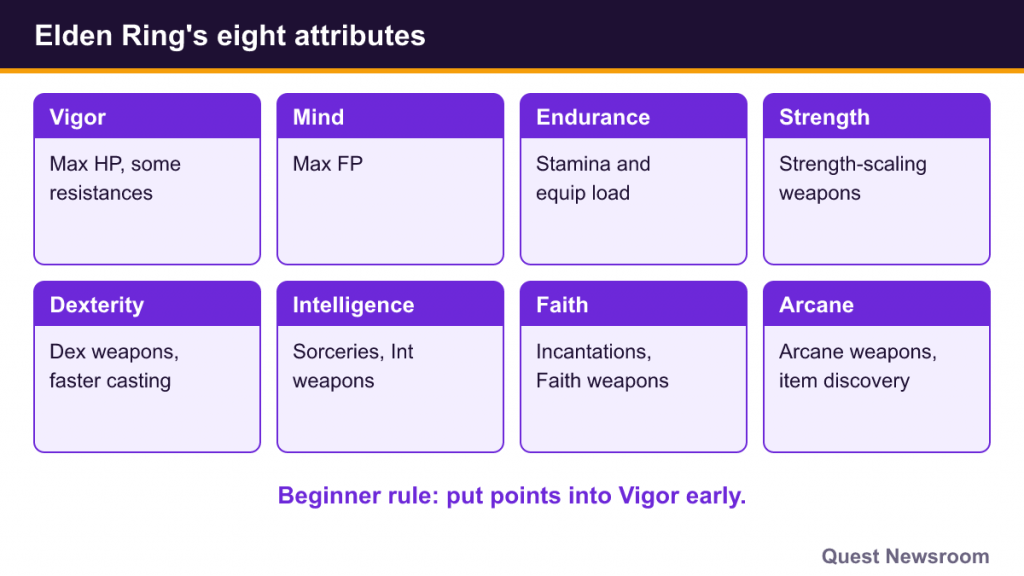
- Vigor: maximum HP and some resistances.
- Mind: maximum FP.
- Endurance: stamina and equipment load.
- Strength: damage with strength-scaling weapons.
- Dexterity: damage with dexterity-scaling weapons, and faster casting.
- Intelligence: sorceries and intelligence-scaling weapons.
- Faith: incantations and faith-scaling weapons.
- Arcane: arcane-scaling weapons, item discovery and some status effects.
The single most common beginner advice is to invest in Vigor early. Extra health lets you survive mistakes while you learn enemy patterns. Beyond that, focus on the stat your main weapon or spells use. Our guide to character builds explains specialists, hybrids and how respecs work, including Elden Ring’s rebirth option.
How the Open World Changes Difficulty
Elden Ring has no difficulty setting. Instead, the open world itself acts as a difficulty dial. If a boss is too hard, you can usually leave, explore elsewhere, gain levels, find better gear and new Spirit Ashes, and come back stronger. The first major legacy dungeon and its boss stop many players, and exploring the surrounding region first is often the answer.
A few more tips for the first hours:
- Explore the starting region thoroughly. It is full of caves, catacombs and upgrade materials.
- Read item descriptions. They explain mechanics and lore the game never states directly.
- Use stealth. Crouching lets you approach enemies unseen and land critical hits on unaware foes.
- Learn to dodge. Rolling through attacks, not away from them, is often safer.
- Take breaks. A boss that seems impossible late at night often falls quickly after rest.
For context on how Elden Ring grew out of FromSoftware’s earlier games, see our FromSoftware history.