Loot Systems Explained: Rarity Tiers, Affixes and Drop Rates
Why blue, yellow, green and gold items mean what they do: how randomized loot works in action RPGs, from affixes and item levels to drop tables and target farming.
In an action RPG, killing a monster is only half the reward. The other half is the shower of items it drops. Some are junk, some are upgrades, and now and then one changes how your whole character plays. That cycle of fighting, picking up, comparing and equipping drives the “loot game.” It came together in Blizzard North’s Diablo II (2000), and almost every action RPG since has used some version of it.
This guide explains the parts of a randomized loot system. It covers rarity tiers and their colors, prefixes and suffixes, item level, set and unique items, drop tables, and the ways modern games help you find what you’re looking for. The aim is to help you make sense of what drops and decide what to keep.
Why Randomized Loot Exists
Hand-placed treasure, like a sword in a chest at the end of a dungeon, is the same for every player. Randomized loot creates items from parts each time something drops. Endless variety comes from a limited set of base items and modifiers. That does three things for the game:
- Replay value. Running the same area again can still give you something new.
- Build variety. Different combinations of stats push players toward different builds. See our guide to character builds for how gear, skills and stats combine.
- Anticipation. Every kill could drop an upgrade, and that steady possibility is the hook of the whole genre.
The design challenge is to keep that anticipation without drowning players in junk or making good items so rare that the search feels pointless.
Rarity Tiers: The Diablo II Color Code
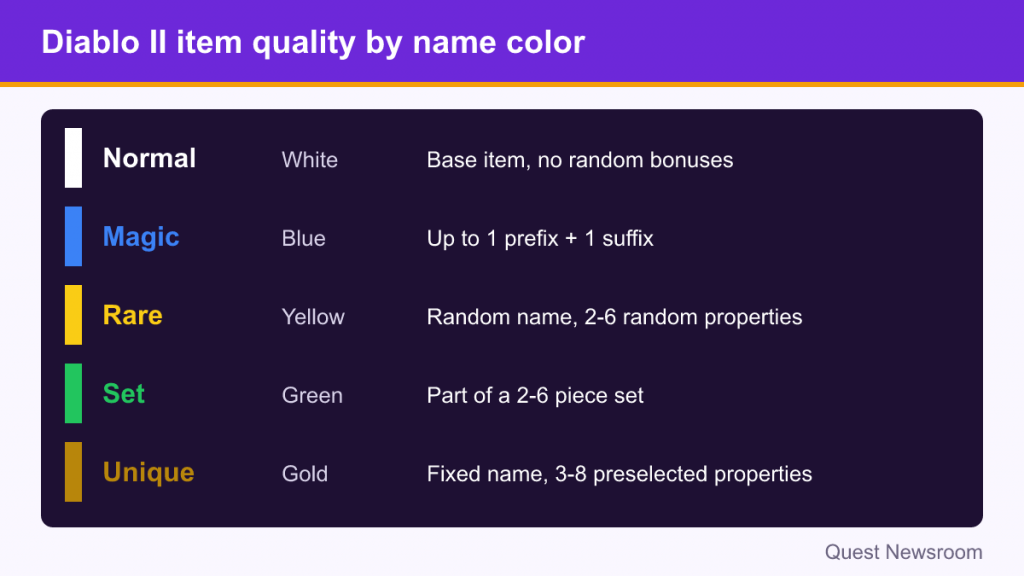
Diablo II set up the color scheme many players now read without thinking. In that game, an item’s name color tells you its quality:
| Quality | Name color | What it means in Diablo II |
|---|---|---|
| Normal | White | A base item with fixed basic properties and no random bonuses. Can be low quality, normal or superior, and may have sockets. |
| Magic | Blue | One or two random bonuses: at most one prefix and one suffix. |
| Rare | Yellow | A randomly generated name and 2 to 6 random properties. |
| Set | Green | Fixed name and properties; part of a 2–6 piece set that gives extra bonuses when worn together. |
| Unique | Gold | Fixed name with 3 to 8 preselected properties. |
There is a twist many newcomers miss. In Diablo II, “higher tier” does not always mean “better.” A rare item with well-rolled properties can beat many uniques. A plain white item with the right number of sockets can be the base for some of the strongest gear in the game. Rarity tells you how an item was made, not whether it suits your build.
How the colors spread
Later games changed the palette. Many added orange or purple tiers above gold, or swapped the meanings of colors. The basic idea of using color to signal rarity has become standard well beyond action RPGs. If you play a new loot game, spend a minute learning its colors. Assuming they match Diablo’s is one of the most common beginner mistakes.
Prefixes and Suffixes: How Random Items Are Built
Most randomized items are built from affixes, modifiers attached to a base item. In Diablo II and many games since, they come in two groups:
- Prefixes go before the base name and often add offensive or defensive stats, such as extra damage or defense.
- Suffixes go after it (“… of the something”) and often add utility or attribute bonuses.
The name tells you what the item does. In Diablo II, a magic item can have one prefix, one suffix or one of each, but never two of the same kind. A rare item can have up to three of each, which is why rares can be so powerful.
Reading an item properly
- Start with the base. The base type sets the damage or defense range, the requirements, and sometimes how many sockets it can have.
- Check which stats help your build. Three strong affixes your character uses beat six that do nothing for you.
- Compare roll ranges. Each affix usually rolls within a range. Two items with the same affix can differ a lot.
- Look at requirements. A powerful item you can’t equip yet is only something to sell or store.
Item Level, Quality Level and Why Areas Matter
Where an item drops matters as much as what it is. Diablo II gives every item a quality level (Qlvl), a number used to sort items into “treasure classes” and to decide which affixes they can roll. Better items appear as monster and area levels rise. In general, tougher monsters in deeper areas or higher difficulties can drop better bases and stronger affixes.
Most loot-based action RPGs keep this idea under different names. An item’s level, set by the monster or area that dropped it, limits what it can become. That is why players farm specific high-level zones. The best items can only drop there. It is also why an early-game unique may be worse than a well-rolled rare found later.
Set Items and Unique Items
Random items create variety. Fixed items create goals.
Unique items have a fixed name and a fixed set of properties, sometimes with small random ranges. Players can look them up, plan builds around them, and recognize them right away when they drop. The best uniques add effects that random affixes can’t, such as changing how a skill works. That makes them build-defining.
Set items work as a group. Each piece is usually modest by itself, but wearing several gives extra bonuses that grow as you equip more. Sets give players a long-term collecting goal. They also raise a design question: if a full set is too strong, every player of a class ends up in the same gear, and build variety suffers. Many games have struggled with this balance.
Diablo II also had sockets and the Horadric Cube, a container that combines items into new ones. For example, three identical gems of lower quality become one better gem. These systems let players improve gear they already had, so not every upgrade depended on a lucky drop.
Drop Tables: What Can Drop and How Often
Behind every kill is a drop table, a list of possible results with relative weights. A typical roll might first decide whether anything drops, then what kind of item (gold, potion, equipment), then the base item, then its quality, then its affixes. Each step uses the monster’s level and type.
A few common features show up across games:
- Boss tables. Bosses roll more times and use better tables, so they are the main targets for repeat runs.
- Monster-specific drops. Some items drop only from certain enemies or areas.
- Magic find. Many games have a stat that raises the chance of better-quality drops, and players often swap into special gear for farming.
- Difficulty scaling. Higher difficulties usually open up better bases and stronger affixes.
Exact drop rates are usually hidden in game data. Fan communities often figure them out, but numbers change with updates, so rely on current, dated community resources rather than old forum posts.
Bad Luck Protection and Target Farming
Pure randomness has a big flaw. Some players get the item they want in an hour, and others never get it. Modern loot games have developed tools to reduce that frustration.
- Bad luck protection (“pity”). The chance of a rare drop quietly goes up each time you don’t get one, so long dry spells end.
- Target farming. Certain items are tied to certain bosses, areas or activities, so you can work toward a specific item rather than hoping it drops anywhere.
- Crafting and rerolling. Systems that let you change one stat, upgrade quality or turn unwanted items into materials. This turns junk into progress.
- Smart loot. Some games favor drops your current class can use.
- Loot filters. Options that hide low-value drops so the screen isn’t buried in clutter.
These systems reflect a change in design thinking since Diablo II. Randomness is still central, but most players today expect some steady progress toward their goals, not only luck.
Practical Tips for Managing Loot
- Know your key stats. Before a session, write down the two or three stats your build needs most. Judge each drop against that list.
- Don’t hoard everything. Inventory and storage space is the real limit. Sell, salvage or drop items that won’t help you or another character you plan to play.
- Keep good bases. In games with sockets or crafting, a plain item with the right base and sockets can be worth more than a flashy drop.
- Upgrade weapons first. In most action RPGs, weapon damage drives skill damage, so a better weapon is usually the biggest single upgrade.
- Use filters early. If the game offers loot filters, setting them up early saves hours of sorting.
- Learn the terms. Our RPG glossary covers words like proc, RNG and affix that loot discussions use a lot.
Loot systems are built to keep you playing “one more run.” Knowing how they work makes it easier to enjoy the hunt without feeling at the mercy of the dice. You can tell a real upgrade from noise, and you know where better items can appear.
Quick Answers to Common Loot Questions
Is a gold item always better than a yellow one?
No. In Diablo II, a rare can roll up to six properties, and the right six can beat a unique that doesn’t suit your build. Compare the stats, not the color.
Why do I keep finding items for other classes?
Many drop tables don’t care what class you play. Games with “smart loot” lean toward your class, but in older designs you are expected to sell, store or pass those items to another character.
Should I farm early or push the story?
Usually push forward. Item level and area level limit what can drop, so the best items for your character tend to be further ahead, not behind you.