Best Story-Driven RPGs: Narrative Classics Across Subgenres
Eight RPGs celebrated for their writing, from Planescape: Torment and Chrono Trigger to Disco Elysium and NieR: Automata, with spoiler-free hooks.
Role-playing games have always been a storytelling medium. They let you inhabit a character for dozens of hours, make choices that matter and build relationships with companions in ways no film can. Some RPGs, though, are remembered above all for their writing: the questions they ask, the characters they create and the endings that stay with you. This list collects eight of the most celebrated narrative RPGs across subgenres, with what each does well and a spoiler-free sense of why it is worth playing.
The list mixes older classics and modern games, and western and Japanese design traditions. Release dates and platforms are listed so you know where each game can be found; availability is as of October 2026.
Planescape: Torment (1999)
Developer: Black Isle Studios. Original release: Windows, December 1999. Modern version: Beamdog’s Enhanced Edition (2017) for PC, Mac, Linux and mobile, with Switch, PlayStation 4 and Xbox One versions released in October 2019.
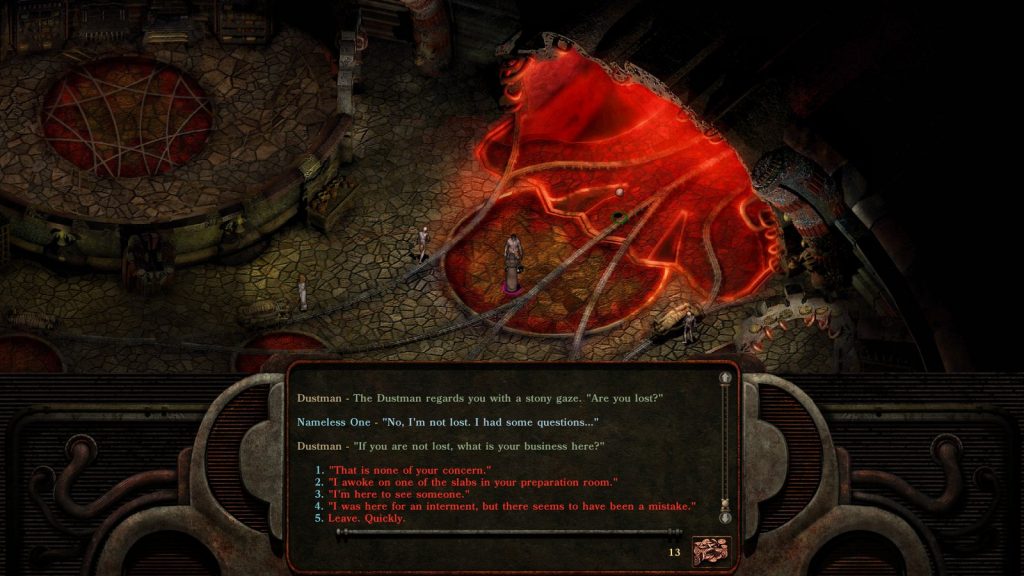
You wake up on a mortuary slab with no memory and a body covered in scars. You are the Nameless One, an immortal who has lived and died countless times, and the city of Sigil, a strange hub at the center of the multiverse, holds the pieces of your past.
Planescape: Torment was built on BioWare’s Infinity Engine, the same technology as Baldur’s Gate, but it pushed combat into the background. Many encounters can be resolved through conversation, and the game’s real content is its enormous amount of writing, led by designer Chris Avellone. Its central question, “What can change the nature of a man?”, runs through every companion and choice.
It sold modestly on release but won RPG of the Year awards from GameSpot and Computer Gaming World and is now regarded as one of the best-written games ever made. Best for: players who love reading and philosophical themes, and don’t mind dated combat.
Chrono Trigger (1995)
Developer: Square. Original release: Super Famicom/SNES, March 1995 in Japan. Modern versions: Nintendo DS (2008), iOS and Android, and Windows via Steam (2018).
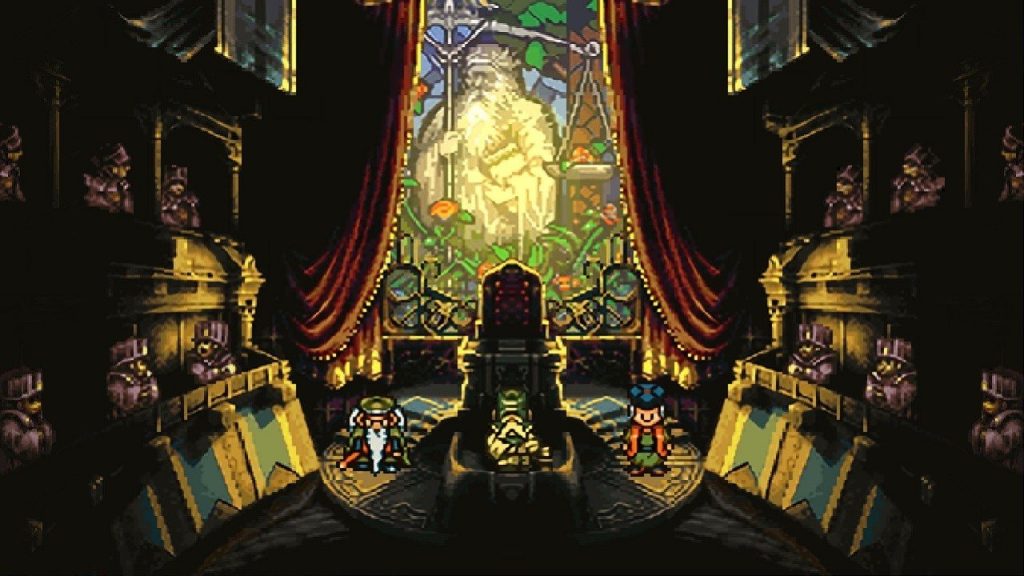
Chrono Trigger was made by a so-called “Dream Team”: Final Fantasy creator Hironobu Sakaguchi, Dragon Quest creator Yuji Horii and Dragon Ball artist Akira Toriyama. A festival accident sends a young swordsman named Crono through time, and the party soon discovers a future catastrophe they set out to prevent.
What makes its story memorable is structure as much as dialogue. Travel between eras means actions in the past change the future, side quests explore each character’s history, and the game has a dozen endings depending on when you face the final challenge. It also introduced New Game Plus, which lets you replay with your characters’ levels and equipment, making those alternate endings easy to explore.
Best for: players who want a brisk, optimistic classic. It is shorter than many JRPGs and has aged remarkably well.
Mass Effect 2 (2010)
Developer: BioWare. Original release: Windows and Xbox 360, January 2010; PlayStation 3, January 2011. Modern version: included in the Mass Effect Legendary Edition (2021).
Commander Shepard must assemble a team of specialists for a mission that everyone describes as suicide. Most of the game is about recruiting those characters and earning their loyalty through personal missions, and the cast is one of the strongest in any RPG.
Mass Effect 2’s finale is famous because its outcome depends on how well you prepared. Ship upgrades, crew loyalty and the roles you assign in the final assault determine who survives; it is even possible to lose Shepard. Players who imported a save from the first Mass Effect also saw their earlier decisions reflected in the story.
The game won Game of the Year at the Interactive Achievement Awards and Best Game at the BAFTA Games Awards. Best for: players who want character-driven science fiction with action combat. The Legendary Edition lets you play the full trilogy in sequence.
The Witcher 3: Wild Hunt (2015)
Developer: CD Projekt Red. Original release: PC, PlayStation 4 and Xbox One, May 2015. Modern versions: Nintendo Switch (2019), PlayStation 5 and Xbox Series X|S (2022), and a Remastered edition released on September 29, 2026, as a free upgrade for existing owners on PC and current consoles.
Geralt of Rivia, a monster hunter for hire, searches for his adopted daughter Ciri while a spectral army called the Wild Hunt pursues her. The main story is strong, but The Witcher 3 is especially admired for its side quests, which often contain moral dilemmas with no clean answer. The Bloody Baron questline is a frequent example of how much weight optional content can carry.
Its two expansions, Hearts of Stone and Blood and Wine, are considered among the best story DLC in the genre. Wild Hunt won Game of the Year at The Game Awards 2015. Our Witcher games history covers the whole series. Best for: players who want a huge open world where nearly every quest tells a story.
Disco Elysium (2019)
Developer: ZA/UM. Original release: Windows, October 2019. Modern version: The Final Cut (2021), with full voice acting and new quests, on PC, Mac, PlayStation, Xbox and Switch.
A detective wakes up in a wrecked hostel room with a hangover so severe he has forgotten his own name. There is a body hanging in the courtyard behind the building, and he has to solve the case while rebuilding his identity.
Disco Elysium has almost no traditional combat. Everything is resolved through dialogue and skill checks. Its 24 skills speak to you as voices in your head, arguing, flattering and sometimes misleading you, and a Thought Cabinet lets you internalize ideas that change your character. Failure is often as interesting as success. At The Game Awards 2019, it won all four categories it was nominated in, including Best Narrative and Best Role-Playing Game.
Best for: players who love writing, politics, humor and unconventional design. It is dense with text, so patience is required.
Persona 5 Royal (2019/2020)
Developer: Atlus. Original release: Persona 5 launched in Japan in 2016 and in the West in April 2017; the expanded Royal version followed in 2019 in Japan and 2020 worldwide.
A transferred high school student and his friends discover they can enter the distorted inner worlds of corrupt adults and steal their hearts, forcing them to confess their crimes. Between heists, you live through a school year in Tokyo, studying, working part-time and building relationships.
Persona 5’s story is about rebellion and found family, and its relationships, called Confidants, give even minor characters arcs of their own. Royal is the expanded edition, with additional story content, and is the version most players pick today. It is long, but its style and structure keep the pace up. For context on how it relates to Atlus’s other games, read our explainer on Persona and Shin Megami Tensei. Best for: players who enjoy character-driven JRPGs and turn-based combat.
NieR: Automata (2017)
Developer: PlatinumGames, published by Square Enix and directed by Yoko Taro. Original release: PlayStation 4, February 2017 in Japan and March 2017 in the West; Windows in March 2017. Later versions: Xbox One (2018) and Nintendo Switch (2022).
Androids fight machine lifeforms on an Earth abandoned by humanity. That premise sounds like a straightforward action game, and for a while it plays like one. NieR: Automata reveals its story across multiple playthroughs, with later runs changing perspective and recontextualizing what you have seen. It has 26 endings, five of them main endings, and several are worth seeing before you decide you have finished.
Its themes, about what gives life meaning, are delivered through gameplay structure as much as cutscenes. As of February 2026, it had sold more than ten million copies. Best for: players who want a stylish action RPG with an unusual, emotional story. Persist past the first ending.
Baldur’s Gate 3 (2023)
Developer: Larian Studios. Release: Windows, August 2023; PlayStation 5 and macOS, September 2023; Xbox Series X|S, December 2023.
A mind flayer parasite has been placed in your head, and you have a limited window to remove it before it transforms you. That urgent premise is the start of a sprawling story shaped by your choices, your companions and how you roll the dice.
Baldur’s Gate 3 combines the reactive storytelling of tabletop Dungeons & Dragons with full cinematic presentation. Companions have complex arcs that can turn in very different directions, and situations often allow many solutions, from combat to persuasion to stealth. It won Game of the Year at The Game Awards 2023. For how its rules work, see our guide to D&D rules in Baldur’s Gate 3. Best for: players who want choices with visible consequences and a cast worth replaying for.
How to Choose Your Next Story RPG
These games tell stories in very different ways, so a few questions can narrow the choice:
- Do you want to read or to watch? Planescape: Torment and Disco Elysium are text-heavy; Mass Effect 2, The Witcher 3 and Baldur’s Gate 3 are fully voiced and cinematic.
- How much time do you have? Chrono Trigger is comparatively compact. Persona 5 Royal, The Witcher 3 and Baldur’s Gate 3 are major time investments.
- Do you prefer choice or a fixed story? Mass Effect 2, Disco Elysium and Baldur’s Gate 3 react heavily to your decisions; Persona 5 and NieR: Automata tell more authored stories.
- How do you feel about combat? If fighting is not your interest, Disco Elysium avoids it almost entirely, and Planescape: Torment lets you talk your way out of many fights.
Whichever you pick, give these games time. Many of them build slowly, and their best moments land because of everything that came before.