Party Roles in Single-Player RPGs: Tank, Healer, Damage and Support
How tank, healer, damage and support roles work in single-player party RPGs, from aggro and taunts to AI tactics menus and Final Fantasy XII's Gambits.

Put four adventurers in a dungeon and they will soon fall into familiar jobs. One stands in front and soaks up hits. One keeps everyone alive. One or two deal as much damage as they can. Someone else makes allies stronger and enemies weaker. These roles go back to tabletop games and spread widely through online games, but they matter just as much in single-player party RPGs. There, you are the one building the party, setting its behavior and fixing it when things go wrong.
This guide explains the classic roles, how threat and taunts work, why support characters are often underrated, how party size limits change your choices, and how games let you program your AI companions. It deals only with single-player and small co-op party RPGs, not MMO raid planning.
The Classic Role Triangle (Plus One)
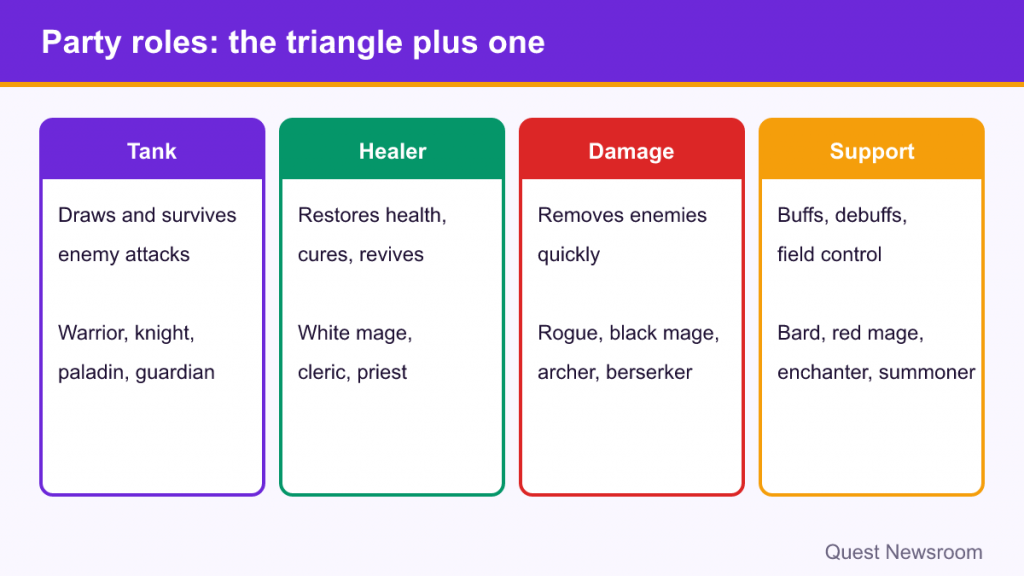
The usual model is a triangle of tank, healer and damage, often written as DPS (damage per second). Many single-player RPGs add a fourth role, support, which covers buffs, debuffs and battlefield control. If any of these terms are new to you, our RPG glossary defines them.
| Role | Job | Typical archetypes |
|---|---|---|
| Tank | Draw and survive enemy attacks so others don’t have to | Warrior, knight, paladin, guardian |
| Healer | Restore health, cure ailments, revive fallen allies | White mage, cleric, priest |
| Damage | Remove enemies quickly, either one target or many | Rogue, black mage, archer, berserker |
| Support | Buff allies, debuff enemies, control the field | Bard, red mage, enchanter, summoner |
Real characters often mix roles. A paladin may tank and do some healing, and a battle mage may deal damage while slowing enemies. Roles are best seen as jobs that need covering, not fixed classes. A party works when every important job has someone handling it.
Tanks and the Mechanics of Aggro
A tank only works if enemies actually attack it. Games handle this in a few ways.
Threat (aggro) systems
Many real-time and real-time-with-pause RPGs track hidden threat, often called aggro, toward each party member. Dealing damage, healing and some abilities create threat. Enemies usually go after whoever has the most. A tank builds threat on purpose with special abilities, so damage dealers can attack freely and the healer isn’t targeted for healing. If a damage dealer pulls too hard and gets ahead of the tank, the enemy turns on them. Fans call this “pulling aggro.”
Taunts and forced targeting
A taunt is a direct tool. It forces an enemy, or every enemy nearby, to target the taunter for a while. In turn-based games, taunts and “cover” abilities often replace hidden threat. A knight may take hits meant for weaker allies, or a guard stance may make one character the obvious target.
Positioning
In tactical and real-time-with-pause games, tanking is partly physical. You put the sturdy character in a doorway or corridor so enemies can’t get past to the back line. This is why classic CRPGs reward careful setup before a fight. Our combat systems guide explains how pausing and turn order change these tactics.
A common mistake is to build a tank who takes hits well but gives enemies no reason to attack them. Defense without threat or taunts just means enemies walk past your strongest character to hit your weakest.
Healers: More Than a Heal Button
The healer is the safety net, but good healing in an RPG is about more than topping up health bars. A healer’s toolkit usually includes:
- Single-target heals for the tank, who takes the most damage.
- Group heals for area attacks.
- Cures for poison, paralysis, silence and other status effects.
- Revives, often the most important spell in the game.
- Healing over time and preventive spells, which cut incoming damage before it lands.
Many games make a dedicated healer optional. If potions are plentiful, regeneration gear is strong, or a damage dealer can heal on the side, you can run with no healer and finish fights faster. On higher difficulties or against bosses that inflict status effects, a dedicated healer often decides whether you win. Healers in a party also tend to draw threat, which is one more reason tanks matter.
Damage Dealers and Support: Winning the Fight
Damage dealers win the fight. The longer a fight lasts, the more chances enemies have to hurt you, so killing them quickly is a kind of defense. Most parties want at least one single-target specialist for bosses and one area-of-effect specialist for groups. Physical and magical damage are usually split, because many enemies resist one type, so a party should have both.
Support is the most underrated role. Buffs like haste, protection or extra attack power make every other character better. Debuffs that lower enemy defense or accuracy do the same thing from the other side. Control effects such as sleep, stun, slow and blind keep enemies from acting at all. In many games, one good support character adds more total damage than another damage dealer would, because they boost the whole party.
Support is also the role most often skipped by new players, because its effects are harder to see than big damage numbers. If boss fights feel like a slog, try swapping one damage dealer for a support character before you go and grind more levels.
Party Size Limits and Bench Characters
Party size changes how roles work. Many RPGs recruit more companions than can fight at once, so you have to choose.
- Final Fantasy X (2001) lets up to three characters fight at once, but you can swap in anyone from the reserve during battle. The party becomes a toolbox, and you bring in the right character for each enemy.
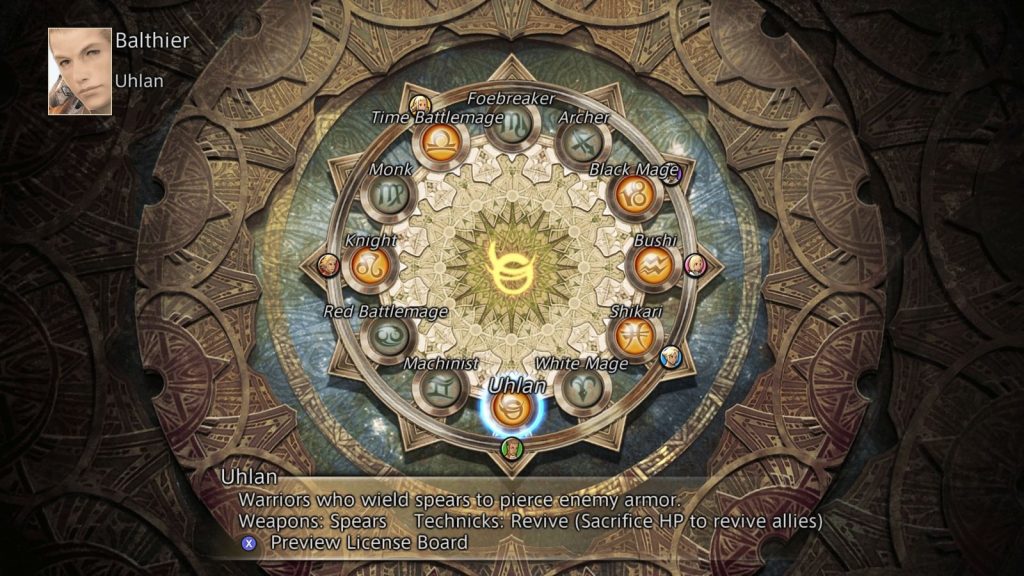
- Final Fantasy XII (2006) fields a party of three you can switch between during real-time battles. Every character can learn any ability on its License Board, so roles are shaped by your planning, not by fixed classes.
- Dragon Age: Origins (2009) keeps companions who aren’t in the active party at a base camp, a hub where you can talk to them between outings.
- Dragon Age: The Veilguard (2024) goes the other way. You control only your main character and bring two of seven companions.
Smaller active parties push characters toward mixed roles, because a three-person group can’t have a dedicated specialist for everything. Larger parties allow cleaner specialization but are harder to manage. Benched characters in some games level up more slowly or not at all, so it pays to rotate them now and then. Many games force you to use certain characters later in the story.
AI Companions and Tactics Settings
In a single-player RPG, you can’t control every party member all the time, especially in real-time combat. Games use several tools to let you guide the characters you aren’t controlling.
Simple behavior presets
The simplest systems offer broad orders like “attack freely,” “focus on healing,” “conserve magic” or “follow my target.” The first Kingdom Hearts, for example, lets you adjust how Donald and Goofy behave from the pause menu. They are easy to use but give you little precise control.
Rule lists: Gambits and Tactics
The most detailed systems let you write rules. Final Fantasy XII’s Gambits are the best-known example. Each Gambit pairs a target condition with an action, such as “Ally: HP < 70%” with a Cure spell, and the list is ranked by priority. The character runs the first rule whose condition is true, and any command you give directly takes priority over the list. A good Gambit setup lets a whole party fight sensibly on its own. Building one is a puzzle in itself.
Dragon Age: Origins uses a similar “Tactics” menu for companions. Our Dragon Age series history describes how the later games cut back this system as combat shifted toward action.
Tips for writing good companion rules
- Put emergencies first. Reviving a fallen ally or healing someone in critical condition should beat everything else.
- Be specific about healing thresholds. Healing at full health wastes resources; healing too late loses fights. Start in the middle and adjust.
- Protect your resources. Add conditions so casters don’t spend all their magic on weak enemies.
- Give the tank a threat rule. If the game has taunts, make sure the tank uses them when enemies attack someone else.
- Test on easy fights. Watch what your companions do before trusting the setup against a boss.
Building a Balanced Party: A Practical Checklist
Whatever the game, a few questions will tell you if a party is ready:
- Who are enemies going to attack, and can that character survive it?
- How do we recover health and cure status effects during a fight?
- Can we deal both physical and magical damage?
- Can we handle one tough boss and a big group of weak enemies?
- Does anyone make the rest of the party stronger, or the enemy weaker?
- If our healer goes down, who can revive them?
If you can answer each question, the party is in good shape. If one is blank, that’s often the reason a fight feels unfair. Changing the party usually helps more than grinding for levels.
When to Break the Rules
The triangle is a starting point, not a law. Some single-player RPGs reward unusual parties, like four damage dealers who end fights before enemies can act, or a party built entirely around debuffs. Games where every character can learn every skill, like Final Fantasy XII, allow plenty of experimenting. On a second playthrough, deliberately skipping one role is one of the most rewarding ways to learn a combat system. Without a healer, you have to master prevention and control. Without a tank, positioning matters more than ever.