The Infinity Engine Games: Baldur’s Gate, Planescape: Torment and Icewind Dale
How BioWare's Infinity Engine powered Baldur's Gate, Planescape: Torment and Icewind Dale from 1998 to 2002, and how Beamdog brought them back.
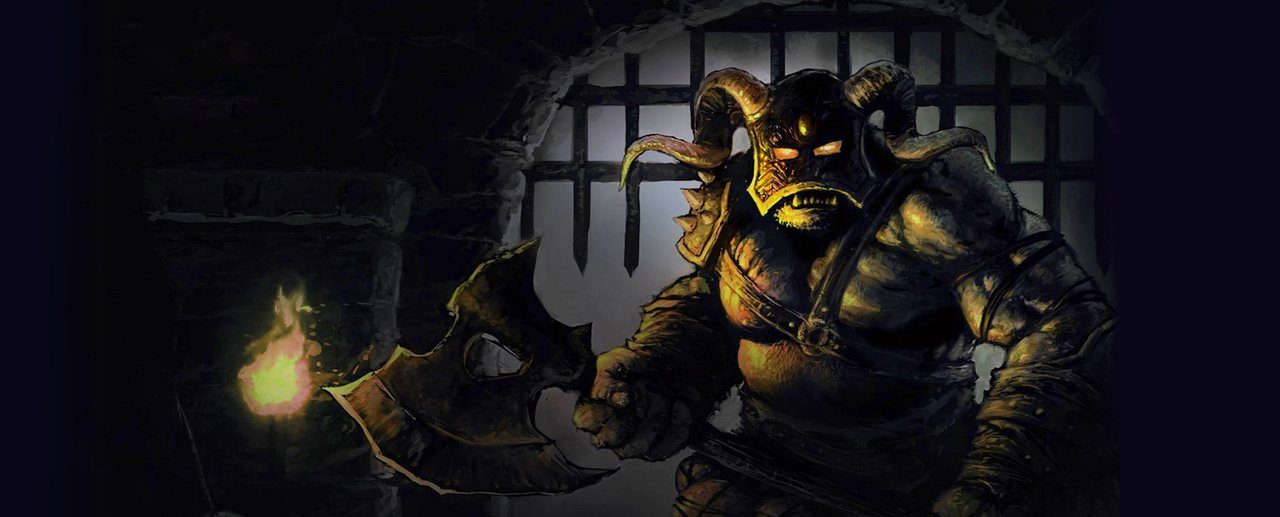
Between late 1998 and the summer of 2002, a single game engine produced five of the most influential computer RPGs ever made, plus a handful of expansions. The Infinity Engine was built by BioWare, a small Canadian studio, and then shared with Black Isle Studios, Interplay’s in-house RPG division. Together they took the rules of Advanced Dungeons & Dragons, set them in hand-painted isometric worlds, and showed that the PC RPG was far from dead.
This history covers where the engine came from, the games built on it, what made the real-time-with-pause design work, and how the games were brought back in the 2010s. If you are new to the term, our explainer on what a CRPG is sets out the tradition these games belong to.
From a Strategy Prototype to Baldur’s Gate
The Infinity Engine was not designed for an RPG at all. BioWare first built it for a real-time strategy game called Battleground: Infinity. That project was reworked into a Dungeons & Dragons role-playing game, and the engine kept the “Infinity” part of the cancelled game’s name.
The strategy roots are easy to see. You select party members by dragging a box around them, give orders by clicking, and watch everyone act at the same time on a large, pre-rendered map. What BioWare added was a way to make that real-time action feel like a tabletop round, which turned out to be the engine’s lasting contribution.
Baldur’s Gate (1998)
Baldur’s Gate was released in North America on December 21, 1998. It was developed by BioWare, with Ray Muzyka as producer and James Ohlen as lead designer, and published under Interplay’s Black Isle Studios label. It is set on the Sword Coast of the Forgotten Realms, in towns and wilderness such as Candlekeep, Nashkel, Beregost, the Cloakwood and the city of Baldur’s Gate itself. An iron shortage is crippling the region, and as you investigate, you learn that you are one of the Bhaalspawn, mortal children of the dead god of murder. Your half-brother Sarevok wants to take Bhaal’s place.
Expectations were low. BioWare’s own internal target was 200,000 copies. Instead the game reached roughly a million copies worldwide by November 1999 and around 2.2 million by early 2003. An expansion, Tales of the Sword Coast, followed in 1999.
Real-Time with Pause and AD&D Rules
Older D&D computer games were mostly turn-based. BioWare’s solution was to run combat in real time while keeping the ability to stop it whenever you wanted. You could pause, look at the situation, give each of your six characters an order, and resume. You could also set the game to pause automatically on events such as an enemy coming into view, a spell finishing, or a character falling.
Under the surface, the game ran a modified version of the Advanced Dungeons & Dragons 2nd edition rules. The computer rolled the dice and tracked the numbers that a human Dungeon Master would otherwise handle: THAC0, armor class (where lower was better), saving throws, spell memorization and class restrictions. A round of combat was mapped to a fixed slice of real time, so a mage’s slow spell or a fighter’s extra attacks played out as they would at the table, only faster.
This hybrid is now known as real-time with pause, or RTwP. It became the defining feature of the Infinity Engine games and of many later RPGs, from Dragon Age: Origins to Pillars of Eternity. For a comparison with turn-based and action combat, see our guide to RPG combat systems.
Black Isle Takes the Engine to New Places
Black Isle Studios was founded in 1996 by Feargus Urquhart as a division of Interplay. It had already made Fallout 2 (1998), and it licensed BioWare’s engine for its own projects. The results show how far one engine can stretch.
Planescape: Torment (1999)
Planescape: Torment came out on December 10, 1999 in North America, with Chris Avellone as lead designer. It uses the Planescape setting of AD&D and takes place largely in Sigil, the City of Doors, which sits atop an infinitely tall spire at the center of the multiverse. You play the Nameless One, an immortal who loses his memory each time he dies and wakes up in a mortuary covered in scars and tattoos.
Torment turned the usual RPG priorities upside down. Combat is rare and often avoidable, and the script runs to about 800,000 words. Intelligence, Wisdom and Charisma matter more than Strength, because they unlock conversation options and memories. The whole game is built around one question, asked by the hag Ravel Puzzlewell: “What can change the nature of a man?”
Critics loved it. GameSpot and Computer Gaming World both named it the RPG of the year for 1999. Sales, however, were weak at first: about 73,000 copies in the US by March 2000, with Brian Fargo later estimating roughly 400,000 over its lifetime. Its reputation has only grown since.
Icewind Dale (2000)
If Torment was all story, Icewind Dale went the other way. Released on June 29, 2000 in North America and directed by Urquhart, it was a combat-focused dungeon crawl set in the frozen north of the Forgotten Realms. Instead of recruiting companions with their own stories, you created a full party of up to six characters yourself, as you might for a tabletop campaign. Josh Sawyer and Chris Avellone were among the designers, and Jeremy Soule’s score was widely praised.
The expansion Heart of Winter followed on February 21, 2001, and a free add-on, Trials of the Luremaster, arrived that summer.
Baldur’s Gate II and the Peak of the Engine
Baldur’s Gate II: Shadows of Amn shipped in North America on September 21, 2000. It continues the story of the Bhaalspawn, who has been captured and experimented on by the mage Jon Irenicus. Most of the game takes place in the merchant nation of Amn and its capital, Athkatla, a city full of guilds, quests and factions.
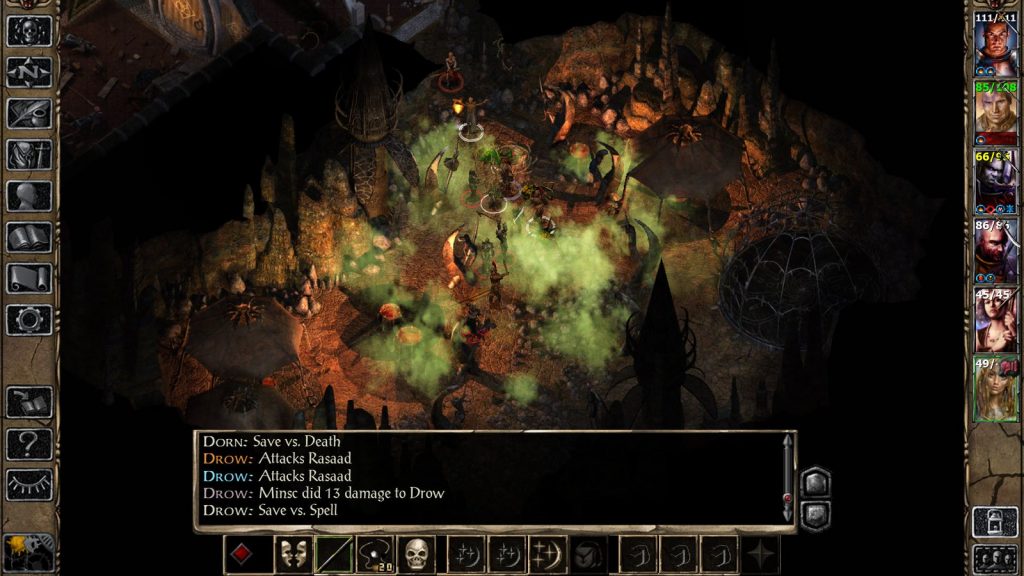
BG2 kept the formula of the first game but improved almost everything: higher resolution, more classes and kits, tougher and more varied enemies, and companions with much richer writing. Romance could develop between your character and some party members, which became a BioWare signature. The game has a Metacritic score of 95, and GameSpot, GameSpy and IGN named it their role-playing game of 2000. The expansion Throne of Bhaal (June 2001) completed the Bhaalspawn saga. Sales of BG2 passed two million by November 2005.
BioWare then moved on. Its next PC RPG, Neverwinter Nights (2002), used a new 3D engine called Aurora, and the Infinity Engine was left to Black Isle.
Icewind Dale II and the End of an Era
The last Infinity Engine game, Icewind Dale II, shipped on August 27, 2002. It made one big change: instead of AD&D 2nd edition, it adapted the newer Dungeons & Dragons 3rd edition rules, with their simpler attack math and more flexible multiclassing. It remained a party-creation dungeon crawl like the first Icewind Dale.
Interplay’s finances were in poor shape by then. Black Isle’s later projects, including a Fallout 3 known as Van Buren, were cancelled in 2003, and on December 8, 2003 Interplay laid off the studio’s entire staff. Several of its veterans went on to Obsidian Entertainment, which is often seen as Black Isle’s successor.
The complete list
| Game | Developer | Year | Rules |
|---|---|---|---|
| Baldur’s Gate (+ Tales of the Sword Coast, 1999) | BioWare | 1998 | AD&D 2nd edition |
| Planescape: Torment | Black Isle Studios | 1999 | AD&D 2nd edition |
| Icewind Dale (+ Heart of Winter, Trials of the Luremaster, 2001) | Black Isle Studios | 2000 | AD&D 2nd edition |
| Baldur’s Gate II: Shadows of Amn (+ Throne of Bhaal, 2001) | BioWare | 2000 | AD&D 2nd edition |
| Icewind Dale II | Black Isle Studios | 2002 | D&D 3rd edition |
Beamdog and the Enhanced Editions
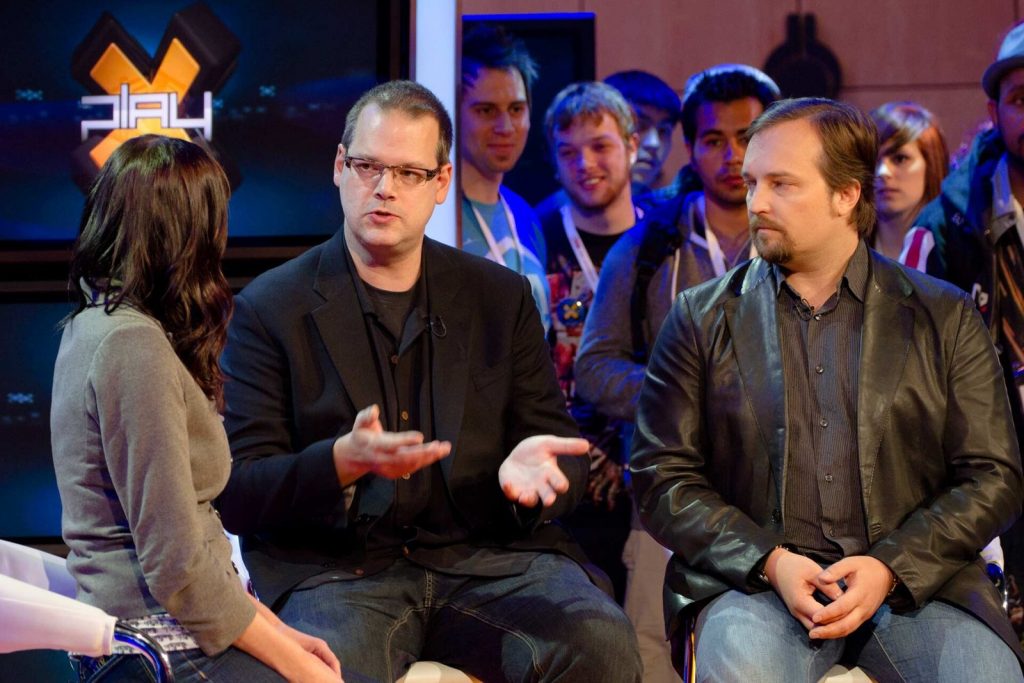
For about a decade, playing these games meant hunting for old discs or wrestling with compatibility patches. That changed thanks to Beamdog, a studio founded in 2009 by BioWare co-founder Trent Oster and former BioWare lead programmer Cameron Tofer. Beamdog updated the original engine and released a run of Enhanced Editions:
- Baldur’s Gate: Enhanced Edition (2012)
- Baldur’s Gate II: Enhanced Edition (2013)
- Icewind Dale: Enhanced Edition (2014)
- Planescape: Torment: Enhanced Edition (April 11, 2017)
The Enhanced Editions added widescreen and high-resolution support, interface fixes and, in the Baldur’s Gate games, some new companions. Beamdog also made a full new expansion, Baldur’s Gate: Siege of Dragonspear (2016), which fills the gap between the first and second games. Console versions followed in 2019, including Baldur’s Gate and Baldur’s Gate II on PS4, Xbox One and Switch, and Planescape: Torment on October 15, 2019.
Icewind Dale II was never remastered, because its source code had been lost. Aspyr’s parent company Embracer Group announced the acquisition of Beamdog in April 2022.
GemRB: the fan-made engine
Fans also recreated the engine themselves. GemRB is an open-source reimplementation of the Infinity Engine that began in 2000. It could complete Baldur’s Gate II by 2009 and all of the Infinity Engine games by 2024, and it runs on Windows, macOS and Linux. Like any engine reimplementation, it still needs the original game data, which you must own.
Why These Games Still Matter
The Infinity Engine games set the template for the party-based western RPG for the next two decades. Their influence is visible in several ways:
- Companions as characters. BG2’s companions, with their banter, personal quests and romances, became the model for BioWare’s later games such as Mass Effect and Dragon Age.
- Real-time with pause. The hybrid combat system became a genre standard, used in Dragon Age: Origins and in the 2010s CRPG revival.
- Writing as gameplay. Planescape: Torment proved that a game could be carried by its dialogue and ideas rather than combat, and it inspired a spiritual successor, Torment: Tides of Numenera (2017).
- The Kickstarter revival. Games such as Pillars of Eternity were openly pitched as Infinity Engine-style RPGs, many made by veterans of these teams.
The Baldur’s Gate name returned in a big way with Larian Studios’ Baldur’s Gate 3 in 2023, which swapped real-time with pause for turn-based combat under D&D 5th edition rules. Our article on D&D rules in video games explains how those systems differ.
Where to Start Today
All four Enhanced Editions are easy to find on modern platforms, and they are the most convenient way to play. A few practical tips:
- For the classic BioWare experience, start with Baldur’s Gate: Enhanced Edition, then Siege of Dragonspear and Baldur’s Gate II. You can carry your character from game to game.
- If you mainly want story, Planescape: Torment stands alone and requires no knowledge of D&D or the other games.
- If you want pure tactical combat, Icewind Dale lets you build a whole party from scratch and skip most of the talking.
- Expect old-school rules. THAC0 and descending armor class confuse newcomers. Lower AC is better, and a lower THAC0 means you hit more often. The game handles the math for you.
- Use the pause. Many new players treat the games as action RPGs and lose fights they could have won. Set auto-pause options and stop the action often, especially when spellcasters are involved.
A quarter of a century on, these games remain the reference point for party-based RPGs. Many later CRPGs are still measured against what this one engine produced in under four years.