FromSoftware History: From King’s Field to Elden Ring
How a Tokyo business-software company became the studio behind Dark Souls, Bloodborne, Sekiro and Elden Ring, from King's Field to Shadow of the Erdtree.
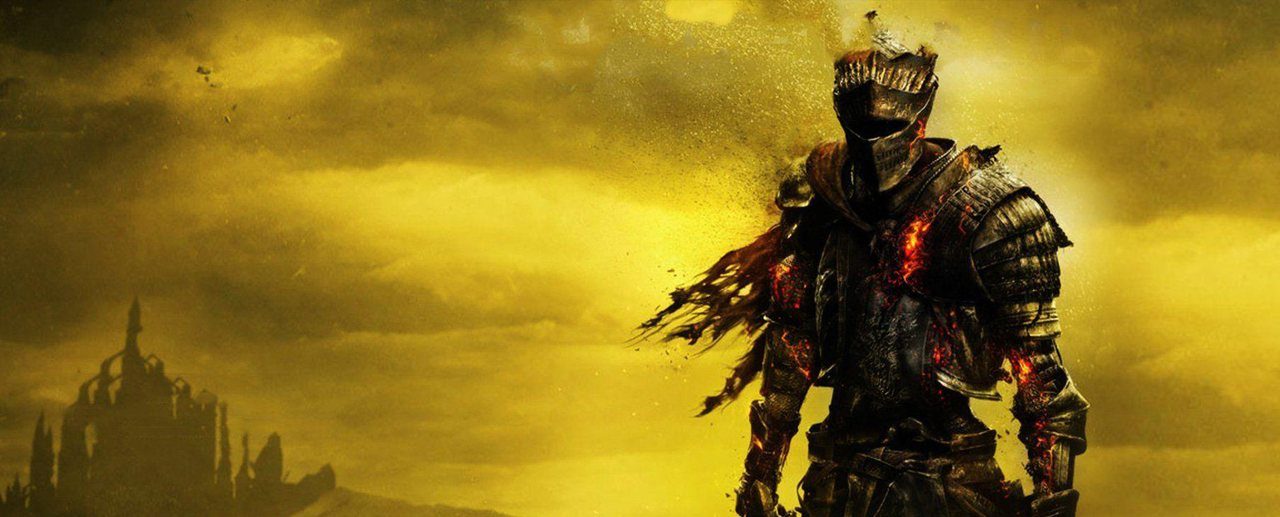
Today FromSoftware is one of the most celebrated developers in the world, the studio whose name is attached to an entire subgenre. But its path to Dark Souls and Elden Ring was long and unusual. It started as a business software company, made dark first-person dungeon crawlers in the 1990s, spent years known mostly for giant robots, and then, with a game its own publisher initially dismissed, changed action RPGs. This is the history of FromSoftware’s RPG work and the director who became synonymous with it.
Beginnings: Business Software and King’s Field
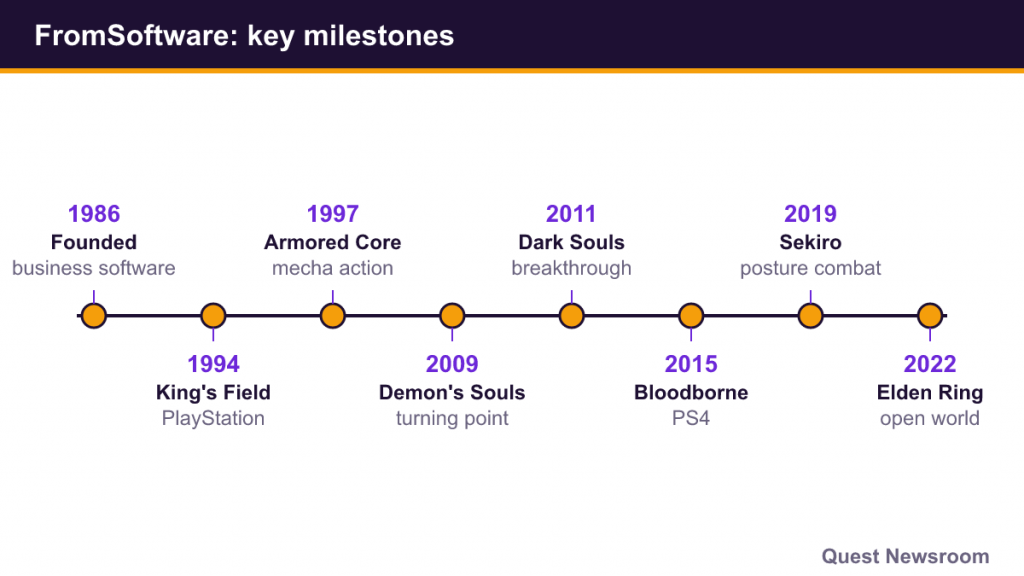
Naotoshi Zin founded FromSoftware in Tokyo on November 1, 1986, as a developer of business software. Its move into games came with the arrival of Sony’s PlayStation.
King’s Field launched in Japan on December 16, 1994, as a PlayStation launch title. It was a fully 3D, first-person RPG, an approach described at the time as groundbreaking for role-playing games. Players explored dark labyrinths and large, seamless areas, fought slow and deliberate battles and pieced together a sparse story. The slow movement had a technical benefit: it let the game stream data from the disc and avoid the loading screens common on the console.
The first King’s Field never received an official English release. Its sequel came to North America and Europe in 1995, confusingly retitled simply King’s Field, and the third game was released in North America as King’s Field II. King’s Field IV (2001) brought the series to PlayStation 2. FromSoftware also released Shadow Tower (1998), another dark first-person RPG in a similar vein.
These games were niche, especially in the West, but they contain much of the DNA of the studio’s later work: oppressive atmosphere, minimal hand-holding, careful combat and stories told through fragments rather than cutscenes. The King’s Field series is widely described as a spiritual predecessor to Demon’s Souls.
Armored Core and the Lean Years
In 1997, FromSoftware launched Armored Core, a mecha action series built around customizing giant robots. It became the studio’s most consistent franchise for more than a decade. Through the 2000s the company also made a wide range of other games, including the stylish Otogi action games for the original Xbox and entries in the Tenchu ninja series, whose rights it acquired from Activision in 2004.
That same year, a new employee arrived. Hidetaka Miyazaki joined FromSoftware in 2004, at around 29, after working as an account manager at Oracle. Few game companies would hire someone with no industry experience; FromSoftware did. He began as a planner on Armored Core: Last Raven (2005) and went on to direct Armored Core 4 (2006) and Armored Core: For Answer (2008).
Demon’s Souls (2009): The Turning Point
Demon’s Souls began as a project proposed and supported by Sony’s Japan Studio. Internally, it was struggling, and the company reportedly considered it a failure. Miyazaki asked to take it over, reasoning that since the project was already seen as failing, he could pursue his own ideas without much to lose.

The result, released in Japan on February 5, 2009, for PlayStation 3, combined King’s Field’s atmosphere with third-person action. Its core ideas became the template for everything that followed:
- Tough, deliberate combat built on stamina, blocking and dodging.
- Losing your souls (the game’s currency and experience) on death, with one chance to recover them.
- Asynchronous online features: messages from other players, bloodstains showing how they died, and invasions.
- Bosses as tests of observation and patience.
Sony was unimpressed at first. After a Tokyo Game Show demo, Shuhei Yoshida, then a senior Sony executive, called it “an unbelievably bad game” after failing to get past the starting area, and Sony decided not to publish it in the West. Atlus released it in North America in October 2009, and Namco Bandai Partners handled PAL regions in 2010. Word of mouth turned it into a cult hit, and Sony and Yoshida later said they regretted the decision. Bluepoint Games remade Demon’s Souls as a PlayStation 5 launch title on November 12, 2020.
For a full explanation of the formula Demon’s Souls established, see our explainer on what a soulslike is.
Dark Souls and the Breakthrough Decade
FromSoftware’s next game in the style was a new series rather than a Demon’s Souls sequel, published by Namco Bandai (now Bandai Namco Entertainment) instead of Sony. Dark Souls (2011) was set in the decaying kingdom of Lordran and is famous for its interconnected world, where shortcuts loop back to earlier areas, and for bonfires, the checkpoints that also respawn enemies. Miyazaki directed and produced it, and it is often named among the greatest games ever made.
The trilogy that grew from it shares a set of ideas rather than a single continuous story. Each game takes place in a different haunted land, Lordran, then Drangleic, then Lothric, and each returns to themes of fire, decay and rebirth, ending with a choice about whether to rekindle the “first flame” that sustains a dying age. Dying costs you your souls, which you can recover only by reaching your bloodstain without dying again. Online, players see ghostly traces of others, leave messages, and can summon help or be invaded. That blend of solitude and quiet community became as much a part of the series’ identity as its difficulty.
Dark Souls’ success changed the company. In April 2014, Kadokawa announced it was buying FromSoftware, and Miyazaki was promoted to president in May 2014.
The years that followed were extraordinarily productive:
| Game | Year | Notes |
|---|---|---|
| Dark Souls II | 2014 | Supervised rather than directed by Miyazaki, who was busy with Bloodborne; set in Drangleic |
| Bloodborne | 2015 | PlayStation 4 exclusive published by Sony; faster, more aggressive Gothic horror |
| Dark Souls III | 2016 | Conclusion of the trilogy, set in Lothric |
| Dark Souls: Remastered | 2018 | Updated version of the first game |
| Sekiro: Shadows Die Twice | 2019 | Published by Activision outside Japan; posture-based combat |
Bloodborne
Released on March 24, 2015, in North America, Bloodborne swapped shields for speed. Its rally system lets players regain recently lost health by striking back quickly, rewarding aggression. Its Victorian Gothic city of Yharnam and its slide into cosmic horror made it a fan favorite, and The Old Hunters expansion followed in November 2015. As of October 2026 it remains on PlayStation 4 only, with no official remaster or PC version.
Sekiro: Shadows Die Twice
Sekiro (March 22, 2019) dropped character builds and multiplayer for a fixed protagonist and a combat system built around posture: deflecting attacks until an enemy’s guard breaks, opening them to a killing blow. It won Game of the Year at The Game Awards 2019 and had sold more than 10 million units by September 2023.
The Dark Souls series as a whole had shipped over 39 million copies as of 2025.
Elden Ring (2022): The Open World
Elden Ring, released on February 25, 2022, brought FromSoftware’s design into a vast open world, the Lands Between. Miyazaki directed it, and fantasy author George R. R. Martin contributed worldbuilding and backstory, while Miyazaki wrote the main story. Players explore on a spectral steed, Torrent, and the map mixes open landscapes with dense “legacy dungeons” in the tradition of Dark Souls.
Openness made the game more flexible than its predecessors. A player stuck on a boss can explore elsewhere, gain levels and return stronger, and Spirit Ashes let players summon AI allies. Our explainer on open-world RPGs discusses how Elden Ring’s approach differs from other open-world designs.
Elden Ring won Game of the Year at The Game Awards 2022 and had sold 30 million copies by April 2025. Its expansion, Shadow of the Erdtree, released on June 20, 2024, and has sold over ten million copies. A Nintendo Switch 2 version, Elden Ring Tarnished Edition, is listed by Wikipedia as released in August 2026.
Recent Years and What’s Next
The 2020s have seen FromSoftware diversify again:
- Ownership: In 2022, Tencent subsidiary Sixjoy acquired 16.25% of the company and Sony Interactive Entertainment 14.09%, leaving Kadokawa with the majority.
- Armored Core VI: Fires of Rubicon (2023) revived the mecha series, applying lessons from the Souls games to boss design.
- Elden Ring Nightreign (2025) is a multiplayer-focused spin-off set in the Elden Ring universe.
- The Duskbloods, a multiplayer action game directed by Miyazaki, was announced in April 2025 as a Nintendo Switch 2 exclusive. As of October 2026 it is scheduled for 2026 with no specific release date announced, following a network test in August 2026.
What Defines a FromSoftware RPG
Across three decades, certain principles recur in FromSoftware’s RPG work:
- Difficulty as meaning. Challenge exists to make progress feel earned, not to punish.
- Environmental storytelling. Lore is spread through item descriptions, architecture and brief conversations, inviting players to piece it together.
- Interconnected spaces. From King’s Field’s labyrinths to Lordran’s shortcuts and Elden Ring’s legacy dungeons, level design rewards exploration and memory.
- Build freedom. Most of the Souls games let players shape characters through stats, weapons and spells. See our guide to character builds for how those systems work. Sekiro is the notable exception.
- Shared struggle. Messages, summons and bloodstains connect players, even in single-player games.
FromSoftware’s history is a reminder that commercial success can come from refining a strange idea over many years. The first-person dungeons of King’s Field and the cult hit nobody wanted to publish led directly to one of the best-selling RPGs of its generation.