
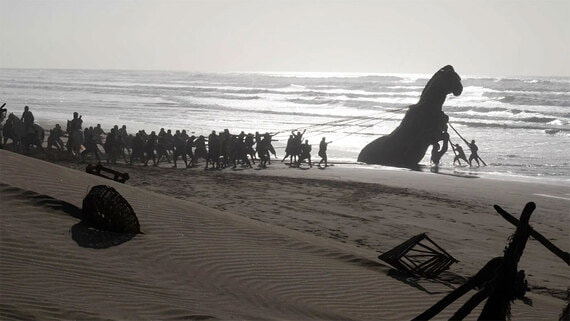
The Trojan Horse stands as one of the most famous military deceptions in Western civilization, a story that has captivated audiences for nearly three millennia. According to ancient Greek tradition, this wooden construction allowed Greek warriors to infiltrate the impregnable city of Troy after ten years of fruitless siege. But was this legendary stratagem truly conceived by the cunning Odysseus, and more importantly, did it ever actually happen? The answer lies somewhere between artistic mythology, possible historical reality, and centuries of scholarly interpretation and reinterpretation.
The Literary Origins of the Trojan Horse Legend
The story of the Trojan Horse does not appear in Homer’s Iliad, which focuses on events during the war rather than its conclusion. Instead, the tale is mentioned briefly in Homer’s Odyssey and elaborated upon in later works, most notably Virgil’s Aeneid, written in the first century BCE. In these accounts, after a decade of unsuccessful warfare against Troy’s mighty walls, the Greeks constructed a massive wooden horse and hid their best warriors inside. The horse was left outside Troy’s gates as an apparent offering to the gods, while the Greek fleet sailed away to create the illusion of retreat. The Trojans, believing they had finally won, brought the horse inside their walls as a trophy. That night, Greek soldiers emerged from the horse’s hollow belly, opened the city gates, and Troy fell to fire and sword.
The attribution of this plan to Odysseus reflects his characterization throughout Greek mythology as a man of exceptional cunning and intelligence. Known by the epithet “polytropos” meaning “of many turns” or “much-traveled,” Odysseus was celebrated not for physical strength like Achilles or Ajax, but for his mental agility and strategic thinking. In some versions, the goddess Athena, patron of wisdom and strategic warfare, assisted or inspired the plan. Other accounts credit the prophet Calchas or the warrior Epeius, who physically constructed the horse. This variability in attribution across different sources suggests the story evolved over centuries of oral tradition before being written down.
Historical Evidence and Archaeological Perspectives
The question of whether the Trojan War actually occurred has fascinated historians and archaeologists since Heinrich Schliemann’s famous excavations at Hisarlik in northwestern Turkey during the 1870s. Schliemann believed he had found Homer’s Troy, and subsequent archaeological work has revealed that the site was indeed destroyed multiple times, with one destruction layer dating to approximately 1180 BCE showing evidence of fire and warfare. However, no physical evidence of a wooden horse has ever been discovered, which is hardly surprising given that wood would not survive over three thousand years.
Some scholars have proposed alternative interpretations of the Trojan Horse story. One theory suggests that the “horse” may have been a metaphor for a battering ram or siege engine, as such devices were sometimes given animal names in ancient warfare. Another hypothesis proposes that the horse represented a naval vessel, since Poseidon, god of the sea and horses, was associated with both. A third interpretation suggests an earthquake may have breached Troy’s walls, with the horse symbolizing Poseidon’s divine intervention, as he was known as the “Earth-Shaker.” These theories attempt to find a rational kernel within the mythological narrative.
The Horse in Military History and Cultural Legacy
Regardless of its historical accuracy, the Trojan Horse has profoundly influenced military thinking and popular culture. The concept of deceptive infiltration has been studied in military academies for centuries, and the term “Trojan Horse” has entered common usage to describe any trick or stratagem that causes a target to invite an enemy into a secure space. In the modern era, computer viruses that disguise themselves as legitimate software are called “Trojans,” demonstrating how this ancient story continues to shape our understanding of deception and vulnerability.
The enduring power of the Trojan Horse narrative lies in its universal themes: the triumph of cleverness over brute force, the dangers of overconfidence, and the thin line between gift and threat. Whether Odysseus actually conceived such a plan, whether the wooden horse was real or metaphorical, or whether the entire story is pure artistic invention, it remains a cornerstone of Western storytelling. The tale reminds us that history and mythology often intertwine in ways that make definitive answers impossible, yet the search for truth behind legend continues to inspire scholars and capture public imagination alike.
Expert Opinion: Classical historians increasingly view the Trojan Horse as a literary device that may encode actual siege warfare techniques used in the Bronze Age Mediterranean, rather than a literal account of events. The story’s survival and elaboration across multiple ancient sources suggests it served important cultural functions in Greek identity formation, regardless of its factual basis. Future archaeological discoveries at Hisarlik and improved analysis of Linear B tablets may yet reveal new insights into the historical events that inspired this immortal tale.