Dark Souls, Bloodborne, Sekiro or Elden Ring: Which to Play First
Dark Souls, Bloodborne, Sekiro and Elden Ring compared on combat, difficulty, builds, structure and platforms, so you can pick the right first FromSoftware game.
FromSoftware’s modern games share a reputation, a director in Hidetaka Miyazaki and a habit of killing the player a lot. They are not interchangeable, though. Dark Souls, Bloodborne, Sekiro: Shadows Die Twice and Elden Ring each ask for different skills, and the one that clicks for one player can drive another away for good. Your first pick matters more than you might think.
This guide compares the four games on the points that matter most to a newcomer: how combat feels, how hard the start is, how much freedom you get to build a character, how the world is laid out, and where you can play each one as of October 2026. At the end you’ll find a recommendation for different types of players. If you’re new to the whole style, our explainer on what a soulslike is covers the shared vocabulary first.
The Four Games at a Glance
| Game | Released | Combat in one line | Character builds | Structure |
|---|---|---|---|---|
| Dark Souls | 2011 | Deliberate, shield-friendly, stamina-driven | Very flexible | Interconnected world |
| Bloodborne | 2015 | Fast, aggressive, dodge-and-punish | Moderate (trick weapons, few shields) | Interconnected city plus optional dungeons |
| Sekiro: Shadows Die Twice | 2019 | Sword duels built on deflection and posture | None (fixed protagonist) | Interconnected, mostly linear progression |
| Elden Ring | 2022 | Souls combat with jumping, mounted fights and summons | Very flexible | Open world plus large legacy dungeons |
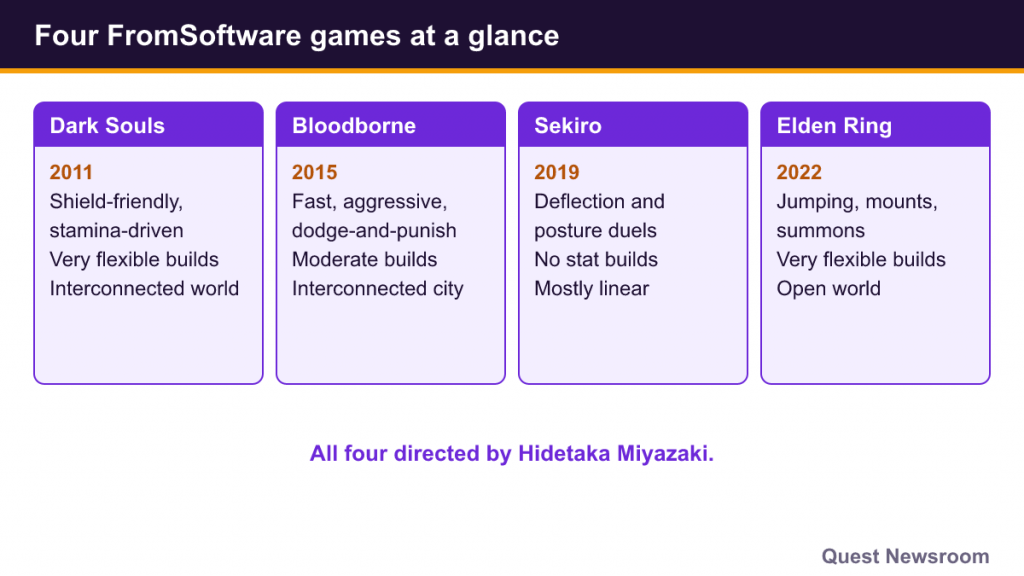
All four were directed by Miyazaki, who led Dark Souls, Bloodborne, Sekiro (as lead director) and Elden Ring. Dark Souls II (2014) and Dark Souls III (2016) are left aside here; most players reach them after the original.
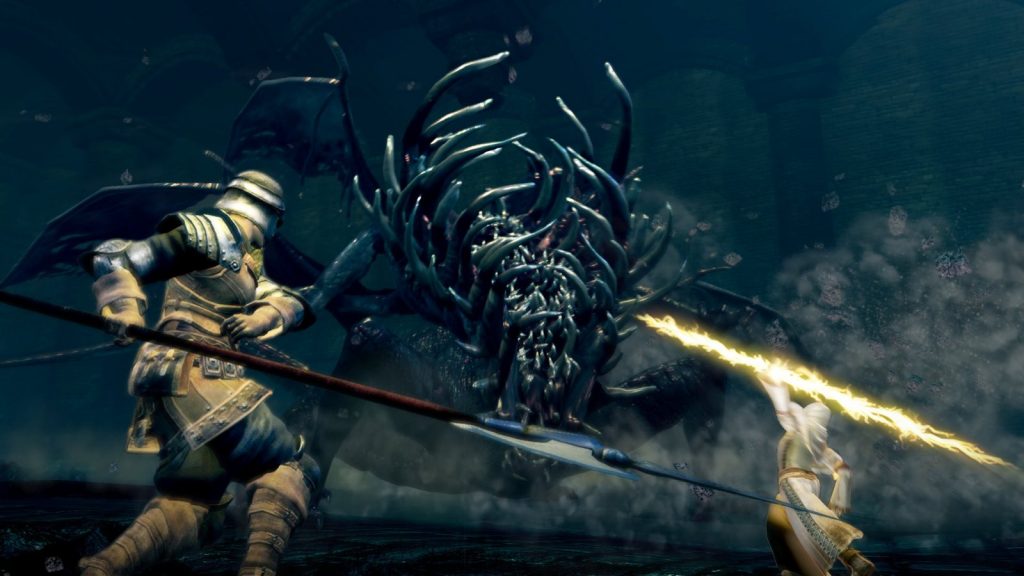
Dark Souls: The Template
Dark Souls came out in 2011 for PlayStation 3 and Xbox 360 (Japan got it on September 22, North America on October 4). A Windows version, the Prepare to Die Edition, followed in August 2012 and added new areas and bosses that consoles later received as the Artorias of the Abyss DLC. Today most people play Dark Souls: Remastered, released on May 25, 2018 for PS4, Windows and Xbox One, and on October 19, 2018 for Nintendo Switch.
How it plays
Combat is slow and weighty by modern standards. Every swing, roll and block drains stamina, so you learn to commit to an attack only when it is safe. Shields are fully viable, which makes Dark Souls the most forgiving of the four for players who like to react rather than attack. Souls work as both experience and money; if you die you drop them, and you lose them for good if you die again before getting back to your bloodstain.
Why it still works as a first game
The world of Lordran is one continuous space folded in on itself, linked by shortcuts you unlock from the far side. Opening a door and realizing you are back at a familiar bonfire is one of the great moments in game design. Bonfires act as checkpoints where you rest, level up and refill your Estus Flask, but resting also respawns most enemies, so every trip out is a small run with its own risk.
The downsides are real. The game tells you very little, and some late areas are visibly rougher than the early ones. If you like slow, careful play, those quirks become part of the appeal.
Bloodborne: Aggression Rewarded
Bloodborne launched on March 24, 2015 in North America as a PlayStation 4 exclusive published by Sony Computer Entertainment. As of October 2026 it is still only available on PS4, playable on PS5 through backward compatibility, with no PC port or remaster released. That platform limit is the biggest practical obstacle to recommending it as a first game.
How it plays
Bloodborne takes away the shield and pushes you forward. Its rally system lets you win back part of the health you just lost by hitting an enemy quickly in return, so the safest choice is often to counterattack instead of backing off. Weapons are “trick weapons” that switch between two forms with different movesets, such as a saw cleaver that extends into a longer blade. A firearm in the off hand is mostly used to interrupt enemy attacks with a well-timed shot, opening them up for a heavy critical hit called a visceral attack.
Insight, a second currency earned by meeting or defeating bosses, also changes parts of the world as it builds, which suits the game’s slide from Gothic horror into cosmic horror. The optional Chalice Dungeons, some fixed and some procedurally generated, add many more hours. The Old Hunters expansion arrived on November 24, 2015.
Who should start here
Bloodborne is more focused than Dark Souls or Elden Ring, and its combat loop is very clear: stay close, dodge and keep up the pressure. Players who come from action games often find that easier to learn than Dark Souls’ defensive patience. If you own a PlayStation and love horror, it is a strong choice.
Sekiro: The Hardest Pure Skill Test
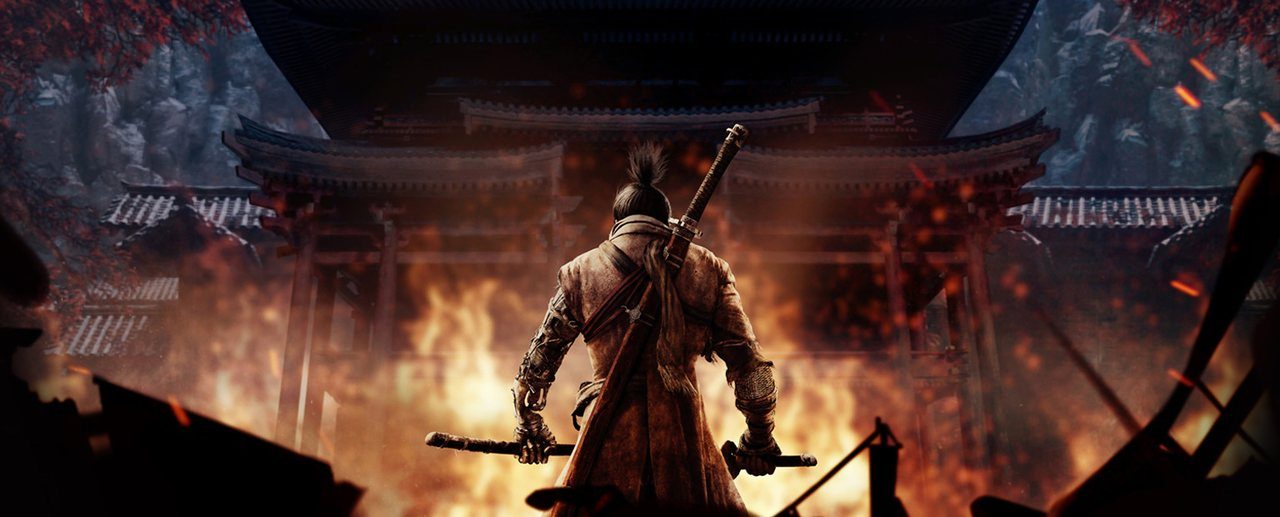
Sekiro: Shadows Die Twice was released on March 22, 2019 for PlayStation 4, Windows and Xbox One, published by Activision outside Japan. It won Game of the Year at The Game Awards 2019. It is also the most different of the four.
How it plays
You play Wolf, a shinobi with a fixed identity and no character creation or stat-based class choice. Combat centers on posture: rather than wearing down a health bar, you break an enemy’s guard through attacks and, above all, by deflecting their blows with well-timed blocks. A full posture bar opens a deathblow. Wolf’s prosthetic arm adds tools such as a grappling hook and situational weapons, and a skill tree unlocks new techniques, but you cannot grind into a different build.
The game has no multiplayer at all, so there is no summoning a friend for a hard boss. There is a resurrection mechanic that lets you get back up on the spot after a death if you have resurrection power, which recharges by defeating enemies. It does not change the core demand: you must learn each fight’s rhythm.
Who should start here
Sekiro suits players who love fighting games, rhythm games or duels, and who would rather master one system than juggle gear. For everyone else it is usually a better second or third game. Its difficulty cannot be eased with levels, spells or allies, so if you hit a wall, the only way past it is to get better at deflecting.
Elden Ring: The Most Approachable Entry
Elden Ring came out on February 25, 2022 for PS4, PS5, Windows, Xbox One and Xbox Series X|S, and won Game of the Year at The Game Awards 2022. Its expansion, Shadow of the Erdtree, followed on June 20, 2024. A Nintendo Switch 2 version, Elden Ring Tarnished Edition, which bundles the base game and the expansion, launched on August 28, 2026 after being delayed from 2025. The game had sold 30 million copies by April 2025.
How it plays
The combat is recognizably Dark Souls, with the addition of jumping, guard counters and the spectral steed Torrent for fights on horseback. The big difference is structure. The Lands Between is an open world: if a boss is too hard, you can ride somewhere else, explore, level up and come back stronger. Spirit Ashes let you summon computer-controlled allies in boss arenas and other large areas, and online co-op is available too. Classic large dungeons such as Stormveil Castle still deliver the dense, interconnected design of the older games.
Why it’s the default recommendation
Elden Ring has more ways to make things easier than any other FromSoftware game, without changing its difficulty setting (there isn’t one). Magic builds can fight from range, summons can draw a boss’s attention, and the open map makes it easy to back off when you’re stuck. It is also the longest of the four and the most available, playable on every current major platform. Our Elden Ring beginner guide covers its core systems in detail.
The risk is the opposite of Sekiro’s: some players feel lost with so much freedom and so little direction. If you need a clear path, start with Dark Souls or Bloodborne instead.
Comparing Difficulty, Builds and Structure
Difficulty curve
All four are hard, but in different ways. The opening hours are the toughest part of Bloodborne and Sekiro, because both expect you to adopt an unfamiliar style of play right away. Dark Souls is hard throughout but lets you hide behind a shield while you learn. Elden Ring’s open world flattens the curve, since you can usually go somewhere easier, though its late-game bosses are among the most demanding the studio has made.
Build flexibility
- Most flexible: Elden Ring and Dark Souls. Strength, dexterity, sorcery, faith and hybrid builds are all viable, and you can respec in Elden Ring after a certain point.
- In between: Bloodborne. You choose weapons and stats, and Arcane opens up some special options, but the game expects you to fight up close.
- Fixed: Sekiro. There are upgrades and skills, but every player is the same shinobi with the same sword.
Platforms as of October 2026
| Game | Where you can play it |
|---|---|
| Dark Souls: Remastered | PS4 (and PS5 via backward compatibility), Xbox One (and Series X|S via backward compatibility), Windows, Nintendo Switch |
| Bloodborne | PS4 only, also playable on PS5 via backward compatibility |
| Sekiro: Shadows Die Twice | PS4, Xbox One, Windows (playable on newer consoles via backward compatibility) |
| Elden Ring | PS4, PS5, Xbox One, Xbox Series X|S, Windows, Nintendo Switch 2 |
If you play only on Nintendo hardware, your choice is between Dark Souls: Remastered on Switch and Elden Ring on Switch 2. On PC or Xbox, Bloodborne is not an option.
Which One Should You Play First?
- Most players: Elden Ring. It is the most widely available, the most flexible, and the best at letting you route around a wall. Its open world teaches the core Souls habits without trapping you in front of one boss.
- Players who want the classic, focused design: Dark Souls: Remastered. It is smaller, its interconnected world is the series at its most influential, and its shields give a gentler learning curve than the speed of Bloodborne.
- PlayStation owners who like fast action and horror: Bloodborne. Its push to be aggressive suits players coming from character action games, and it is a complete, compact experience.
- Players who already love precise duels: Sekiro. Start here only if mastering one demanding system sounds like fun. Otherwise, keep it for later, once the general rhythm of these games feels familiar.
Common mistakes on a first run
- Treating it like a standard action game. Mashing attacks drains stamina and leaves you open. Learn when an enemy is vulnerable.
- Refusing all help. Summons, Spirit Ashes and ranged builds are part of the design, not a cheat.
- Quitting at the first wall. Every one of these games has a point where many players stall. Explore elsewhere, upgrade your weapon, or take a break and come back.
Whichever you pick first, the others become easier because the habits carry over: watch the enemy, manage stamina, and treat each death as information. For how the studio got from its early dungeon crawlers to these games, read our history of FromSoftware.