Pokémon Battle Mechanics Explained: Types, Stats, IVs, EVs and Natures
A clear guide to the RPG systems behind main-series Pokémon battles: type matchups, STAB, physical vs. special moves, base stats, IVs, EVs and natures.

Pokémon looks simple on the surface. Pick a creature, choose a move, watch the health bar drop. Underneath, though, the main-series games run on one of the most detailed stat systems in any RPG. Two Pokémon of the same species and level can have noticeably different stats, and a single move can deal wildly different damage depending on types, categories and hidden values. You don’t need to master any of this to finish the story, but understanding it makes the games more interesting and helps you build a stronger team. This guide explains the core systems in plain language, with notes on when key changes arrived.
The Basics: A Turn-Based RPG at Heart
Main-series Pokémon battles are turn-based. Your party holds up to six Pokémon, and each turn you can use a move, use an item, switch Pokémon or, in wild battles, run. Pokémon gain experience when an opponent faints and level up as experience accumulates, which raises their stats and can unlock new moves and evolutions. For a general look at how XP systems work across RPGs, see our guide to experience points and leveling.

Many other systems have been layered on over the years, including abilities (introduced in Ruby and Sapphire, the third generation), held items (second generation) and double battles (third generation). This article focuses on the parts that determine damage and stats in standard battles. Note that some spin-off-style entries in the main series, such as Legends: Arceus, simplify or change several of these systems.
Types and Matchups
Every Pokémon has one or two types, and every damaging move has one type. As of the current games there are 18 types: Normal, Fire, Water, Electric, Grass, Ice, Fighting, Poison, Ground, Flying, Psychic, Bug, Rock, Ghost, Dragon, Dark, Steel and Fairy. Dark and Steel were added in the second generation, and Fairy arrived in the sixth generation with X and Y in 2013.
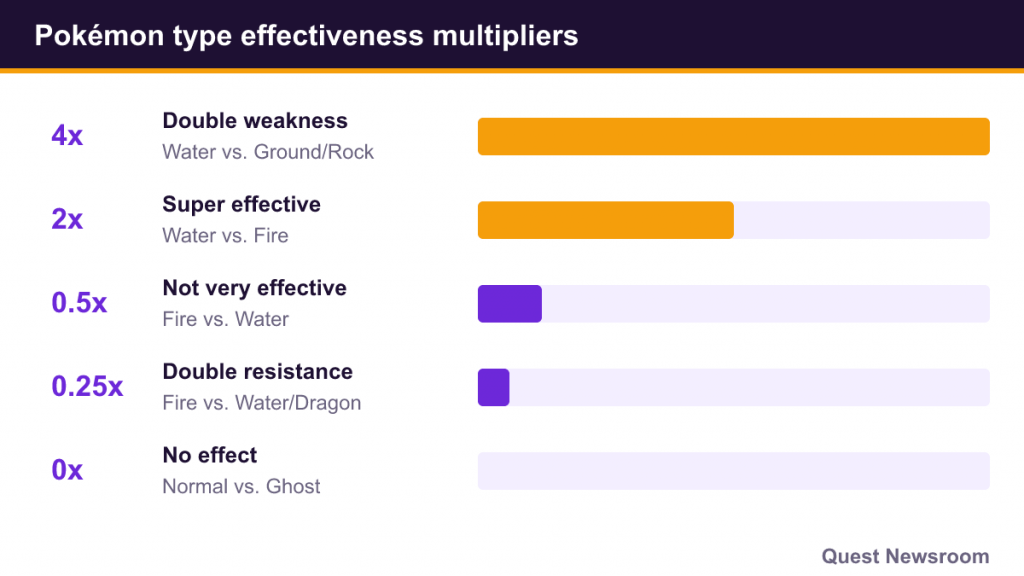
Type effectiveness is a multiplier applied to damage:
| Matchup | Multiplier | Example |
|---|---|---|
| Super effective | 2x | Water move against a Fire-type |
| Not very effective | 0.5x | Fire move against a Water-type |
| No effect | 0x | Normal move against a Ghost-type |
| Double weakness | 4x | Water move against a Ground/Rock Pokémon |
| Double resistance | 0.25x | Fire move against a Water/Dragon Pokémon |
For dual-type Pokémon, the two multipliers stack. That is why a Pokémon that is both Ground and Rock takes four times damage from Water moves, while a weakness on one type can be cancelled by a resistance on the other.
Why types matter in the story
In single-player play, types are your most powerful tool. Gym Leaders usually specialize in a single type, so bringing a Pokémon with a super-effective move can turn a tough fight into an easy one. A balanced team covering many types handles surprises better than six of your favorite Pokémon that share weaknesses.
STAB: Same-Type Attack Bonus
When a Pokémon uses a move that matches one of its own types, the move gets a 1.5x boost, known as STAB (Same-Type Attack Bonus). A Water-type using a Water move gets the bonus; a Water-type using an Ice move does not.
STAB stacks with type effectiveness. A Water-type Pokémon using a Water move against a Ground/Rock Pokémon deals 1.5 x 2 x 2, or six times the base damage. This is why most Pokémon want at least one strong move of their own type.
In Pokémon Scarlet and Violet, the Terastal phenomenon adds a twist. Terastallizing changes a Pokémon’s type to a single Tera Type. Its original types still receive STAB, and the Tera Type does too. If the Tera Type matches one of the Pokémon’s original types, moves of that type get a 2x bonus instead of 1.5x.
Physical, Special and Status Moves
Moves come in three categories:
- Physical moves use the attacker’s Attack stat against the target’s Defense.
- Special moves use Special Attack against Special Defense.
- Status moves deal no direct damage; they change stats, inflict conditions or affect the field.
Before the fourth generation, a move’s category was determined entirely by its type. All Fire, Water, Ice, Electric, Grass, Psychic, Dragon and Dark moves were special, and all Normal, Fighting, Flying, Ground, Rock, Bug, Ghost, Poison and Steel moves were physical. That created odd situations: a Pokémon with a high Attack stat but an Ice or Dark typing could not use its own-type moves effectively.
Starting with the fourth generation (Diamond and Pearl), each move received its own category regardless of type. Fans call this the physical/special split. It made many Pokémon more useful and is one of the most important changes the series has made.
The practical lesson: match moves to your Pokémon’s stronger attacking stat. A Pokémon with high Attack and low Special Attack should mostly use physical moves, even if a special move has a higher listed power.
Base Stats: What a Species Is Good At
Each Pokémon species has six base stats: HP, Attack, Defense, Special Attack, Special Defense and Speed. These are fixed for the species and determine its general strengths. Some species are fast and fragile, others slow and sturdy, others built for special attacks.
Base stats are the biggest single factor in a Pokémon’s final stats. Two Pokémon of the same species and level, without special training, will be broadly similar. Speed deserves special attention because it usually decides who moves first in a turn, which can be the difference between landing a knockout and being knocked out.
For a broader look at how stat systems work across RPGs, from D&D to Fallout, see our explainer on RPG character stats.
IVs: Individual Values
IVs, or Individual Values, are hidden numbers that make each Pokémon slightly different from others of its species. Since the third generation, each Pokémon has one IV per stat, ranging from 0 to 31. Each IV point adds roughly one stat point at level 100, so a Pokémon with perfect IVs can have up to 31 more points in a stat than one with the worst possible IVs at that level.
IVs are set when a Pokémon is caught, hatched or received. Later games added in-game ways to view and improve them. Recent main-series games include a “judge” function that rates IVs and Hyper Training, which uses Bottle Caps to raise a high-level Pokémon’s effective IVs to the maximum.
For players focused on the story, IVs make only a small difference. They matter most in competitive battles where small stat differences decide speed ties and knockouts.
EVs: Effort Values
EVs, or Effort Values, represent training. Every time your Pokémon defeats an opponent and gains experience, it also earns EVs, usually in the stat or stats the defeated species is best at. Defeating fast Pokémon tends to give Speed EVs, for example.
The rules in modern games:
- A Pokémon can have 510 EVs in total.
- Every 4 EVs in a stat add 1 stat point at level 100.
- Because 4 does not divide evenly into the per-stat maximum, 252 EVs (worth 63 stat points) is the practical maximum for a single stat, which is why competitive players often put 252 EVs into two stats and 4 into a third.
Players can also adjust EVs with items. Vitamins add EVs to a specific stat, held Power items add extra EVs in a stat when the holder earns them, and certain berries lower EVs in a stat so you can redistribute them. Pokérus, a rare and harmless in-game virus, doubles EV gains.
The EV system arrived in its modern form in the third generation (Ruby and Sapphire). The first two generations used a different system, often called stat experience, with much larger numbers.
Natures
Natures were introduced in the third generation. Every Pokémon has one of 25 natures, chosen at random. Twenty of them raise one stat (other than HP) by 10% and lower another by 10%. The other five raise and lower the same stat, making them effectively neutral.
For example, an Adamant nature raises Attack and lowers Special Attack, which suits physical attackers. A Timid nature raises Speed and lowers Attack, which suits fast special attackers.
Natures used to be permanent, but Sword and Shield introduced mints. A mint changes how a Pokémon’s stats grow to match a different nature, though the Pokémon’s displayed nature does not change.
Putting It Together: How Stats Are Calculated
A Pokémon’s final stats combine everything above. In simplified form, each stat is based on twice the base stat plus IVs plus a quarter of the EVs, scaled by level, with the nature multiplier applied at the end for non-HP stats. HP uses a slightly different formula.
Roughly, then:
- Base stats set the shape of the Pokémon.
- IVs add up to 31 points per stat at level 100.
- EVs add up to 63 points per stat at level 100.
- Natures shift one stat up and another down by 10%.
How Much Does This Matter in Single-Player?
For the main story, much less than online discussions suggest. The campaign is balanced so that a reasonable team of Pokémon at appropriate levels can win without any IV or EV planning. Practical advice for story play:
- Prioritize type coverage. A team with diverse types and moves handles most fights.
- Use STAB moves. A strong move of the Pokémon’s own type is usually its best attack.
- Match move category to stats. Physical attackers use physical moves; special attackers use special moves.
- Check natures for your favorites. If a nature hinders your Pokémon’s main stat, a mint in later games can fix it.
- Don’t worry about IVs and EVs unless you enjoy optimization or plan to battle competitively.
Learning these systems turns Pokémon from a collection game into a surprisingly deep RPG. Even if you never calculate a single stat, knowing why a move hit so hard or why your Pokémon always moves second makes every battle easier to read.