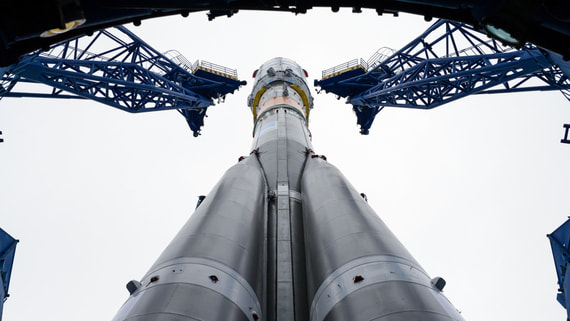
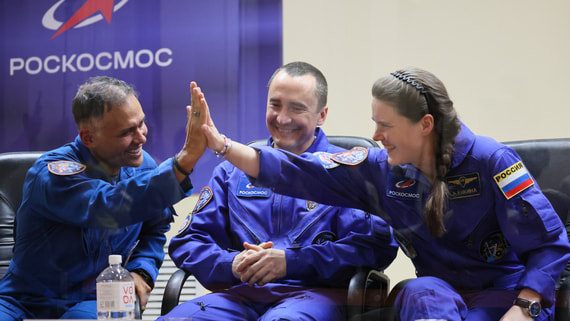
A Russian Soyuz MS-29 spacecraft has successfully launched from the historic Baikonur Cosmodrome in Kazakhstan, carrying a crew of cosmonauts on their journey to the International Space Station. The mission represents another milestone in the ongoing international cooperation in space exploration, as the crew prepares for an ambitious program that includes 38 scientific experiments and two planned spacewalks during their stay aboard the orbital laboratory. The launch proceeded smoothly, with the spacecraft entering its designated orbit and beginning its approach to the ISS for docking operations.
The Baikonur Cosmodrome, located in the steppes of Kazakhstan, has served as humanity’s gateway to the stars since the dawn of the space age. It was from this very location that Yuri Gagarin became the first human to travel to space in 1961, and the facility has remained central to Russian space operations ever since. The cosmodrome spans approximately 6,717 square kilometers, making it one of the largest space launch facilities in the world, with multiple launch pads capable of supporting various rocket configurations.
Mission Objectives and Scientific Program
The crew aboard Soyuz MS-29 faces an intensive work schedule during their expedition to the International Space Station. The 38 planned experiments span multiple scientific disciplines, including biology, physics, materials science, and human physiology research. These experiments are designed to take advantage of the unique microgravity environment aboard the ISS, where conditions impossible to replicate on Earth allow scientists to observe phenomena and conduct research that advances our understanding of fundamental scientific principles.
Among the most challenging aspects of the mission are the two scheduled extravehicular activities, commonly known as spacewalks. These operations require extensive preparation and carry inherent risks, as cosmonauts work outside the protective confines of the station while traveling at approximately 28,000 kilometers per hour in the vacuum of space. Spacewalks typically involve maintenance tasks, equipment installation, and scientific instrument deployment on the station’s exterior. Each EVA can last between five and eight hours, demanding peak physical and mental performance from the crew members.
International Cooperation in Space
The International Space Station represents one of humanity’s most ambitious collaborative engineering projects, involving space agencies from the United States, Russia, Europe, Japan, and Canada. Since the first module was launched in 1998, the ISS has been continuously inhabited since November 2000, serving as a testament to what nations can achieve when working together toward common goals. The station orbits Earth approximately 16 times per day at an altitude of roughly 400 kilometers, providing a unique platform for scientific research and technology demonstration.
Despite geopolitical tensions on Earth, cooperation aboard the ISS has remained remarkably stable. Russian Soyuz spacecraft have served as critical crew transportation vehicles, particularly during periods when other options were limited. The spacecraft design has proven exceptionally reliable over decades of operation, with the Soyuz family of rockets and capsules accumulating an impressive safety record. This reliability has made the Soyuz system a cornerstone of crewed space operations, complementing newer vehicles from commercial partners.
Future of Human Spaceflight
As the ISS enters its third decade of operations, discussions continue about the future of low Earth orbit habitation. Plans are underway for commercial space stations that could eventually replace or supplement the ISS, while both Russia and China develop their own orbital facilities. The scientific knowledge gained from missions like Soyuz MS-29 contributes to humanity’s broader ambitions of returning to the Moon and eventually sending humans to Mars. Each experiment conducted and each spacewalk completed adds valuable data to the collective understanding of how humans can live and work in space for extended periods.
The successful launch of Soyuz MS-29 demonstrates the continued importance of established space programs even as new commercial players enter the field. The experience accumulated over decades of Soyuz operations provides invaluable institutional knowledge that benefits the entire global space community. As the crew settles into their routine aboard the station, they join a legacy of explorers pushing the boundaries of human achievement in one of the most hostile environments known to mankind.
Expert Opinion: The Soyuz MS-29 mission underscores Russia’s continued commitment to maintaining its presence in low Earth orbit despite budget constraints and shifting global priorities. With 38 experiments planned, this expedition appears focused on maximizing scientific return while the ISS partnership remains active. Looking ahead, the success of such missions will be crucial for maintaining expertise needed as the international community transitions toward next-generation orbital facilities in the late 2020s.