
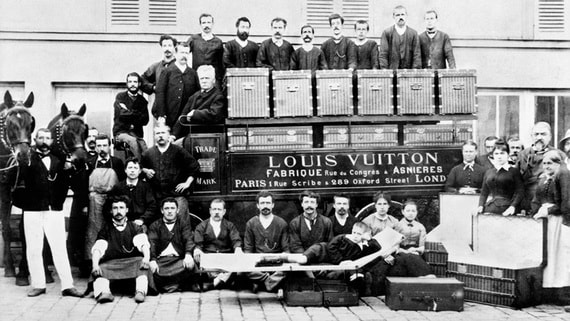
Two hundred and five years ago, in the small village of Anchay in eastern France, a boy was born who would eventually revolutionize the luxury goods industry and create one of the most recognizable brands in the world. Louis Vuitton, born on August 4, 1821, rose from humble beginnings to establish an empire built on craftsmanship, innovation, and an unwavering commitment to quality that continues to define luxury fashion to this day.
The journey of young Louis Vuitton began under circumstances that would seem unlikely for a future titan of luxury. His family were modest millers and carpenters, and his childhood was marked by hardship. After his mother’s death when he was just ten years old and his father’s remarriage to a stepmother with whom he had a difficult relationship, the fourteen-year-old Louis made a decision that would change his life forever. In 1835, he left his village and walked nearly 300 miles to Paris, taking odd jobs along the way to survive the two-year journey.
The Making of a Master Craftsman
Upon arriving in Paris in 1837, Louis Vuitton apprenticed himself to Romain Maréchal, a renowned layetier-emballeur, or trunk-maker and packer. This profession was highly regarded in an era when wealthy aristocrats and the emerging bourgeoisie required skilled craftsmen to pack their elaborate wardrobes and delicate possessions for long journeys. Vuitton proved to be an exceptionally talented apprentice, quickly mastering the art of creating protective packaging for the most fragile items and constructing sturdy travel trunks. His reputation grew rapidly among Parisian high society, and by 1853, he had become the personal trunk-maker and packer to Empress Eugénie, wife of Napoleon III.
The patronage of the French imperial court was transformative for Vuitton’s career. It provided him not only with prestige but also with deep insight into the needs of the world’s most demanding travelers. He observed how the rounded-top trunks of the era, designed to shed rainwater when transported by horse-drawn carriages, were impractical for the new age of steamship and railway travel. These traditional designs could not be stacked efficiently, wasting precious cargo space.
Revolutionary Innovation in Trunk Design
In 1854, Louis Vuitton opened his own workshop at 4 Rue Neuve-des-Capucines in Paris, marking the official birth of the House of Vuitton. His first major innovation was the flat-topped trunk, a seemingly simple modification that represented a paradigm shift in luggage design. These new trunks could be easily stacked in the holds of ships and railway compartments, making them infinitely more practical for modern travel. Vuitton also pioneered the use of Trianon canvas, a grey waterproof fabric that replaced the traditional leather covering, making his trunks both lighter and more resistant to the elements.
The success was immediate and spectacular. Orders poured in from aristocrats, industrialists, and celebrities across Europe and beyond. By 1859, demand had grown so substantially that Vuitton moved his operations to a larger facility in Asnières-sur-Seine, a location that remains the spiritual home of Louis Vuitton craftsmanship to this day. The workshop there still produces the brand’s most exclusive and custom pieces, maintaining techniques that Louis himself would recognize.
The Birth of an Iconic Pattern
After Louis Vuitton’s death in 1892, his son Georges inherited the business and faced a growing problem that plagued the luxury industry: counterfeiting. Imitators were producing inferior copies of Vuitton trunks, damaging both sales and reputation. Georges’s response was both practical and visionary. In 1896, he introduced the iconic LV monogram canvas featuring his father’s initials intertwined with geometric floral motifs. This design was not merely decorative; it was one of the world’s first trademarked patterns, created specifically to combat forgery. More than 125 years later, this same monogram remains perhaps the most recognized symbol in luxury fashion.
The twentieth century saw Louis Vuitton expand far beyond its origins in travel goods. The brand weathered two world wars, adapted to changing travel customs, and eventually evolved into a full-fledged fashion house. In 1987, Louis Vuitton merged with Moët Hennessy to form LVMH, now the world’s largest luxury goods conglomerate. Under the creative direction of designers like Marc Jacobs and currently Pharrell Williams, the brand has embraced ready-to-wear fashion, accessories, and cultural collaborations while maintaining its heritage of exceptional craftsmanship. Today, Louis Vuitton generates annual revenues exceeding 20 billion euros, making it the crown jewel of the LVMH empire and a testament to the enduring vision of a young craftsman who walked to Paris with nothing but determination and dreams.
Expert Opinion: The Louis Vuitton story exemplifies how authentic craftsmanship combined with strategic innovation can create multigenerational brand value. What distinguishes Vuitton from competitors who failed is the brand’s ability to honor its heritage while continuously reinventing itself for new consumer generations. As luxury markets increasingly shift toward experiential and digital engagement, heritage brands like Louis Vuitton that maintain genuine artisanal roots while embracing contemporary culture will likely continue to dominate the sector for decades to come.