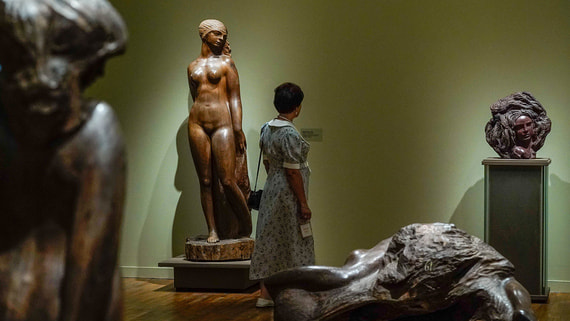
The New Tretyakov Gallery in Moscow has opened a remarkable exhibition featuring more than 80 sculptural works by Stepan Erzia, an artist often referred to as the “Russian Rodin” for his extraordinary ability to transform raw materials into breathtaking artistic statements. The exhibition, titled “Mythology of Sculpture,” brings together an unprecedented collection of works by this master craftsman who spent decades perfecting his unique approach to sculpting, one that he described as “correcting” nature’s own creative work. The display offers visitors a rare opportunity to experience the full scope of Erzia’s artistic vision, from his early classical influences to his later innovative techniques that would establish him as one of the twentieth century’s most distinctive sculptors.
Stepan Dmitrievich Nefedov, who adopted the artistic pseudonym Erzia in honor of his Mordovian ethnic heritage, was born in 1876 in the village of Baevo in what is now the Republic of Mordovia. His chosen name pays tribute to the Erzya people, one of the two main ethnic groups of the Mordovian nation, reflecting his deep connection to his cultural roots throughout his artistic career. From humble beginnings as a village icon painter, Erzia rose to international prominence, studying at the Moscow School of Painting, Sculpture and Architecture before traveling extensively through Europe, where he absorbed influences from Italian Renaissance masters and contemporary artistic movements alike.
A Revolutionary Approach to Natural Materials
What set Erzia apart from his contemporaries was his revolutionary approach to working with materials. While studying and working in Argentina from 1927 to 1950, he discovered the extraordinary potential of quebracho and algarrobo, two South American hardwoods of exceptional density and durability. These materials, which indigenous peoples had used for centuries, became Erzia’s signature medium. Unlike marble or bronze, these woods presented unique challenges and opportunities, with their natural grain patterns, knots, and color variations becoming integral elements of the finished works rather than obstacles to be overcome. Erzia developed the philosophy that the artist’s role was not to impose form upon material but to reveal the sculpture already hidden within it, a concept he expressed through his famous statement about “correcting” nature.
The technical mastery required to work with quebracho, often called “axe-breaker” due to its hardness, demanded extraordinary patience and skill. Erzia would spend months, sometimes years, on a single piece, carefully following the wood’s natural contours while coaxing his envisioned forms from the resistant material. His portraits, particularly those depicting women’s faces emerging from twisted roots and burls, achieved an almost supernatural quality, as if the subjects were spirits dwelling within the trees themselves. This approach aligned Erzia with broader movements in early twentieth-century art that sought to break free from academic conventions while maintaining technical excellence.
International Recognition and Soviet Legacy
Erzia’s international reputation grew substantially during his years abroad. He exhibited throughout Europe and the Americas, earning comparisons to Auguste Rodin for the emotional intensity and technical virtuosity of his work. When he finally returned to the Soviet Union in 1950, he brought with him hundreds of sculptures, effectively donating his life’s work to his homeland. The Soviet government recognized his contributions by providing him with a studio and living quarters, though his artistic independence and religious themes sometimes created tension with official cultural policies. After his death in 1959, a significant portion of his collection was transferred to the Mordovian Republican Museum of Fine Arts in Saransk, which now bears his name and houses the world’s largest collection of his works.
The current Tretyakov exhibition represents a significant scholarly and curatorial effort to reassess Erzia’s place in art history. For decades, his work remained relatively unknown outside specialist circles, overshadowed by the political priorities of Soviet-era cultural institutions and later by the tumultuous post-Soviet period. However, recent years have seen renewed interest in artists who defied easy categorization, and Erzia’s unique fusion of European sculptural traditions with innovative material choices has attracted attention from art historians and collectors worldwide. The exhibition includes works spanning his entire career, allowing visitors to trace his artistic evolution from conventional academic pieces to the transcendent wood sculptures that define his mature period.
Preserving a Master’s Vision for Future Generations
The “Mythology of Sculpture” exhibition arrives at a moment of broader cultural reflection on Russia’s artistic heritage. Museums and galleries across the country have been working to preserve and promote works by artists whose contributions may have been underappreciated or misunderstood during previous eras. For Erzia, whose philosophy centered on the eternal dialogue between artist and material, the exhibition offers a fitting tribute to his vision of sculpture as a living conversation between human creativity and natural form. Visitors to the New Tretyakov Gallery will encounter works that challenge conventional boundaries between craft and art, between control and surrender, and between the artist’s will and nature’s wisdom—themes that remain as relevant today as they were during Erzia’s remarkable lifetime.
Expert Opinion: This exhibition marks a crucial turning point in the international reassessment of Stepan Erzia’s legacy. As global art markets increasingly value artists who pioneered sustainable and material-conscious approaches to creation, Erzia’s philosophy of working with rather than against natural forms positions him as a surprisingly contemporary figure. We may expect growing scholarly attention and rising market interest in his work over the coming decade, potentially elevating him from regional treasure to globally recognized master.