
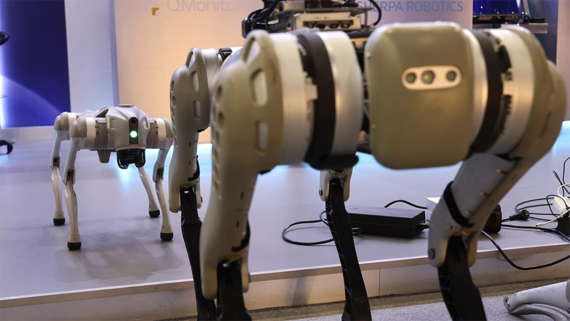
The St. Petersburg International Economic Forum (SPIEF) 2026 has become a showcase for Russia’s rapidly advancing robotics industry, with humanoid robots and intelligent machines capturing the attention of attendees from government ministries to major corporations. The Ministry of Health, online marketplace Avito, and numerous other forum participants have turned to robotic assistants, signaling a significant shift in how Russian organizations approach automation and artificial intelligence integration. This year’s exhibition floor has transformed into a glimpse of the future, where machines designed to work alongside humans demonstrate capabilities that were science fiction just a decade ago.
The presence of humanoid robots at SPIEF 2026 represents more than mere technological curiosity—it reflects a strategic pivot in Russia’s economic development priorities. As the country navigates complex geopolitical realities and seeks to reduce dependence on foreign technology, domestic robotics development has become a national imperative. The forum, traditionally a platform for major economic announcements and international business deals, has increasingly become a venue for showcasing Russian technological achievements and attracting investment into the country’s growing tech sector.
Healthcare Revolution: Ministry of Health Embraces Robotic Assistance
The Ministry of Health’s adoption of robotic technologies at the forum highlights the healthcare sector’s growing interest in automation solutions. Medical robots have been demonstrating capabilities ranging from patient interaction and basic diagnostics to logistical support within hospital environments. Russian healthcare administrators see these machines as potential solutions to persistent staffing shortages, particularly in remote regions where medical professionals are scarce. The robots on display can perform routine tasks such as patient registration, medication delivery, and even preliminary health screenings, freeing human medical staff to focus on more complex care requirements.
Russia’s healthcare robotics push aligns with global trends that have accelerated since the COVID-19 pandemic, which exposed vulnerabilities in healthcare systems worldwide. Countries from Japan to the United States have invested heavily in medical automation, and Russia aims to establish itself as a competitive player in this space. The Ministry of Health representatives at SPIEF emphasized that robotic integration would supplement rather than replace human healthcare workers, addressing concerns about job displacement while highlighting efficiency gains that could improve patient outcomes across the country’s vast territory.
Corporate Adoption: Avito and Private Sector Lead the Charge
Avito, Russia’s leading online classifieds platform, represents the private sector’s enthusiasm for robotic solutions. The company has been exploring automation for customer service, warehouse operations, and delivery logistics. At SPIEF 2026, Avito demonstrated how intelligent machines could streamline operations in e-commerce, from sorting packages to interacting with customers at pickup points. The company’s investment in robotics reflects broader trends in the Russian tech industry, where major players are racing to develop or acquire automation capabilities to maintain competitive advantages.
The corporate embrace of robotics extends beyond technology companies. Manufacturing firms, agricultural enterprises, and retail chains have all sent representatives to SPIEF specifically to explore robotic partnerships and procurement opportunities. Industry analysts note that Russia’s robotics market has grown substantially in recent years, driven by both necessity and opportunity. Sanctions and supply chain disruptions have motivated domestic development, while labor market pressures—including demographic challenges and skilled worker shortages—have made automation increasingly attractive to businesses across sectors.
Russia’s Robotics Ambitions: From Import Dependency to Domestic Innovation
The robot boom at SPIEF 2026 represents the culmination of years of government policy aimed at fostering domestic robotics capabilities. Russian authorities have launched multiple initiatives to support robotics research and development, including funding for university programs, tax incentives for robotics manufacturers, and procurement preferences for domestically produced machines. These efforts have yielded results, with several Russian companies now producing humanoid robots, industrial automation systems, and specialized machines for sectors ranging from agriculture to defense.
Historical context illuminates the significance of this moment. Russia has a long tradition of robotics research dating back to Soviet-era cybernetics programs, but commercial robotics development lagged behind Western and Asian competitors for decades. The current push to close this gap involves not only government support but also partnerships between research institutions and private industry. Universities in Moscow, Saint Petersburg, and other cities have established robotics centers that work closely with commercial partners to bring innovations from laboratory to market. The SPIEF exhibition showcases products from this collaborative ecosystem, demonstrating that Russian robotics has matured from experimental projects to commercially viable solutions ready for deployment across the economy.
Expert Opinion: The concentration of robotic technologies at SPIEF 2026 signals Russia’s serious commitment to establishing technological sovereignty in automation—a sector that will define industrial competitiveness for decades to come. While challenges remain in scaling production and developing truly advanced AI capabilities, the breadth of applications demonstrated suggests that Russian robotics is transitioning from demonstration phase to practical implementation. The next two to three years will be critical in determining whether these ambitious programs can achieve the scale and sophistication needed to compete globally.