
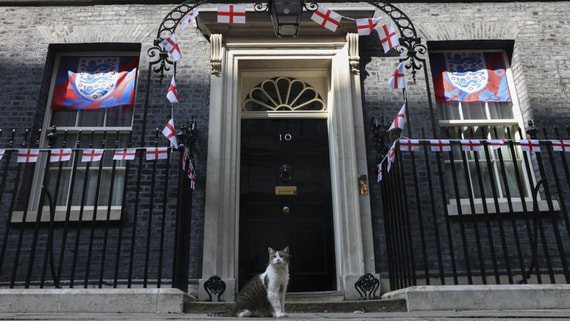
In the heart of British political power, where prime ministers come and go with increasing frequency, one resident has remained a constant presence through every crisis, scandal, and change of government. Larry the cat, officially known as the Chief Mouser to the Cabinet Office, has now served at 10 Downing Street for 15 remarkable years, outlasting six different prime ministers. This tabby and white rescue cat has become not just a beloved fixture of British political life, but an unofficial symbol of stability in an era of unprecedented governmental turbulence.
Larry’s tenure began in February 2011 when he was brought to Downing Street during David Cameron’s government to address a rat problem that had become visible on television broadcasts. Rescued from Battersea Dogs and Cats Home at approximately four years old, Larry quickly adapted to his new role as the nation’s most famous feline civil servant. His official title, Chief Mouser to the Cabinet Office, is a position with historical roots dating back to the 16th century, when cats were first employed by the British government to control vermin in royal palaces and government buildings.
A Living Institution Amid Political Chaos
The contrast between Larry’s permanence and the revolving door of prime ministers he has served could not be more stark. He has witnessed the arrivals and departures of David Cameron, Theresa May, Boris Johnson, Liz Truss, Rishi Sunak, and now Keir Starmer. Most notably, Larry outlasted Liz Truss, who served just 45 days as prime minister in 2022, making her tenure shorter than some of Larry’s afternoon naps. This remarkable continuity has led many Britons to joke that Larry is the true constant in British politics, remaining steadfast while human leaders struggle to maintain their positions.
Larry’s daily routine at Downing Street involves far more than simply catching mice, although that remains his official job description. He has become a masterful diplomat in his own way, greeting visiting world leaders and dignitaries at the famous black door. Photographs of Larry alongside presidents, monarchs, and other heads of state have circulated globally, and he has developed a particular reputation for blocking the entrance to Number 10, forcing even the most powerful visitors to wait while he decides whether to move. His social media presence, managed unofficially by an anonymous account holder, boasts hundreds of thousands of followers who eagerly await his sardonic commentary on current political events.
The Historical Tradition of Government Cats
The tradition of keeping cats in British government buildings stretches back centuries, reflecting the practical necessity of rodent control in an era before modern pest management. Records indicate that cats have been employed at 10 Downing Street since at least 1924, though the role was only given an official title in more recent decades. The position of Chief Mouser carries a modest budget allocation from the civil service for food and veterinary care, making Larry a genuine government employee. Previous notable mousers include Humphrey, who served from 1989 to 1997 under Margaret Thatcher, John Major, and Tony Blair, becoming similarly famous for his presence during significant political moments.
Larry’s relationship with his prime ministers has varied considerably over the years. David Cameron famously developed a close bond with the cat, often being photographed carrying him around Number 10. However, reports suggested more complicated dynamics with subsequent residents. Boris Johnson brought his own dog, Dilyn, to Downing Street, creating occasional tensions in the household. Despite these challenges, Larry has maintained his position with characteristic feline indifference to human political dramas, focusing instead on his territorial patrols and his ongoing rivalry with Palmerston, the Foreign Office cat who resided nearby until his retirement in 2020.
A Symbol of Stability in Turbulent Times
In an age when British politics has experienced unprecedented instability, with Brexit negotiations, pandemic responses, and multiple leadership crises dominating headlines, Larry has emerged as an unlikely symbol of continuity. His impassive presence through successive governments has endeared him to a public often exhausted by political turmoil. Merchandise featuring his image sells briskly, and tourists visiting Downing Street often express more enthusiasm about potentially spotting Larry than seeing any current politician. Now estimated to be around 18 years old, Larry continues to perform his duties with the dignified laziness that has made him a national treasure, embodying a peculiarly British form of quiet resilience.
Expert Opinion: Larry’s extraordinary longevity at Number 10 reflects not just the enduring British affection for cats, but a deeper public desire for institutional continuity amid political fragmentation. As governments increasingly struggle to complete full terms, Larry represents the civil service ideal of serving the nation regardless of who holds power. His continued presence suggests that even as Britain navigates challenging political waters, some traditions—however whimsical—remain reassuringly constant.