
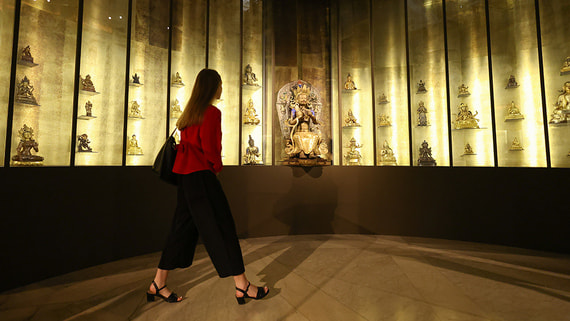
The Pushkin State Museum of Fine Arts in Moscow has unveiled a remarkable exhibition featuring over 650 treasures of Buddhist art from collections across Russia. Titled “The Diamond Chariot,” this extraordinary showcase represents one of the most comprehensive displays of Buddhist artistic heritage ever assembled in the country, offering visitors a profound journey through centuries of spiritual contemplation and artistic mastery. The exhibition brings together sacred objects, sculptures, paintings, and ritual items that illuminate the rich tapestry of Buddhist traditions that have flourished within Russia’s borders for centuries.
A Celebration of Russia’s Buddhist Heritage
Russia holds a unique position among European nations as the only one with indigenous Buddhist communities, primarily concentrated in the republics of Buryatia, Kalmykia, and Tuva. Buddhism first took root in Russian territory in the 17th century, brought by Mongolian and Tibetan monks who established monasteries and teaching centers in the remote steppes and mountainous regions of Siberia and the Volga region. This centuries-long presence has resulted in an extraordinarily rich accumulation of Buddhist art and artifacts, much of which has been preserved in museums throughout the country. The current exhibition draws upon these diverse collections, creating a unified narrative that traces the development and influence of Buddhist artistic traditions across different Russian regions and historical periods.
The title “The Diamond Chariot” references the Vajrayana tradition, also known as the Diamond Vehicle, which represents one of the major branches of Buddhism practiced in Tibet, Mongolia, and the Buddhist regions of Russia. This esoteric tradition emphasizes ritual practices, meditation techniques, and the use of sacred imagery as tools for spiritual transformation. The artworks on display reflect these practices, featuring intricate thangka paintings, bronze sculptures of deities and bodhisattvas, ritual implements used in ceremonies, and illuminated manuscripts containing sacred texts. Many of these objects were created by master craftsmen whose skills were passed down through generations of devoted practitioners.
Artistic Mastery and Spiritual Purpose
What distinguishes Buddhist art from purely decorative works is its fundamentally spiritual purpose. Every element of a Buddhist artwork, from the hand positions of a depicted deity to the colors used in a painting, carries specific symbolic meaning intended to guide meditation and spiritual practice. The exhibition at the Pushkin Museum provides visitors with context to understand these symbolic languages, transforming what might otherwise be an aesthetic experience into an educational journey into Buddhist philosophy and practice. Curators have organized the display to reveal the interconnections between different artistic traditions while highlighting the unique characteristics that developed in various Buddhist communities across Russia’s vast territory.
The collection includes masterpieces dating from the 17th century through the modern era, demonstrating both the continuity of Buddhist artistic traditions and their evolution over time. Particularly notable are works from the Buryat Buddhist tradition, which developed distinctive stylistic features that blend Tibetan influences with local artistic sensibilities. The Kalmyk collection, representing the only Buddhist community in Europe, offers insights into how this spiritual tradition adapted to life on the Caspian steppes. Meanwhile, artifacts from Tuva reveal the influence of both Mongolian and Tibetan Buddhist schools on this remote Central Asian republic that became part of Russia only in 1944.
Preserving Sacred Traditions for Future Generations
The exhibition arrives at a moment of renewed interest in Buddhist philosophy and meditation practices worldwide. For Russian audiences, it offers an opportunity to engage with a spiritual tradition that, while representing a minority faith, has been an integral part of the nation’s cultural fabric for centuries. The Pushkin Museum’s decision to mount such a comprehensive exhibition reflects a broader institutional commitment to presenting the full diversity of religious and artistic traditions that have shaped Russian culture. By bringing together objects from multiple museums and private collections, the exhibition creates a dialogue between artworks that are normally scattered across the country, allowing visitors to appreciate the full scope of Buddhist artistic achievement in Russia.
Museum officials have noted that the exhibition required years of careful preparation, including conservation work on fragile textiles and paintings, scholarly research to properly attribute and contextualize the objects, and complex negotiations to secure loans from institutions across Russia. The result is a once-in-a-generation opportunity to experience the depth and beauty of Buddhist sacred art without traveling to the remote regions where these traditions originated. For those seeking understanding in an increasingly complex world, “The Diamond Chariot” offers timeless lessons in contemplation, compassion, and the transformative power of artistic devotion.
Expert Opinion: This exhibition represents a significant cultural moment for Russia’s Buddhist heritage, demonstrating that minority religious traditions can contribute enormously to a nation’s artistic wealth. As global interest in mindfulness and Buddhist philosophy continues to grow, institutions like the Pushkin Museum play a crucial role in bridging ancient wisdom traditions with contemporary audiences. The careful curation of over 650 objects suggests a new era of scholarly attention to Russia’s Buddhist collections, which may inspire further research and preservation efforts in the coming decades.